

DPDP Act 2025: Privacy Maturity in Indian Enterprises
Date Published
Key Takeaways
Indian enterprises are steadily moving from privacy intent to operational DPDP readiness. Mature organizations are embedding consent governance, data discovery, and audit-ready workflows into enterprise systems, while privacy maturity itself is increasingly becoming tied to enterprise resilience, AI governance, and customer trust.
For decades, the Indian corporate landscape viewed data as “the new oil”, a resource to be extracted, refined, and stored indefinitely. However, as Indian enterprises move toward operational implementation of the DPDP Act in 2026, a new reality has set in. Data is increasingly being treated as a high-accountability asset that requires continuous governance, visibility, and operational control.
As Justice B.N. Srikrishna, former Judge of the Supreme Court and Chair of the Srikrishna Committee, pointed out during the recent Privacy After Hours session hosted by Privy by IDfy in collaboration with Khaitan & Co:
“If you deal with dangerous goods, you are strictly liable for any leakage, irrespective of intent.”
That statement captures the broader shift taking place across Indian enterprises today. Privacy is no longer being viewed as a legal formality or policy exercise. Increasingly, it is becoming an operational discipline tied directly to governance, digital trust, and enterprise resilience. For many organizations, the DPDP conversation has now shifted from interpretation to execution, with leadership teams focusing more deeply on consent governance, data discovery, vendor accountability, breach readiness, and audit visibility.
From Compliance Checklists to Systems-First Architecture
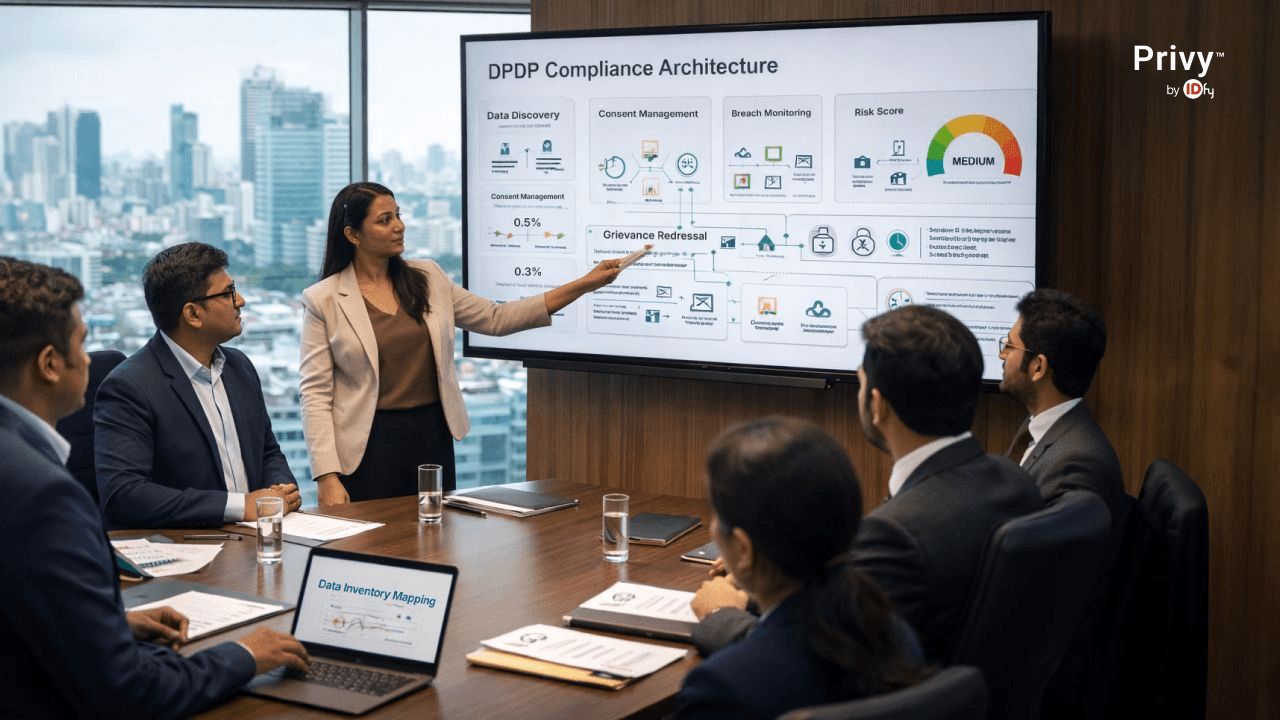
One of the clearest indicators of privacy maturity in India is the move away from fragmented, “piecemeal” compliance approaches. For years, information privacy was often managed through SOPs, spreadsheets, policy documents, and reactive legal workflows. Today, mature enterprises are increasingly treating the DPDP Act 2025 as an operational and architectural challenge rather than simply a legal obligation.
Vijay Rajagopal observed during the discussion that organizations are currently splitting into different stages of maturity. Some are still interpreting the law and reconciling it with existing IT frameworks, while others are tactically embedding consent into customer journeys. The most mature organizations, however, are operationalizing privacy directly into systems and platforms.
This shift is particularly visible across BFSI, fintech, insurance, e-commerce, and digital-first enterprises where personal data exists across fragmented ecosystems, vendors, and cloud environments. The organizations leading this transition are moving toward what many industry leaders describe as “Next Level Readiness,” embedding automation, governance, and privacy operations directly into business infrastructure. In these environments, privacy is increasingly becoming a systems problem rather than a documentation problem.
We have also published a white paper in collaboration with MIT on Privacy Maturity in India with more detailed insights.

The Strategic ROI of the "Avoided Liability"
One of the most common boardroom questions today is simple: What is the ROI of privacy?
Krishnanand Bhat, Data Protection Officer at IDBI Bank, offered a compelling perspective during the discussion: the ROI of privacy is not always measured through direct gains, but through avoided liabilities, reduced exposure, and stronger enterprise resilience.
In the current regulatory climate, the cost of poor privacy governance extends far beyond penalties. It can directly impact customer trust, operational continuity, governance quality, and long-term digital credibility. According to IBM’s Cost of a Data Breach Report, organizations with mature governance and security practices are often able to reduce breach-related costs significantly compared to organizations operating with fragmented compliance systems.
This is one reason why privacy maturity is increasingly being discussed alongside enterprise resilience and operational governance rather than only within legal or compliance functions. Manual workflows involving consent records, grievance handling, data subject rights, and breach response operations become difficult to scale across large enterprises. Over time, fragmented processes increase operational costs through manpower dependency, delayed response cycles, and inconsistent governance practices.
By leveraging technology-first privacy operations platforms like Privy by IDfy, enterprises can expand compliance coverage without proportionally increasing operational overhead.
Navigating Regulations Beyond Consent
In conversations around the DPDP Act 2025, consent is often treated as the visible front-end layer of compliance. But as several industry practitioners noted during the discussion, consent alone does not define operational readiness. Munesh Ahuja described consent as the “entry point” rather than the entire privacy lifecycle. The real operational challenge begins after consent is collected.
Organizations today are expected to demonstrate accountability across the full data lifecycle from grievance management and retention controls to breach response and data principal rights handling. This becomes especially difficult in enterprises where personal data flows across multiple vendors, internal systems, customer touchpoints, and business functions.
For example, if a customer withdraws consent,
- Can that withdrawal be reflected consistently across downstream systems and processors?
- Can the organization demonstrate audit trails showing when consent was captured, modified, or revoked?
- Can grievance workflows and incident response mechanisms operate at enterprise scale?
These are increasingly becoming operational governance questions rather than purely legal ones. The broader message emerging across the industry is clear: privacy maturity now extends far beyond consent collection. Enterprises are being pushed toward building resilient governance systems capable of standing up to regulatory review, operational audits, and long-term accountability expectations.
The 90-Day DPDP Execution Checkpoint
Indian enterprises are no longer operating in a “wait and watch” environment.
Aastha Kharia highlighted that the first 90 days of DPDP readiness are often defined by operational visibility, locating personal data, identifying ownership, and understanding how information moves across systems and departments.
For large enterprises, this visibility challenge is substantial. Personal data is often distributed across legacy systems, cloud environments, internal business functions, third-party vendors, and disconnected operational platforms. Bhavika Dave emphasized that for fast-paced consumer businesses, the starting point is often data inventory and discovery.
The challenge today is no longer purely legal; it is organizational. Privacy maturity increasingly depends on operational alignment across leadership teams, legal departments, security functions, customer-facing operations, and frontline staff handling personal data interactions daily.
Organizations progressing faster are typically prioritizing a few foundational capabilities:
- enterprise-wide data discovery
- ownership mapping
- vendor visibility
- audit-ready workflows
- continuous governance reporting
Building a Defensible Privacy Posture
For many enterprises, the “Build vs. Buy” privacy debate remains a major operational hurdle. Building internal privacy infrastructure may appear attractive initially, but organizations often underestimate the evolving regulatory complexity and continuous governance effort required over time. This is where connected privacy operating models become increasingly important.
Solutions like Privy by IDfy help enterprises unify data discovery, consent lifecycle management, grievance workflows, audit trails, and continuous compliance operations within a connected governance ecosystem. The advantage of this approach is not simply automation; it is operational visibility.
As organizations scale digitally, privacy operations cannot remain fragmented across spreadsheets, emails, disconnected workflows, and isolated teams. Mature enterprises are increasingly moving toward centralized governance layers capable of connecting consent, data flows, vendors, audit evidence, and operational accountability into one continuous system. This is also where Privacy by Design becomes practical rather than theoretical, ensuring that every new customer journey or digital workflow is operationally aligned with privacy expectations from the start.
The Road Ahead: Adoption Over Observation
Privacy is no longer just a regulatory requirement. Increasingly, it is becoming a marker of governance maturity, operational discipline, and customer trust. Organizations prioritizing operational privacy maturity today are also positioning themselves more effectively for the future of AI governance. As enterprises accelerate AI adoption, privacy maturity is becoming foundational to responsible AI deployment, enterprise-wide data visibility, and trustworthy automation systems.
This shift was also explored during Privacy After Hours: DPDP in the Age of AI, where enterprise leaders discussed how AI adoption is rapidly expanding privacy risk surfaces across vendors, data pipelines, and operational systems, making continuous governance far more critical than static compliance exercises.
The next phase of DPDP readiness will likely be defined by how effectively enterprises can demonstrate that personal data is collected for specific purposes, governed transparently, and operationally controlled across systems and vendors.
Organizations that delay operational readiness until the final stages of enforcement may ultimately face significantly higher remediation costs, governance complexity, and operational rework. In the DPDP era, privacy maturity will increasingly be defined not by policy documentation alone, but by an enterprise’s ability to demonstrate accountability, visibility, operational control, and governance readiness at scale.
Ready to move your privacy program from intent to execution?
Privy by IDfy helps enterprises operationalize privacy through connected consent management, data discovery, audit-ready workflows, and enterprise-scale compliance operations. To learn more about building a defensible privacy posture, get in touch with the team at shivani@idfy.com.
FAQs
Why are enterprises focusing more on operational readiness under the DPDP Act 2025?
Most large organizations already have privacy policies in place. The shift now is toward proving operational accountability. Regulators, customers, and enterprise stakeholders increasingly expect organizations to demonstrate how consent, grievance handling, vendor governance, breach response, and audit workflows function in practice, not just on paper.
What does “privacy maturity” actually mean under the DPDP Act?
Privacy maturity refers to how deeply privacy governance is embedded in enterprise operations. Mature organizations typically have stronger visibility into personal data flows, centralized governance mechanisms, audit-ready workflows, and operational accountability across teams, vendors, and systems.
Why is consent management alone not enough for DPDP compliance?
Consent is only one layer of compliance. Organizations must also operationalize grievance redressal, data principal rights handling, retention controls, breach management, processor accountability, and governance reporting. Enterprises that focus only on consent often struggle with downstream operational compliance requirements.
How does privacy maturity impact AI readiness?
AI systems depend heavily on enterprise data quality, visibility, governance, and accountability. Organizations with stronger privacy maturity are generally better positioned to manage responsible AI deployment because they already have clearer visibility into how data is collected, governed, processed, and retained.
What are the biggest operational challenges enterprises face during DPDP implementation?
Most enterprises struggle with fragmented data visibility, legacy systems, disconnected workflows, vendor oversight, and a lack of centralized governance. Operationalizing privacy across multiple departments and platforms often becomes more challenging than drafting policies themselves.
.jpg&w=3840&q=75)
Learn why DPDP readiness for banks is important and how Privy can help in DPDP compliance for the banking sector.

Explore how DPDP rules are reshaping the balance between personalisation and privacy, enabling consent-based personalisation and driving data minimisation compliance in India’s digital economy
Analyze the implications of the allocation of ₹10 crore in the FY 2026-2027 budget for the Data Protection Board. Understand the shift from setup to activation, the digital-first operating model, and what enterprises must do to prepare for the DPDP Act enforcement

Learn how Indian enterprises can operationalize DPDP compliance at scale through privacy operations, consent governance, breach readiness, and automated workflows.

A joint MIT Sloan Management Review India and IDfy study reveals how large enterprises are operationalizing privacy beyond consent under India’s DPDP regime.