

DPDP Compliance at Scale: A 90-Day Implementation Guide for Indian Enterprises
Date Published

Key Takeaways
- DPDP compliance at scale requires operational systems, not static policy documents.
- Indian enterprises are moving toward automated privacy operations and audit-ready governance.
- The first 90 days are critical for establishing data visibility, consent governance, and breach readiness.
- Privacy maturity is increasingly becoming a measure of enterprise resilience and customer trust.
For many Indian enterprises, DPDP readiness is no longer being evaluated through policies alone. The real challenge now lies in operationalizing compliance across fragmented systems, third-party processors, customer journeys, and rapidly evolving digital infrastructure.
What initially appeared to be a legal compliance exercise is increasingly becoming an enterprise-wide operational transformation initiative.
Large organizations today are attempting to answer difficult implementation questions:
- Where does personal data actually reside?
- Which vendors and processors have access to it?
- Can consent changes propagate across systems in real time?
- How quickly can breach workflows be activated?
- And can all of this be demonstrated through audit-ready evidence?
This is where DPDP compliance at scale becomes significantly more complex than policy creation.
As enterprises accelerate digital transformation and AI adoption, privacy operations are becoming deeply connected to governance, operational resilience, customer trust, and long-term business continuity
Why Manual Frameworks Fail in the Indian Enterprise Environment
The biggest challenge with DPDP implementation is scale.
In large Indian enterprises, personal data is often distributed across:
- CRMs
- analytics platforms
- customer support systems
- legacy infrastructure
- cloud environments
- employee devices
- third-party processors
Without centralized visibility, privacy governance quickly becomes fragmented.
During a recent industry discussion hosted by Privy by IDfy, leaders across BFSI, fintech, ecommerce, and consumer businesses highlighted how operational visibility itself has become one of the hardest parts of DPDP readiness.
For many organizations, compliance workflows are still managed manually through spreadsheets, email approvals, disconnected trackers, and fragmented documentation. While this may work temporarily, these systems become increasingly unsustainable as:
- customer volumes grow
- vendors expand
- new digital journeys are launched continuously
Manual governance also creates delayed response cycles. Teams may discover issues after an incident occurs, but they often lack the operational controls needed to prevent exposure proactively.
This is why enterprises are increasingly shifting from policy-led compliance toward privacy operations where governance becomes embedded into systems, workflows, and infrastructure itself.
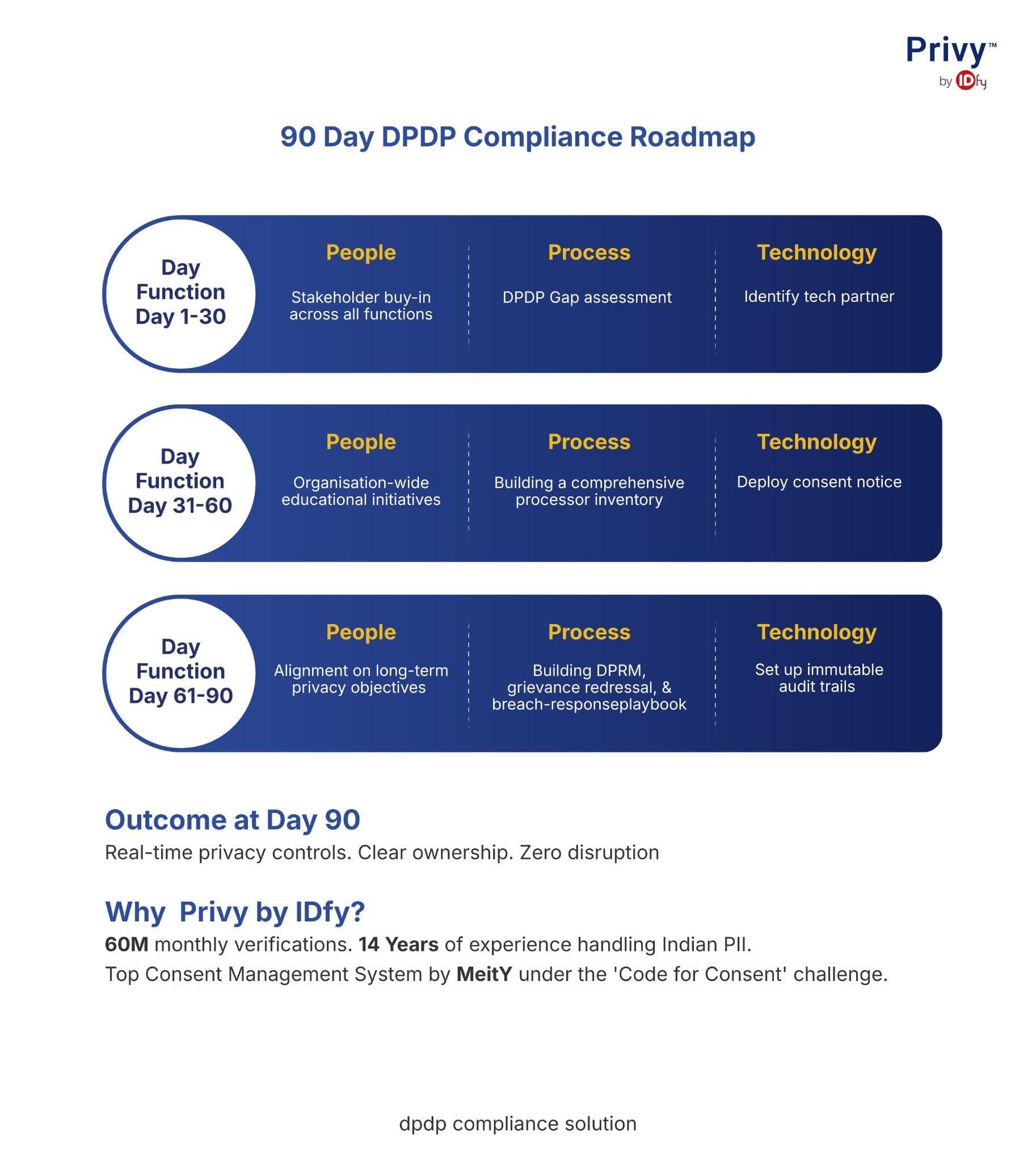
The 90-Day Foundation for DPDP Readiness
Organizations trying to operationalise DPDP compliance often make the mistake of pursuing exhaustive transformation immediately.
In reality, the most successful enterprises focus first on building operational foundations:
A structured 90-day implementation roadmap allows enterprises to establish scalable controls without disrupting existing business operations.
.jpg&w=3840&q=75)
Phase 1: Creating the Bedrock of Visibility (Days 1-30)
You cannot protect what you cannot see. The first 30 days must be dedicated to Personal Data Governance. This isn't just a simple inventory; it is a structured process of cataloging, categorizing, and classifying every piece of PII (Personally Identifiable Information).real time
Mature enterprises are now looking beyond central databases. Real-time dynamic governance must include automated tracking of new product launches and scanning local devices like employee laptops for residual data. If a new customer journey is launched on Day 45, your privacy operations should automatically detect and map that data flow without a manual prompt.
We have done a deep dive on all of this in our comprehensive DPDP Implementation guide as well, where you can access the exact blueprint used by India's leading banks and fintechs to automate their compliance journeys.
Phase 2: Actioning Consent and Rights Management (Days 31-60)
Consent is often dismissed as a one-and-done activity, but in a scaled environment, it is a lifecycle. A data fiduciary must manage collection, updates, and expiry in real time. If a user withdraws consent on your mobile app, does that information instantly reach your marketing vendor's CRM?
This is where technology like a Consent Governance Platform (CGP) becomes non-negotiable. By using immutable consent artifacts tied to every action, you create a defensible audit trail that survives regulatory scrutiny. Simultaneously, enterprises must operationalize Data Principal Rights Management (DPRM). A self-serve portal that allows users to raise access or erasure requests is no longer a "nice-to-have"; it is the only way to handle these requests at scale without overwhelming your legal and tech teams.
Phase 3: Building a Defensible Breach and Vendor Posture (Days 61-90)
The final stage of the 90-day sprint focuses on the ecosystem. Bhavika Dave (General Counsel, Restaurant Brands Asia) noted during the event that vendor contracts can no longer be standardized; they require granular discussions on liability and data purges.
At scale, you need automated notification systems between the fiduciary and the processor. If a vendor experiences a lapse, your inspection and breach case management framework must be able to trigger a secondary investigation within 72 hours, as mandated by the law. Having an incident response playbook for ransomware or accidental exposure isn't just about security; it's about demonstrating intent to the regulator.
Why Privy by IDfy?
60M monthly verifications. 14 Years of experience handling Indian PII. Top Consent Management System by MeitY under the 'Code for Consent' challenge.
Beyond the Checklist: Privacy as a Performance Metric
The most insightful takeaway from the Privacy After Hours discussion was the shift in how ROI is calculated. Munesh Ahuja (DPO, YES Bank) emphasized that the ROI on privacy capabilities is immediate because it prevents the catastrophic reputational loss that follows a breach. In a financial ecosystem, trust is the primary currency.
By moving toward the best DPDP solutions in India that integrate disparate modules, linking data governance to consent, and vendor risk to impact assessments, privacy ceases to be a cost center. It becomes a performance driver. Smarter, cleaner datasets lead to better AI models and more personalized and permissioned customer experiences.
The Role of DPDP Implementation Partners
Choosing the right DPDP compliance solution is no longer simply about purchasing software.
Indian enterprises increasingly require implementation partners capable of understanding:
- legacy infrastructure
- multilingual consent ecosystems
- processor-heavy operations
- evolving regulatory expectations,e
- enterprise-scale governance complexity
This is where connected privacy operating models become important.
Privy by IDfy helps enterprises operationalize DPDP compliance through:
- consent governance
- data discovery
- data principal rights workflows
- processor oversight
- breach management
- audit-ready evidence systems
Instead of relying on fragmented manual processes, enterprises can move toward a centralized operational governance layer capable of scaling alongside business growth.
The Road Ahead
The next phase of DPDP readiness in India will be defined by operational execution.
Organizations relying entirely on spreadsheets, fragmented approvals, and reactive workflows may eventually face increasing scalability challenges as regulatory expectations mature.
The enterprises progressing fastest today are not necessarily the ones with the largest policy repositories. They are the ones building operational visibility, governance automation, audit readiness, and continuous compliance directly into enterprise systems.
Privacy maturity is increasingly becoming a measure of operational resilience and digital trust.
Ready to operationalize DPDP compliance at scale?
Privy by IDfy helps enterprises build connected privacy operations across consent governance, data discovery, breach readiness, and audit-ready compliance workflows.
To learn more, reach out to us at shivani@idfy.com, and we would be more than happy to help.
FAQs
Why do manual workflows fail for DPDP compliance at scale?
Manual governance processes struggle to scale across fragmented enterprise systems, vendors, cloud platforms, and evolving customer journeys. As organizations grow, spreadsheet-driven workflows create operational blind spots and delayed response cycles.
What does “privacy operations” mean under DPDP?
Privacy operations refer to the operational layer managing consent governance, data discovery, rights handling, vendor accountability, grievance management, breach response, and audit readiness continuously across the enterprise.
Why is consent governance becoming more complex for enterprises?
Consent updates and withdrawals must often propagate across multiple internal systems and third-party processors simultaneously. Without automation and centralized governance, maintaining consistency becomes extremely difficult.
Why is vendor governance important under DPDP?
Third-party processors frequently handle large volumes of personal data. Enterprises require visibility into processor obligations, retention practices, incident escalation mechanisms, and compliance accountability to reduce operational risk.
What should enterprises prioritise during the first 90 days of DPDP implementation?
Most enterprises should initially focus on:
- operational visibility
- data discovery
- ownership mapping
- consent governance
- processor inventory
- breach readiness
These controls create the foundation for scalable compliance operations.
How can technology help operationalize DPDP compliance?
Technology platforms help automate consent governance, rights handling, breach workflows, processor oversight, audit evidence generation, and continuous compliance monitoring at enterprise scale.
.jpg&w=3840&q=75)
Learn why DPDP readiness for banks is important and how Privy can help in DPDP compliance for the banking sector.

Explore how DPDP rules are reshaping the balance between personalisation and privacy, enabling consent-based personalisation and driving data minimisation compliance in India’s digital economy
Analyze the implications of the allocation of ₹10 crore in the FY 2026-2027 budget for the Data Protection Board. Understand the shift from setup to activation, the digital-first operating model, and what enterprises must do to prepare for the DPDP Act enforcement

Discover where Indian enterprises stand on privacy maturity today. Insights from Justice Srikrishna and industry leaders on navigating the DPDP, 2023

A joint MIT Sloan Management Review India and IDfy study reveals how large enterprises are operationalizing privacy beyond consent under India’s DPDP regime.