

What Is DSPM and Why Every Indian CISO Should Care About It in 2026
Date Published

A CISO running security for a large Indian enterprise in 2026 faces a problem that firewalls and endpoint tools don't solve: they don't know where all their sensitive data actually is. Not approximately. Precisely. Which databases hold Aadhaar numbers. Which shared drives contain scanned KYC documents. Which SaaS tools have pulled customer records that were never meant to leave the core system. Which cloud buckets hold sensitive personal data with open access policies that nobody has reviewed in 18 months.
Data Security Posture Management, DSPM, is the category of tooling that answers that question. It discovers sensitive data across every environment, classifies it by type and risk level, and continuously monitors how that data is exposed. For Indian CISOs specifically, 2026 is the year DSPM moved from a nice-to-have to a prerequisite, for two converging reasons: the DPDP Rules, 2025 take full effect around May 2027, and Indian enterprises are accelerating cloud adoption precisely when sensitive personal data is spreading faster and wider than most security teams can manually track.
What DSPM Actually Does
Data security posture management has 4 core functions that operate continuously rather than as a one-time scan.
Data discovery. DSPM scans structured databases, unstructured file stores, cloud environments, SaaS applications, and data warehouses to find where sensitive data exists. It covers data a security team knows about and data that has accumulated in shadow systems without formal ownership.
Data classification. Once discovered, data gets classified by type: personal identifiers (names, Aadhaar, PAN, phone numbers), sensitive personal data (health records, financial data, biometrics), and non-personal data sharing the same environments. Classification determines which regulatory obligations, which security controls, and which access policies apply to each data store.
Risk assessment. DSPM scores the posture of each data store: whether it is encrypted, whether access controls are appropriate for what it contains, whether it has been accessed recently by users who shouldn't need it, and whether it is replicating to locations that inherit the same sensitive data without the same controls.
Continuous monitoring. Posture is not a state that stays stable. New data gets added, permissions drift, SaaS integrations copy data to new locations, and employees transfer files. DSPM monitors these changes and alerts when a data store's posture degrades below an acceptable threshold.
How DSPM Differs from CSPM, DLP, and PAM
CISOs evaluating DSPM usually already own tools in adjacent categories. The distinctions matter because they determine where DSPM fits in a security stack rather than replacing what is already there.
DSPM versus CSPM. Cloud security posture management focuses on cloud infrastructure configuration: whether S3 buckets are publicly accessible, whether IAM policies are overly permissive, whether logging is enabled. CSPM knows that a bucket is exposed. DSPM knows that the exposed bucket contains 2 million Aadhaar numbers. CSPM tells you about misconfiguration. DSPM tells you about the data cost of that misconfiguration. Both are necessary for a CISO running significant cloud infrastructure in India.
DSPM versus data loss prevention. DLP tools intercept data in motion, watching for sensitive data being emailed, copied to a USB drive, or uploaded to an unauthorised destination. They operate at the egress point. DSPM operates at the data store itself, before the data moves. DLP catches exfiltration. DSPM tells you which stores are most at risk of being exfiltrated, and whether their controls match that risk level.
DSPM versus privileged access management. PAM controls who can access systems with elevated rights. It governs authentication and session management for privileged users. DSPM reveals what sensitive data those privileged users can actually reach once authenticated, and whether that access is proportionate to a business purpose. PAM controls the door. DSPM tells you what is in the room.
None of these tools is a substitute for the others. A complete security posture for a data-intensive Indian enterprise needs all four working together, with DSPM providing the data layer visibility the others lack.
Why 2026 Is the Year Indian CISOs Need to Act
3 forces are converging on the Indian CISO's desk in 2026 that make DSPM specifically urgent.
DPDPA Rule 6 and the obligation to protect personal data at rest. The DPDP Rules require data fiduciaries to implement reasonable security safeguards proportionate to the sensitivity of the data they hold, and to extend those safeguards to data processed by vendors on their behalf. That obligation is not satisfiable without first knowing what sensitive personal data exists in which systems. A CISO who cannot answer that question for their own estate cannot credibly attest that proportionate safeguards are in place.
Cloud migration is spreading sensitive data to environments that were designed for compute, not data governance. Indian enterprises running significant workloads on cloud infrastructure regularly accumulate sensitive data in object storage, data lakes, and analytics environments that were provisioned for performance rather than compliance. DSPM finds the sensitive data that accumulated there while the security team was watching other things.
Insider threats in data-intensive enterprises are a real, documented risk class. A customer service agent downloading a copy of the customer database to work from home has created a data store outside the enterprise perimeter. A data scientist pulling a production dataset to a personal cloud account for analysis has done the same. DSPM detects these copies because it is scanning for the data, not just watching the network.
What DSPM Produces That a CISO Can Use
A mature DSPM deployment gives a CISO 4 practical outputs.
A data risk register that inventories every sensitive data store by classification tier, current posture score, and the security obligations that apply to it under DPDPA. This is the evidence base for proportionate security investment decisions, and the document a Board or regulator can actually interrogate.
A posture gap list that identifies every data store where the controls in place are insufficient relative to the sensitivity of what it contains. An encrypted database holding ordinary customer IDs has a good posture. An unencrypted file share holding Aadhaar numbers and health records does not. The gap list is what drives remediation prioritisation.
A continuous alert feed for posture degradation events: a new SaaS integration copying customer records to a new location, a change in access permissions that opens a sensitive data store to a broader user group, a data replication job creating a copy in an environment without the same encryption policy.
An audit trail demonstrating that sensitive data was identified, classified, risk assessed, and actively monitored across a defined period. This is what a compliance audit or a Data Protection Board inquiry asks for.
The DSPM and DPDPA Compliance Connection
DSPM is the security tool that sits at the intersection of the CISO's programme and the DPO's compliance obligations. Data classification, data discovery, sensitive data risk scoring, and continuous monitoring are all functions that appear in the DPDPA compliance agenda. The difference is that DSPM addresses them from a security posture angle while data governance addresses them from a regulatory compliance angle.
Both are necessary. An enterprise with strong DSPM but no compliance workflow cannot respond to a data principal's erasure request, because DSPM finds data but doesn't automate rights fulfilment. An enterprise with a compliance workflow but no DSPM is operating on a data inventory that was accurate when it was built and has drifted since. The combination of security posture management and a connected compliance platform is what makes both programmes defensible.
How Privy by IDfy Connects DSPM to DPDPA Compliance
Privy by IDfy built Data Compass as an India-native DSPM module that extends beyond posture scoring into the DPDPA compliance workflows a pure security tool cannot cover.
Data Compass discovers and classifies personal and sensitive personal data across structured and unstructured systems, scores data stores for security posture relative to DPDPA's proportionality requirement, and feeds that classification directly into Privy's consent governance, data principal rights, incident response, and vendor risk modules. The discovery output is not a standalone report. It is the live data layer that the other compliance modules run against.
InspectAI adds the continuous monitoring layer: scanning digital journeys and AI pipelines for new sensitive data flows and posture changes, and connecting any flagged risk directly to the remediation workflow before it becomes an incident.
For a CISO who needs to answer the question "what sensitive personal data do we hold, where, and how well is it protected," Data Compass is the answer. For a DPO who needs to answer "how do we act on that data in response to a request, a breach, or an audit," the rest of the Privy platform runs on the same foundation.
Conclusion
DSPM is the category of tooling that gives CISOs the one thing perimeter security and access management cannot: visibility into sensitive data at rest across every environment, continuously rather than at the point of the last audit. For Indian enterprises approaching the DPDPA's May 2027 deadline with significant cloud infrastructure, data-intensive workflows, and a growing vendor ecosystem, DSPM is not a future consideration. It is a 2026 purchase decision.
The enterprises that deploy DSPM this year will enter 2027 with a data risk register, a posture gap remediation record, and an audit trail. The ones that don't will be building those under pressure when the Data Protection Board or an auditor asks.
If you want to see how Data Compass delivers DSPM that connects directly to your DPDPA compliance programme, write to shivani@idfy.com for a demo or to discuss your specific data security posture needs.
FAQs
What is DSPM?
Data Security Posture Management is a category of tooling that discovers sensitive data across every environment an enterprise operates, classifies it by type and regulatory sensitivity, scores each data store's security posture, and continuously monitors for posture degradation.
How is DSPM different from CSPM?
CSPM tells you a cloud resource is misconfigured. DSPM tells you what sensitive data that misconfiguration exposes. CSPM focuses on infrastructure configuration; DSPM focuses on the data risk that configuration creates.
Why do Indian CISOs need DSPM specifically in 2026?
The DPDP Rules, 2025 require security safeguards proportionate to the sensitivity of personal data held; cloud adoption is accelerating the spread of sensitive data into environments not designed for data governance, and the May 2027 deadline gives a defined window to build the evidence base.
Does DSPM replace DLP or PAM?
No. DLP intercepts data in motion at egress. PAM controls privileged access. DSPM discovers, classifies, and monitors sensitive data at rest. All three address different parts of the data security problem and work best in combination.
What does a CISO actually get from a DSPM deployment?
A data risk register, a posture gap list for remediation prioritisation, a continuous alert feed for degradation events, and an audit trail demonstrating active monitoring of sensitive data over time.
How does DSPM connect to DPDPA compliance?
DSPM provides the data classification and discovery layer that DPDPA compliance workflows depend on. Without a current, accurate picture of what sensitive personal data exists and where, consent notices, data principal rights fulfilment, breach scoping, and proportionate safeguards cannot all be operationalised reliably.
What makes Privy's Data Compass different from a standalone DSPM tool?
Data Compass connects discovery and classification directly to DPDPA compliance workflows, consent governance, rights management, incident response, vendor risk, and audit trails, so the sensitive data it finds becomes the live foundation the compliance programme operates on rather than a static report.
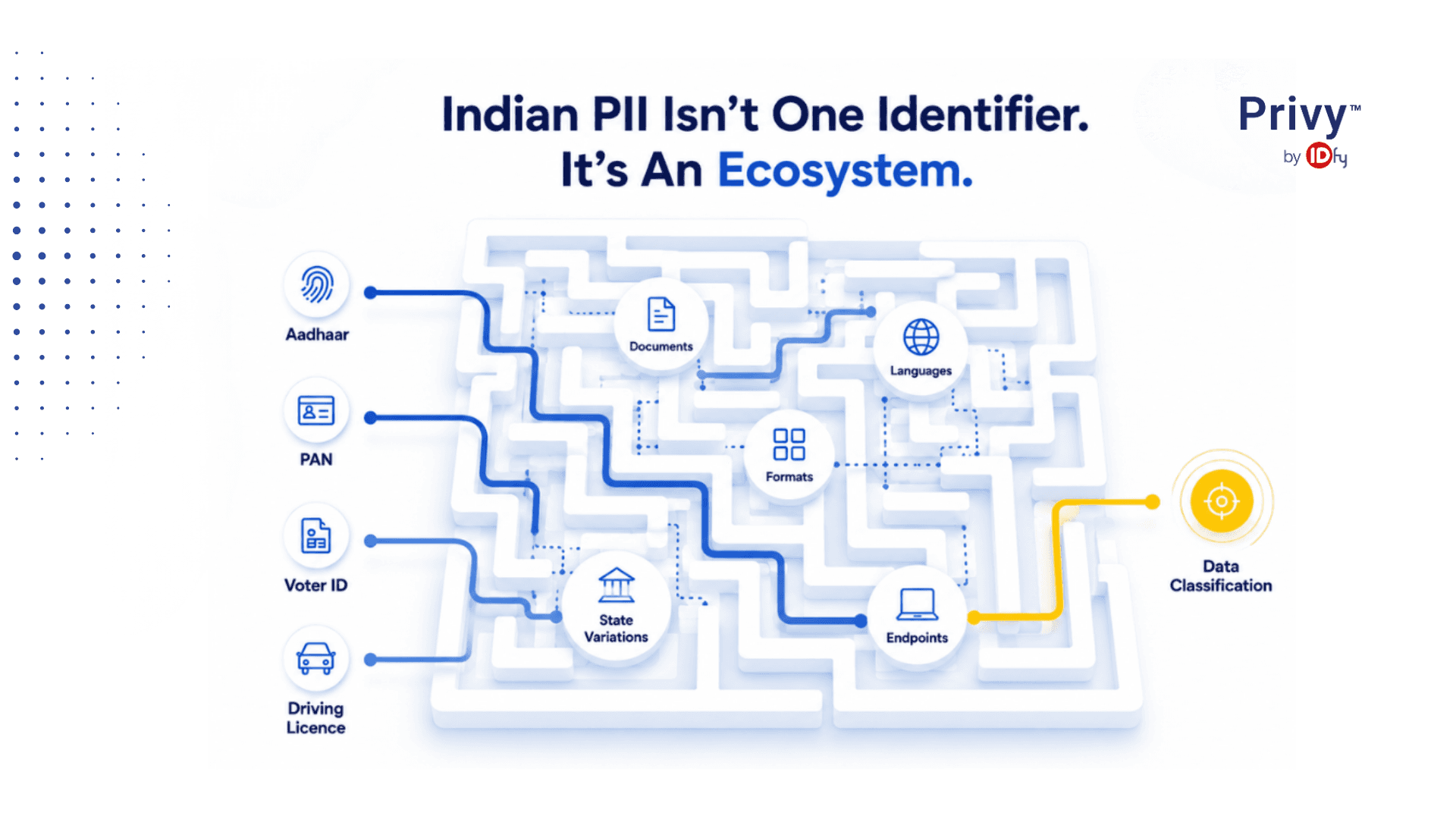
Most data classification tools weren't built for Indian PII. Here's why generic tools miss them, and what that means for your DPDP obligations.

DPDP compliance begins with data visibility. Learn how discovery, classification, mapping, and DSPM enable effective governance.