

What Is a Consent Artefact? Understanding the Core of DPDP Consent Compliance
Date Published

Most organisations believe they have consent covered. They have a privacy policy on their website, a terms-and-conditions page during onboarding, and perhaps a cookie notice. Under India's Digital Personal Data Protection Act, 2023, none of that constitutes proof of lawful consent. Proof requires something more specific as a consent artefact.
As India moves toward full enforcement of the DPDP Act on 13 May 2027, the consent artefact has become one of the most operationally significant concepts in data protection compliance. This guide explains what it is, what it must include, how it functions across the data lifecycle, and what organisations need to build to generate one correctly.
What Is A Consent Artefact?
A consent artefact is a structured, machine-readable digital record that documents a specific consent interaction between two parties: the data principal (the individual whose personal data is being collected) and the data fiduciary (the organisation that collects and processes it).
It is created at the point of consent, holds a fixed set of information about that interaction, and must remain accessible throughout the period for which the consent is valid.
To be clear about what it is not: a consent artefact is not a general-purpose privacy document. It is not a statement of intent. It is not a system log. It is a structured, verifiable record of a single, specific consent event tied to a specific individual, a specific organisation, and a specific purpose.
This distinction matters because the DPDP Act requires data fiduciaries to be able to demonstrate that every processing activity has a lawful basis. For consent-based processing, the consent artefact is that demonstration.
Why The DPDP Act Makes Consent Artefacts Essential
India's DPDP Act and the DPDP Rules, notified on 13 November 2025, significantly raise the bar for what constitutes valid consent. Under Section 6 of the Act, consent must meet five conditions simultaneously. It must be free, meaning it cannot be coerced or made a precondition for an unrelated service. It must be specific, meaning it applies to a particular purpose and not to data processing in general. It must be informed, meaning the individual must have received a proper notice before consenting. It must be unconditional, meaning it cannot be bundled with unrelated terms or conditions. And it must be unambiguous, meaning it requires a clear, deliberate affirmative action by the individual. Silence, inaction, and pre-ticked boxes are not valid forms of consent under this framework.
This is a materially higher standard than what most Indian organisations currently meet. Building and maintaining consent artefacts is the mechanism through which compliance with this standard can be demonstrated, tracked, and defended.
What A Consent Artefact Must Contain
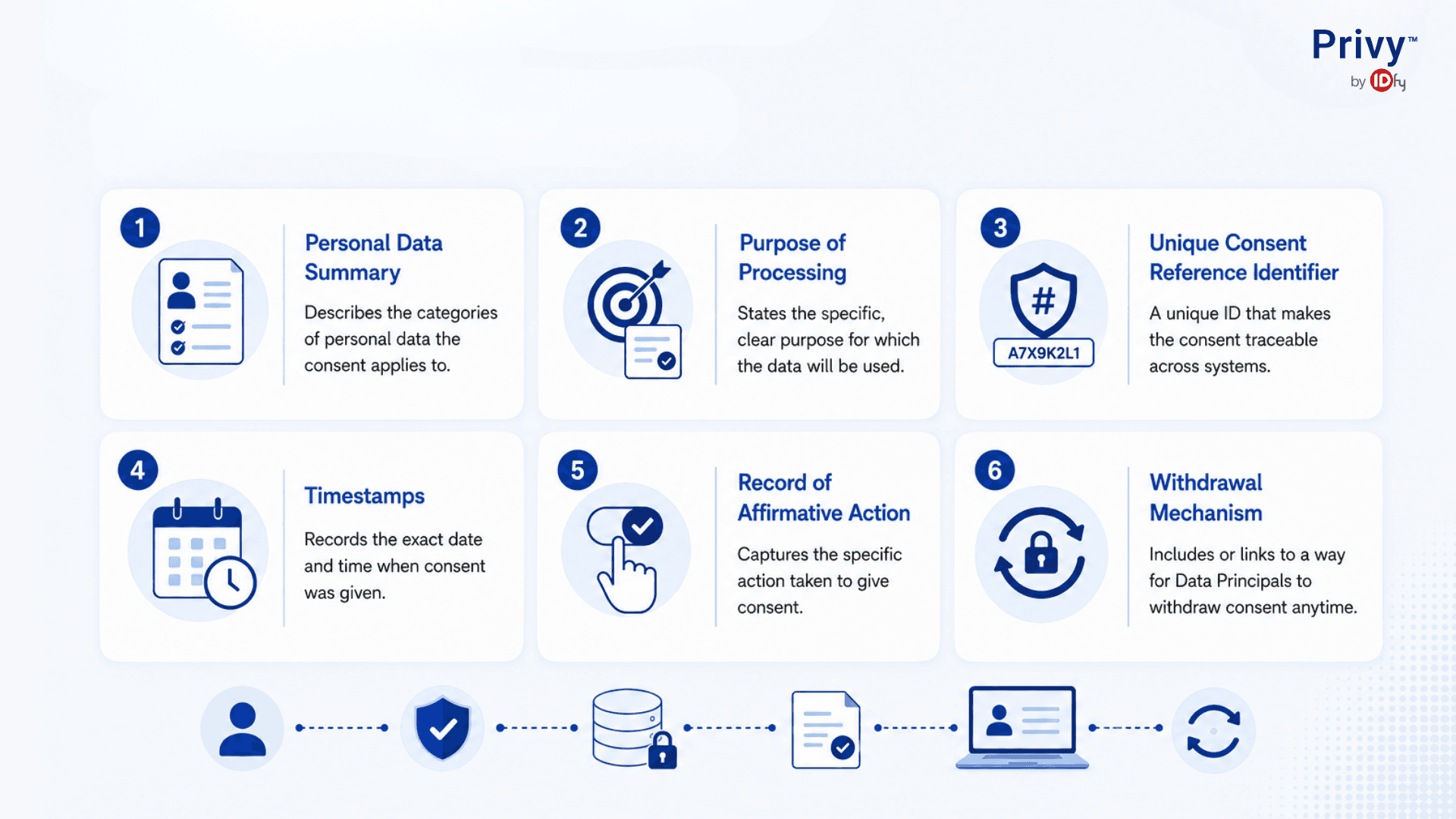
A valid consent artefact is built from several interconnected elements. Each one addresses a specific legal or operational requirement under the DPDP framework.
Personal Data Summary: The artefact includes a description of the categories of personal data to which the consent applies. This is a summary of what data is being collected, not the data itself. The artefact does not store personal data; it records the scope of the consent that authorises processing it. For instance, a lending application might record that consent covers identity documents submitted for KYC, the mobile number used for communication, and income data shared for credit assessment. Each category is listed against the purpose it serves.
Purpose of Processing: Every consent artefact must state the specific purpose for which the data will be used. This is one of the most consequential requirements under the DPDP framework. Purpose limitation is legally binding: if an organisation wishes to use the same data for a different purpose at a later date, it must seek fresh consent and generate a new consent artefact. The original artefact does not extend to cover new uses. Vague statements such as "to enhance your experience" do not satisfy this requirement. The purpose must be specific, discrete, and clearly communicated in plain language.
Unique Consent Reference Identifier: Each consent interaction receives a unique identifier within the artefact. This reference code is what makes the consent traceable across systems. It connects the consent record to processing logs, data maps, rights request histories, and audit trails. Without a unique identifier, consent records cannot be reliably located, verified, or cross-referenced when needed.
Timestamps: The artefact records the exact date and time at which consent was given. This is essential for retention period calculations, for verifying that consent predated the start of data processing, and for consent management over time. If a data principal later disputes whether consent was given, the timestamp provides the reference point.
Record of Affirmative Action: The consent artefact documents the specific action through which the data principal expressed consent. This could be clicking a clearly labelled consent button, tapping an agreement toggle, or completing a digital signature flow. The record confirms that the consent was an active, deliberate choice and not an assumed or inferred one.
Withdrawal Mechanism: The DPDP Act requires that consent withdrawal must be as straightforward as consent provision. The consent artefact must, therefore, include or link to a mechanism through which the Data Principal can revoke their consent at any time. When withdrawal occurs, the artefact is updated to reflect it, and the organisation must cease processing the relevant data. Where erasure is required, that too must be completed and recorded.
How a Consent Artefact Works Across the Data Lifecycle
.png&w=3840&q=75)
Consent artefacts are not static documents. They are active records that must be maintained and updated as the relationship between the Data Principal and the data fiduciary evolves. When a Data Principal first provides consent, the artefact is created and stored. If the individual later requests access to their data, the artefact supports verification of what data was collected and on what basis. If the individual requests correction or deletion, the artefact records the action taken. If the individual withdraws consent, the artefact is updated to reflect the withdrawal and the cessation of processing. If the organization changes the purpose for which it uses the data, a new consent interaction must occur, and a new artefact must be generated. The original artefact remains on record, and the new one is linked to it.
This lifecycle dimension is what makes the consent artefact more than a compliance tick-box. It is the living record of the data relationship between an organisation and the individuals it serves.
Consent Artefacts And The Consent Manager Framework
The DPDP Act introduces the concept of a registered Consent Manager: a DPBI-registered intermediary that enables data principals to give, manage, review, and withdraw consent across multiple data fiduciaries from a single platform. The Consent Manager framework is scheduled to become operational in November 2026.
Within this framework, the consent artefact takes on additional structural requirements. Consent records maintained through a Consent Manager must be stored in a standardised, interoperable format. The DPDP Rules require these records to be retained for seven years.
For organisations that integrate with the Consent Manager ecosystem, this means consent artefacts must be built to a format that is readable and transferable across platforms. Proprietary internal consent logs that cannot be exported or verified externally will not meet this standard.
For Data Principals, the Consent Manager provides a unified interface through which they can see all their active consents across different services, withdraw them selectively, and track how their data is being used. The consent artefact is the underlying record that makes this visibility possible.
Consent Artefacts and Audit Readiness
When the Data Protection Board of India investigates a complaint or a breach, the first evidentiary question it will ask is whether the organisation had a valid, lawful basis for the processing in question.
For consent-based processing, the answer to that question is the consent artefact.
An organisation that cannot retrieve a valid consent artefact for the interaction in question cannot demonstrate lawful processing. An organisation that can retrieve a complete, timestamped, purpose-specific artefact tied to a named individual and a named organisation has a substantively stronger compliance position.
Processing logs under the DPDP framework must be retained for a minimum of one year. Consent records managed through a Consent Manager must be retained for seven years. Data fiduciaries that manage consent directly should build their retention and retrieval architecture to equivalent standards.
The consent artefact is not administrative overhead. It is the foundation of audit-ready compliance.
Conclusion
The consent artefact is where intent becomes evidence.
India's DPDP Act does not ask organisations to describe their approach to privacy. It asks them to demonstrate that every consent interaction was lawful, specific, and documented. The consent artefact is the record that makes that demonstration possible.
For organisations preparing for May 2027 enforcement, building a robust consent artefact infrastructure is one of the most critical operational priorities. It requires rethinking how consent is collected, recorded, and managed across every data touchpoint.
Privy by IDfy helps enterprises operationalise exactly this: from consent notice infrastructure and artefact generation to rights management workflows, processing logs, and audit-ready evidence across the full compliance programme. The goal is not just to collect consent. It is to be able to prove it.
Ready to build your consent artefact infrastructure? Reach out to us at shivani@idfy.com
FAQ's
What must a consent artefact contain?
A valid consent artefact should contain unique identifiers for both the Data Principal and the data fiduciary, a summary of the personal data categories covered, the explicit purpose of processing, a unique consent reference identifier, a timestamp, a record of the affirmative action taken by the data principal, and a link to or inclusion of the consent withdrawal mechanism. Where a registered Consent Manager is involved, the artefact must also meet the interoperability and retention standards prescribed under the DPDP Rules.
What is the difference between a consent notice and a consent artefact?
A consent notice is the standalone document that must be served to a Data Principal before personal data is collected. It explains what data is being collected, for what purpose, and how rights can be exercised. The consent artefact is the record generated after the Data Principal takes an affirmative action in response to that notice. The notice is the legal precondition; the artefact is the proof of what followed.
How long must consent artefacts be retained under the DPDP framework?
Under the DPDP Rules, 2025, consent records maintained through a registered consent manager must be retained for seven years. Processing logs must be retained for at least one year. Data fiduciaries that manage consent independently should build retention and retrieval systems that meet equivalent standards to support audit and enforcement readiness.
Can a Data Principal withdraw consent, and what happens to the artefact?
Yes. Under the DPDP Act, withdrawing consent must be as straightforward as providing it. When a Data Principal withdraws consent, the consent artefact is updated to record the withdrawal. The Data Fiduciary must then stop processing the relevant data and, where applicable, erase it. The artefact continues to serve as the record of both the original consent and the subsequent withdrawal.

Learn what data retention is, why a strong data retention policy is essential for compliance, and how Privy enables modern data governance and data discovery to manage data responsibly across its lifecycle.

Detailed guide on top consent tools vs privacy platforms. Learn why AI-driven governance is the fastest route to DPDP compliance in India.