

What Is Data Retention and Why Is It Critical for Modern Data Governance
Date Published
Summary
Data retention is no longer just an IT housekeeping task. It has become a core pillar of modern data governance, compliance, and operational resilience. This blog explores what data retention means, why organizations struggle with over-retention and fragmented data environments, and how data discovery and governance frameworks help enforce responsible data lifecycle management. It also explains how Privy by IDfy enables consent-aware retention, automated governance controls, and auditable compliance under evolving regulations like the DPDP Act.
Every organization today runs on data. From customer onboarding and marketing campaigns to compliance reporting and analytics, data fuels decision-making at every level. However, as data volumes grow, so do the risks of mismanaging them. One of the most overlooked yet critical components of responsible data handling is data retention: deciding how long data should be kept, where it should live, and when it should be securely deleted.
Without a well-defined data retention policy, organizations often retain data longer than necessary, exposing themselves to regulatory penalties, higher security risks, and operational inefficiencies. This is where data retention becomes inseparable from data governance and data discovery. You cannot govern or retain what you do not understand.
In this blog, we break down what data retention really means, why it matters, common challenges organizations face, and how Privy approaches data retention through a governance-first lens.
What many enterprises underestimate is that over-retention silently expands compliance exposure over time. Data collected years ago for one business purpose may continue sitting across systems long after that purpose has expired. This creates “compliance drift,” where organizations technically hold personal data without an active lawful basis or operational necessity. Under evolving DPDP expectations, this gap is becoming increasingly difficult to justify during audits and investigations.
Modern enterprises are also discovering that poor data retention practices directly impact AI governance initiatives. AI systems trained on outdated, irrelevant, or unauthorized datasets create downstream compliance risks that are difficult to detect later. Strong data retention practices, therefore, improve not just privacy compliance but also data quality, AI accountability, and governance maturity across the enterprise.

What Is Data Retention?
Data retention refers to the practice of storing data for a specific period of time to meet business, legal, regulatory, and operational requirements. Once that purpose is fulfilled, the data should be deleted or anonymized in a secure and compliant manner.
Importantly, data retention is not about keeping data forever. In fact, over-retention is one of the biggest risks organizations face today. A sound data retention strategy ensures that:
- Data is retained only for legitimate, documented purposes
- Retention periods are aligned with applicable laws and regulations
- Data is disposed of safely once it is no longer required
Effective data retention sits at the intersection of data governance, compliance, and risk management. It determines how data flows through its lifecycle from collection and usage to archival and deletion.
A mature data retention framework also distinguishes between operational retention, regulatory retention, and analytical retention. While some data may need to be retained for taxation or financial reporting purposes, other datasets may lose operational value much earlier. Organizations that fail to separate these categories often end up applying blanket retention practices that create unnecessary storage burdens and compliance risks.
Why Data Retention Matters More Than Ever
In the past, storage was expensive and limited. Today, storage is cheap and abundant, which has ironically made data retention harder. Organizations often store everything “just in case,” without realizing the downstream impact.
Here’s why data retention is now a board-level concern:
Regulatory Pressure Is Increasing
Privacy laws across the globe, such as GDPR, CCPA/CPRA, HIPAA, and India’s Digital Personal Data Protection Act (DPDP Act), explicitly require organizations to limit data retention to what is necessary for a defined purpose. Retaining personal data longer than required is considered a compliance failure.
Data Breaches Are Costlier
The more data you retain, the larger your attack surface becomes. Old, forgotten data is often poorly protected and becomes an easy target during breaches. Reducing unnecessary retained data directly reduces risk. Under DPDP rules, organisations must pay a penalty of ₹250cr for a data breach.
Operational Complexity Grows with Data Sprawl
Without proper data discovery, organizations struggle to locate, classify, and manage retained data across systems. This slows down audits, legal holds, and data subject requests.
Data retention is also becoming a financial optimization issue. Large enterprises spend significant amounts maintaining inactive data across cloud environments, backup systems, archives, and redundant repositories. Poor retention discipline inflates storage costs, increases infrastructure complexity, and slows analytics systems overloaded with outdated information.
Forward-looking enterprises are therefore treating data retention not as a defensive legal exercise, but as part of operational modernization. Reducing redundant, obsolete, and trivial (ROT) data improves system efficiency, simplifies governance, and strengthens cybersecurity resilience simultaneously.
The Role of a Data Retention Policy
A data retention policy is a formal document that defines how long different types of data should be retained and when they should be deleted. It translates regulatory and business requirements into actionable rules.
A strong data retention policy typically includes:
- Categories of data (personal data, financial records, logs, consent records, etc.)
- Retention durations for each category
- Legal or regulatory justification for retention
- Secure deletion or anonymization procedures
- Ownership and accountability
When implemented correctly, a data retention policy becomes a foundational pillar of data governance, ensuring consistency and accountability across teams and systems.
One of the most overlooked aspects of a data retention policy is defensibility. During regulatory investigations or litigation, organizations must demonstrate not only that policies exist, but that they are actively enforced across operational systems. Static PDF policies without technical enforcement mechanisms increasingly fail to satisfy modern regulatory expectations.
Retention policies must also evolve dynamically as regulations, processing purposes, and customer expectations change. Enterprises operating across sectors such as BFSI, healthcare, insurance, and e-commerce often require layered retention frameworks aligned with multiple legal obligations simultaneously.
How Data Retention Fits into Data Governance
Data retention does not exist in isolation. It is one component of a broader data governance framework that governs how data is collected, processed, shared, stored, and deleted.
Without governance:
- Retention rules remain theoretical
- Teams apply inconsistent practices
- Compliance becomes reactive instead of proactive
Strong data governance ensures that retention policies are:
- Embedded into business processes
- Enforced automatically
- Auditable and defensible
This is where data discovery plays a crucial role because governance cannot function without visibility.
Modern data governance frameworks are increasingly moving toward lifecycle-aware governance, where organizations continuously evaluate whether data still serves an active business, legal, or operational purpose. This shift is critical because privacy compliance is no longer measured only at the point of collection. Regulators increasingly evaluate how responsibly organizations manage data years after collection as well.
The Importance of Data Discovery in Data Retention
You cannot retain or delete what you cannot find. Data discovery helps organizations identify where data resides, what type of data it is, and how sensitive it may be. This includes structured databases, unstructured files, cloud storage, applications, and third-party systems.
Without effective data discovery:
- Retention policies cannot be applied consistently
- Sensitive data may be retained unintentionally
- Compliance reporting becomes manual and error-prone
Data discovery bridges the gap between policy and execution, making data retention practical rather than aspirational.
This becomes especially important in large enterprises where shadow data accumulates silently across collaboration platforms, archived email systems, temporary exports, unmanaged SaaS applications, and legacy databases. Many organizations underestimate how much personal data exists outside officially governed environments.
Advanced data discovery capabilities now incorporate AI-assisted classification, contextual tagging, and automated risk scoring to help governance teams prioritize retention and deletion decisions more intelligently. This significantly improves audit readiness and reduces the operational burden on compliance teams.
Common Challenges Organizations Face with Data Retention
Despite understanding its importance, many organizations struggle to implement effective data retention. Some of the most common challenges include:
1. Fragmented Data Environments
Data is spread across multiple systems, vendors, and geographies. Applying a unified data retention policy across these environments becomes extremely complex without centralized governance.
2. Manual and Static Policies
Many retention policies live in documents that are rarely updated or enforced. This disconnect between policy and practice leads to compliance gaps.
3. Lack of Consent-Aware Retention
Retention rules often ignore consent status. When a user withdraws consent, organizations may not have visibility into where that data exists or how retention should change.
4. Difficulty Proving Compliance
Auditors and regulators expect organizations to demonstrate, not just claim, that data is retained appropriately. Without audit trails, this becomes challenging.
Another growing challenge is retention inconsistency between internal teams and third-party vendors. Even when organizations implement strong internal retention controls, external processors, analytics vendors, and SaaS providers may continue storing personal data beyond approved timelines. This creates hidden downstream compliance exposure that many enterprises fail to monitor adequately.
How Privy by IDfy Approaches Data Retention Differently
At Privy, we view data retention not as a standalone compliance checkbox, but as a governance-driven lifecycle process that starts with consent and ends with defensible deletion.
Privy’s Consent Governance Platform (CGP) addresses data retention challenges by integrating data governance, data discovery, and consent management into a single framework.
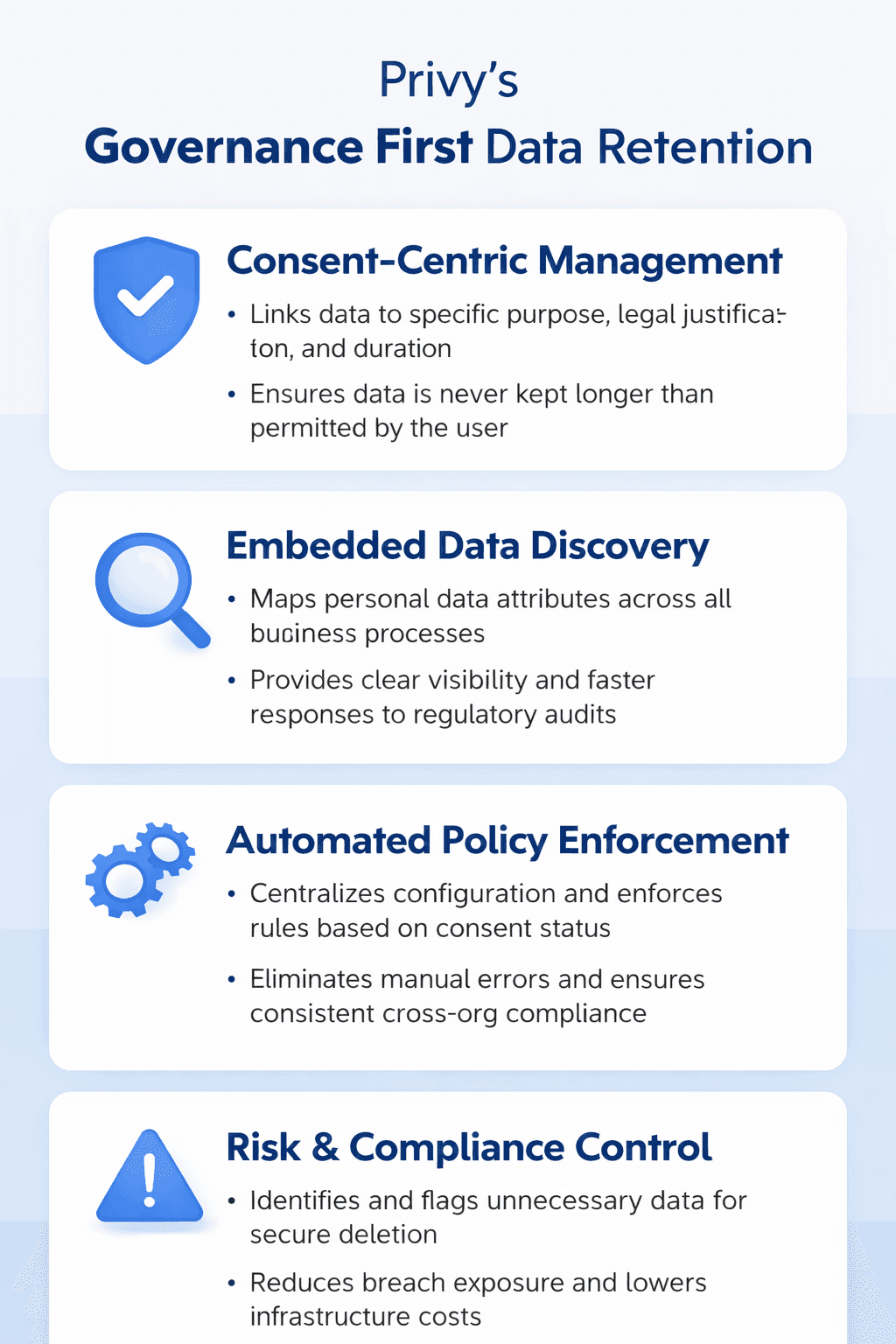
Privy’s Governance-First Model for Data Retention
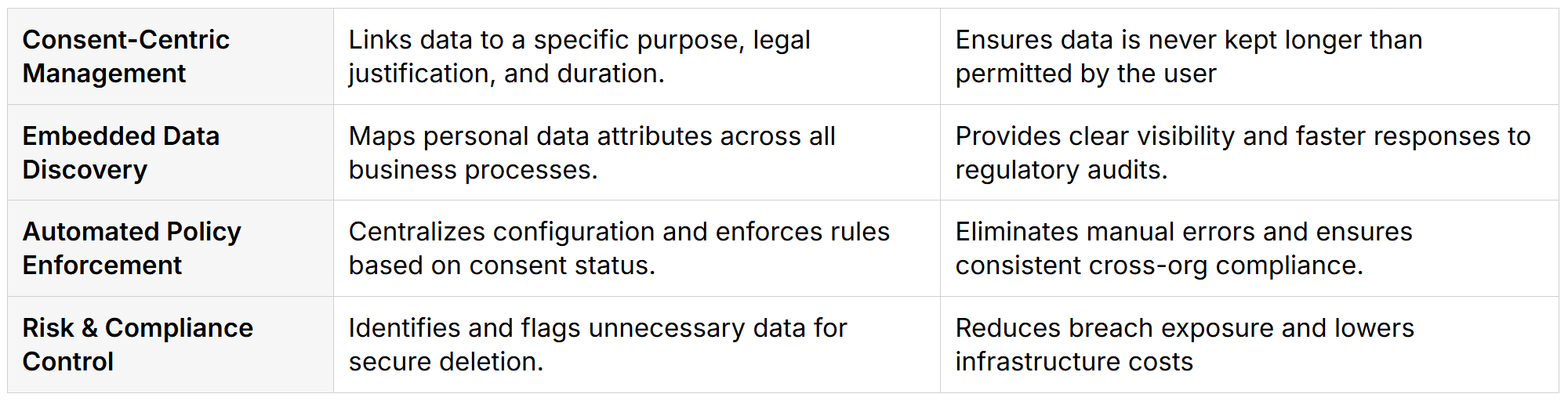
Consent-Centric Retention Management
Privy links data retention directly to consent and purpose. Every piece of personal data is tied to:
- A defined processing purpose
- A legal or consent-based justification
- A retention duration
When consent is withdrawn or a purpose expires, retention rules automatically adapt, ensuring that data is not kept longer than permitted.
Embedded Data Discovery
Privy enables organizations to map personal data attributes across business processes and systems. This built-in data discovery capability ensures:
- Clear visibility into what data is being collected
- Accurate mapping between data, purpose, and retention
- Faster response to audits and regulatory inquiries
Automating Data Retention Policies with Privy
Privy transforms static data retention policies into enforceable governance controls.
Key capabilities include:
- Centralized configuration of retention durations
- Policy enforcement based on purpose and consent status
- Version-controlled audit trails for retention changes
- Alignment with sectoral and regulatory requirements
This automation ensures that data retention is applied consistently across the organization, not left to individual teams or manual processes.
Reducing Risk Through Controlled Data Retention
By minimizing over-retention, Privy helps organizations:
- Reduce breach exposure
- Lower storage and infrastructure costs
- Improve operational efficiency
- Strengthen regulatory defensibility
Data that no longer serves a legitimate purpose is identified early and flagged for secure deletion, ensuring compliance with both privacy laws and internal governance standards.
Data Retention in the Context of Regulatory Compliance
Modern regulations explicitly mandate purpose limitation and storage limitation. Privy’s platform is designed to support these principles by:
- Ensuring retention aligns with lawful purposes
- Providing visibility into historical consent and retention actions
- Supporting audits with immutable records
This makes data retention not just compliant, but provably compliant.
Why Data Retention Is a Competitive Advantage
Organizations that master data retention don’t just gain compliance but they also gain trust.
Customers increasingly expect transparency and accountability in how their data is handled. Demonstrating strong data governance, disciplined data discovery, and a clearly enforced data retention policy builds credibility with regulators, partners, and users alike.
Conclusion
Data retention is no longer optional, and it is certainly no longer simple. As data ecosystems grow more complex, organizations need governance-first platforms that connect retention, consent, and discovery into a single operational model.
Privy’s approach ensures that data retention policies are not just written but lived, enforced, and auditable across the entire data lifecycle. By combining data governance, data discovery, and consent intelligence, Privy helps organizations move from reactive compliance to proactive control.
In a world where data misuse carries real consequences, getting data retention right is not just good practice; it’s good business.
Reach out to us at shivani@idfy.com to start a conversation on building a stronger, smarter data discovery, data retention, and data governance framework.

Consent Governance under the DPDP Act: a transformative approach ensuring compliance, fostering trust, and redefining customer engagement

Navigate the essentials of the 'Notice' under the DPDP Act 2023: your guide to data collection with clarity and choice. Learn the crucial role of notice in empowering Data Principals and ensuring informed consent.

Learn the difference between explicit consent and implied consent under DPDP and what is considered valid consent in India under the DPDP rules.

A complete guide to data governance and sensitive data, what it is, why it matters, how discovery fits in, and how organizations can govern data responsibly at scale

Discover why data visibility is essential for modern compliance and how effective data governance, data discovery, data mapping, and sensitive information management reduce risk, improve accountability, and build customer trust.