

Data Governance Explained: Understanding Sensitive Data, Risk, and Control in Modern Organizations
Date Published

Summary
Modern data governance is no longer just about policies or compliance documentation; it’s about continuously understanding and controlling sensitive data across complex digital ecosystems. As organizations adopt more cloud tools, AI systems, and third-party platforms, sensitive data spreads rapidly across environments, increasing operational, regulatory, and security risks.
This blog explains how effective data governance begins with visibility. Organizations cannot govern, protect, or retain data responsibly if they do not know where it exists, how it moves, or who can access it. Sensitive data discovery plays a central role by helping teams identify, classify, and contextualize data across structured and unstructured systems.
The blog also explores why governance programs often fail without continuous discovery, how modern governance must evolve alongside AI and dynamic data flows, and why governance maturity is becoming a business differentiator rather than just a compliance requirement.
Finally, it highlights how Data Compass by Privy enables organizations to operationalize governance through continuous discovery, real-time visibility, and scalable control over sensitive data.
Every organization today believes it has a data governance strategy. Fewer can confidently say they understand their sensitive data. That gap is where most governance programs quietly struggle. Sensitive data doesn’t announce itself. It blends into operational systems, shared folders, cloud tools, analytics platforms, and third-party applications. Over time, it spreads, copied for convenience, retained “just in case,” and accessed by more people than originally intended.
Data governance exists to bring order to this chaos. However, governance only works when it starts with a clear understanding of what data exists, how sensitive it is, and how it should be handled. Without that foundation, governance remains aspirational rather than operational.
What is Data Governance: Beyond Policies and Frameworks
At its simplest, data governance is about decision-making. It defines who can do what with data, under which conditions, and with what accountability, basically data mapping and compliance in a nutshell.
In practice, strong data governance answers everyday questions teams face:
- Can this data be shared with another department?
- Is this dataset safe to use for analytics?
- Who owns this information and approves access?
- How long should this data be retained?
When governance works, these questions don’t slow teams down. They’re already answered. Effective data governance creates consistency across the organization so data is accurate, secure, compliant, and usable. It aligns people, processes, and technology around a shared understanding of responsibility.
Modern governance programs are also evolving beyond compliance-centric thinking. Today, leading enterprises treat data governance as an operational intelligence layer that improves business agility, accelerates digital transformation, and strengthens customer trust simultaneously. Governance is no longer just about control; it’s about enabling safer innovation.
For organizations beginning their governance journey, this detailed guide on data visibility and governance foundations explains why visibility is the starting point of scalable governance.
Why Data Governance Has Become Mission-Critical
The urgency around data governance isn’t theoretical. It’s driven by real shifts in how organizations operate.
Data volumes have exploded. Cloud adoption has removed traditional boundaries. Teams use dozens of tools that store and process information independently. At the same time, privacy regulations and security expectations continue to tighten.
In this environment, sensitive data is exposed not because organizations are careless but because they lack visibility. Governance fills that gap, but only if it’s grounded in reality.
The rise of AI adoption has also intensified governance challenges. Enterprises are now processing larger volumes of behavioral, operational, and personal data through AI systems, often without fully understanding how that data is being classified, retained, or reused. This creates new governance blind spots that traditional frameworks were never designed to handle.
If you’re exploring how AI is changing governance and compliance expectations, this blog on AI governance and privacy risk detection adds a useful perspective.
Understanding Sensitive Data: More Than Just PII
Sensitive data is often described narrowly, but in reality, it’s broader and more contextual. It includes personal data such as names, contact details, financial information, health records, and identifiers. It also includes employee data, credentials, authentication logs, behavioral data, and any information that could cause harm if accessed or disclosed improperly.
What makes data sensitive isn’t just its type, it’s the risk associated with its exposure. A customer database and an internal spreadsheet can carry very different sensitivities depending on how they’re used, who can access them, and where they’re stored.
Sensitive data is also increasingly dynamic rather than static. Modern applications continuously generate metadata, activity logs, consent trails, geolocation signals, and interaction histories that may individually appear harmless but collectively create highly identifiable user profiles. Governance programs must now account for this layered sensitivity.
Why Sensitive Data Is So Difficult to Control
Sensitive data rarely stays in one place. It moves as teams collaborate, systems integrate, and processes evolve. Data is exported for analysis, copied for testing, archived for compliance, and shared for convenience. Each movement increases exposure.
Over time, organizations lose track of:
- Where sensitive data originated
- How many copies exist
- Who has access
- Whether governance policies still apply
This is why sensitive data often represents the highest risk and why identifying it accurately is so difficult.
You cannot govern what you cannot see. Sensitive data discovery provides visibility into what data exists across structured and unstructured systems. It reveals not only obvious repositories, but also unexpected locations where sensitive data quietly accumulates.
Once discovered, data can be classified, contextualized, and governed appropriately. Without discovery, governance policies operate in the dark.
This is where many organizations struggle, not because they lack rules, but because they lack insight.
Discovery transforms governance from static documentation into a living system.
It allows organizations to:
- Apply controls based on actual risk
- Assign ownership with confidence
- Enforce access policies consistently
- Reduce unnecessary data exposure
- Support compliance and audit readiness
One of the largest governance blind spots today is “orphaned sensitive data,” information that continues to exist long after its original business purpose has expired. These forgotten datasets often sit in backups, collaboration tools, archived systems, and unmanaged cloud environments, creating silent regulatory and security exposure.
Organizations looking to reduce this exposure should also explore data retention and lifecycle governance, especially in the context of long-term compliance readiness.
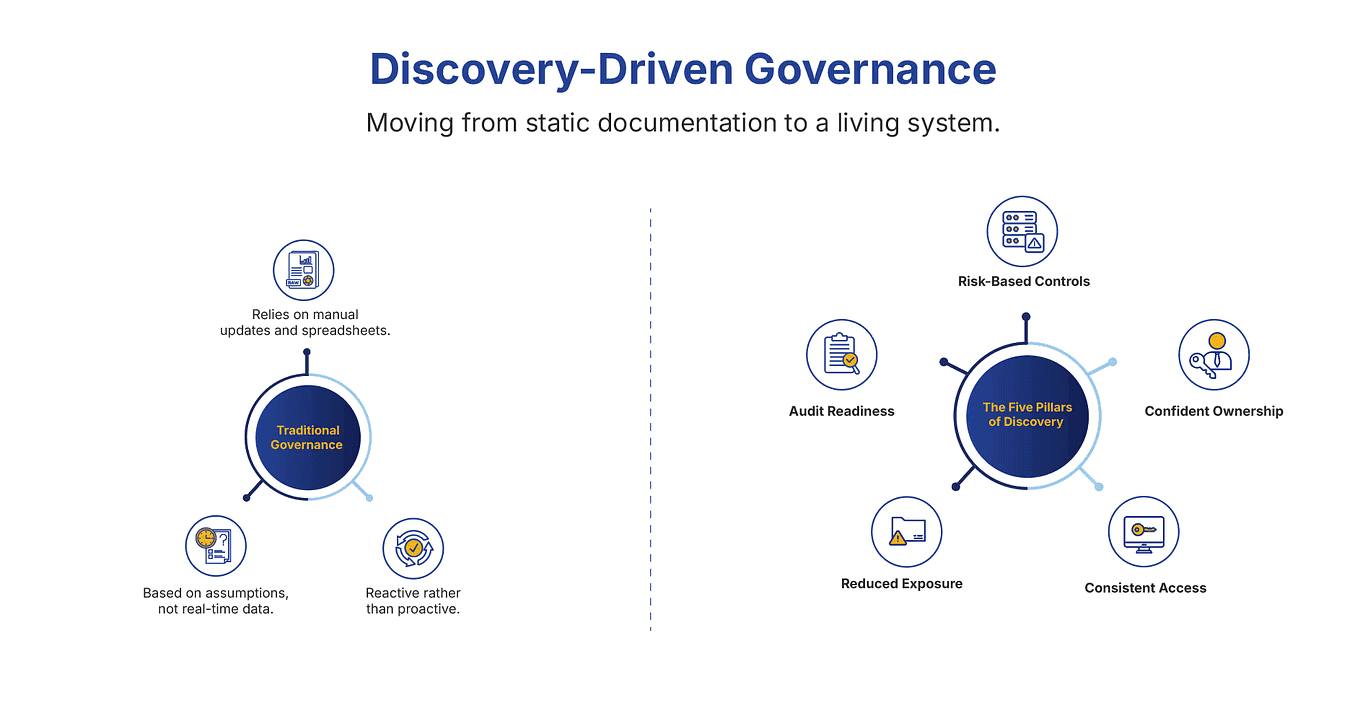
Most importantly, discovery ensures governance decisions are grounded in real data behavior, not assumptions.
Across industries, similar challenges appear again and again. Sensitive data exists across too many platforms to track manually. Ownership is unclear or fragmented. Classification efforts fall behind fast-changing environments. And governance rules are applied inconsistently across teams and systems.
These challenges don’t stem from a lack of effort. They stem from the complexity of modern data ecosystems.
Why Governance Fails Without Continuous Discovery
Governance fails when it’s treated as a one-time exercise. Organizations invest time defining policies, roles, and frameworks, but data doesn’t stand still. When new systems are added, data is duplicated, and access patterns change. Without continuous discovery, governance slowly drifts out of alignment with reality.
That’s why Privy believes governance must be discovery-led and ongoing. Understanding sensitive data isn’t a phase; it’s a capability.
Continuous discovery is especially critical under modern privacy laws, where organizations are expected to demonstrate ongoing accountability rather than point-in-time compliance. Regulators increasingly expect evidence that governance controls evolve alongside business operations, vendor ecosystems, and changing processing activities.
For teams operationalising governance programs at scale, this webinar on operationalising DPDP compliance for Indian enterprises provides additional implementation-focused insights
How Data Compass Brings Governance and Reality Together
Data Compass by Privy by IDfy is built to bridge the gap between policy and practice. It enables organizations to continuously discover sensitive data, understand its context, and apply governance controls that reflect how data is actually used. Instead of relying on manual inventories or outdated classifications, teams gain a dynamic view of their data landscape. Governance becomes actionable, measurable, and adaptable rather than static and reactive. One-time audits provide a snapshot, while continuous discovery provides confidence.
As data environments evolve, continuous discovery ensures that new sensitive data is identified early, governance policies remain relevant, and risk doesn’t quietly accumulate.
This approach shifts organizations from reactive cleanup to proactive control, one of the defining traits of mature data governance programs.
Data Compass also enables organizations to strengthen cross-functional alignment between privacy, security, legal, and operational teams by creating a shared visibility layer. Instead of governance existing in isolated spreadsheets or disconnected workflows, stakeholders work from a unified understanding of sensitive data exposure and ownership.
Organizations modernizing their governance posture may also find value in this guide to privacy-enhancing technologies under DPDP, particularly for reducing sensitive data exposure architecturally.
Strong data governance does more than reduce risk. It enables organizations to use data more confidently. Teams collaborate faster when they know what data they can access safely. Decision-making improves when data quality and accountability are clear. Trust grows both internally and with customers. When sensitive data is governed well, data becomes an asset rather than a liability.
Governance Maturity Is Becoming a Competitive Differentiator
Organizations with mature governance programs are increasingly outperforming peers in areas beyond compliance. Faster audit readiness, improved AI deployment confidence, lower breach remediation costs, and stronger customer trust are all emerging as measurable outcomes of governance maturity.
This is particularly important as enterprise buyers and regulators increasingly evaluate not just whether organizations collect data responsibly, but whether they can explain and justify how sensitive data moves across systems, vendors, and AI-driven workflows.
For additional perspective, this blog on data minimization and privacy-by-design strategies connects governance directly with risk reduction and operational efficiency.
Conclusion
Data governance doesn’t begin with frameworks. It begins with awareness. Understanding where sensitive data lives, how it’s used, and how it should be protected is the foundation of any effective governance strategy.
With discovery-led governance supported by Data Compass, organizations can move beyond uncertainty and into control. That’s when governance stops feeling like overhead and starts delivering real value.
If you’re looking to gain visibility into your sensitive data and build a data governance program that reflects how your organization actually works, we’d be happy to help. Reach out to us at shivani@idfy.com to learn how Data Compass can support scalable and responsible data governance.

Consent Governance under the DPDP Act: a transformative approach ensuring compliance, fostering trust, and redefining customer engagement

Navigate the essentials of the 'Notice' under the DPDP Act 2023: your guide to data collection with clarity and choice. Learn the crucial role of notice in empowering Data Principals and ensuring informed consent.

Learn the difference between explicit consent and implied consent under DPDP and what is considered valid consent in India under the DPDP rules.

Discover why data visibility is essential for modern compliance and how effective data governance, data discovery, data mapping, and sensitive information management reduce risk, improve accountability, and build customer trust.

Learn what data retention is, why a strong data retention policy is essential for compliance, and how Privy enables modern data governance and data discovery to manage data responsibly across its lifecycle.