

Top Consent Tools vs Privacy Platforms: Fastest DPDP Compliance Guide 2026
Date Published

In the pre-DPDP era, data privacy in India was a bit like a "No Parking" sign in a busy Mumbai lane, more of a suggestion than a rule. Most businesses operated on the principle of "ask for forgiveness, not permission", burying data clauses in 40-page terms and conditions that no human had ever read.
However, the Digital Personal Data Protection (DPDP) Act has officially ended the era of the sneaky opt-in. We are now in the age of explicit consent, where the data principal (user) is the protagonist of the story, not a bystander.
The market is currently flooded with solutions, but they generally fall into two camps: the specialised Consent Management Platforms (CMPs) and the comprehensive Privacy Governance Platforms. One is a digital clipboard; the other is a full-blown air traffic control tower. If you’re a DPO or a CXO looking for the fastest route to compliance without breaking your product’s user journey, the choice you make today determines whether you’re building a fortress of trust or a house of cards.
Why a Basic CMP Isn’t Enough for DPDP
Most businesses think online consent management is just about slapping a cookie banner on a website. It’s a classic mistake, like buying a fancy front door and forgetting to build the rest of the house.
A standard consent management platform is excellent at the "handshake", the moment a user clicks "I Agree." It handles cookie consent and logs the event. But under the DPDP Act, consent is a living, breathing entity. It must be granular, informed, and, most importantly, revocable with the same ease it was given.
If a user withdraws consent at 2:00 PM, but your marketing engine sends them a "Buy Now" SMS at 2:05 PM because your CMP doesn't talk to your CRM, you’ve just earned yourself a potential ₹250 crore penalty. A basic tool manages the click; a privacy platform manages the consequence.
Decoding the DPDP Consent Management Maze
To understand why "fast" compliance requires more than just a tool, we need to look at the types of consent mandated by the Act. It’s no longer a binary Yes/No.
1. Explicit Consent: The gold standard. No pre-ticked boxes, no "by continuing to use this site" vagueness. It must be a clear, affirmative action.
2. Multilingual Consent: India is a land of 22 official languages. If your CMP only speaks English, you aren't compliant for a majority of your Indian users.
3. Notice-Linked Consent: Every request for data must be accompanied by a notice explaining what is being collected and why.
Imagine you are at a high-end restaurant. A basic CMP is the waiter who asks if you want water. A privacy platform is the sommelier who tells you where the grapes were grown and the alcohol content and ensures that if you change your mind halfway through the bottle, the charges are reversed instantly across the entire billing system.
Consent Tools vs. Privacy Platforms
When you search for online consent management, you’ll find hundreds of tools. It is vital to distinguish between a tool and a platform.
- Consent Tools (CMPs): These are lightweight scripts designed for the front-end. They are great for "Cookie Consent" and passing signals to Google Tag Manager. However, they often live in a vacuum. They don't know where your data is stored or if your backend systems are actually respecting the user's choice.
- Privacy Platforms (Governance): These are holistic ecosystems. They don't just collect consent; they govern the entire data lifecycle. They automate data discovery, generate Records of Processing Activities (RoPA), and manage Data Principal Rights (DPR) requests.
For an Indian enterprise, a tool is a band-aid. A platform is the immune system. While a tool might get you a banner by Monday, a platform like Privy ensures you aren't investigated by Friday.

Top 5 Consent & Privacy Platforms for DPDP Compliance
1. Privy by IDfy
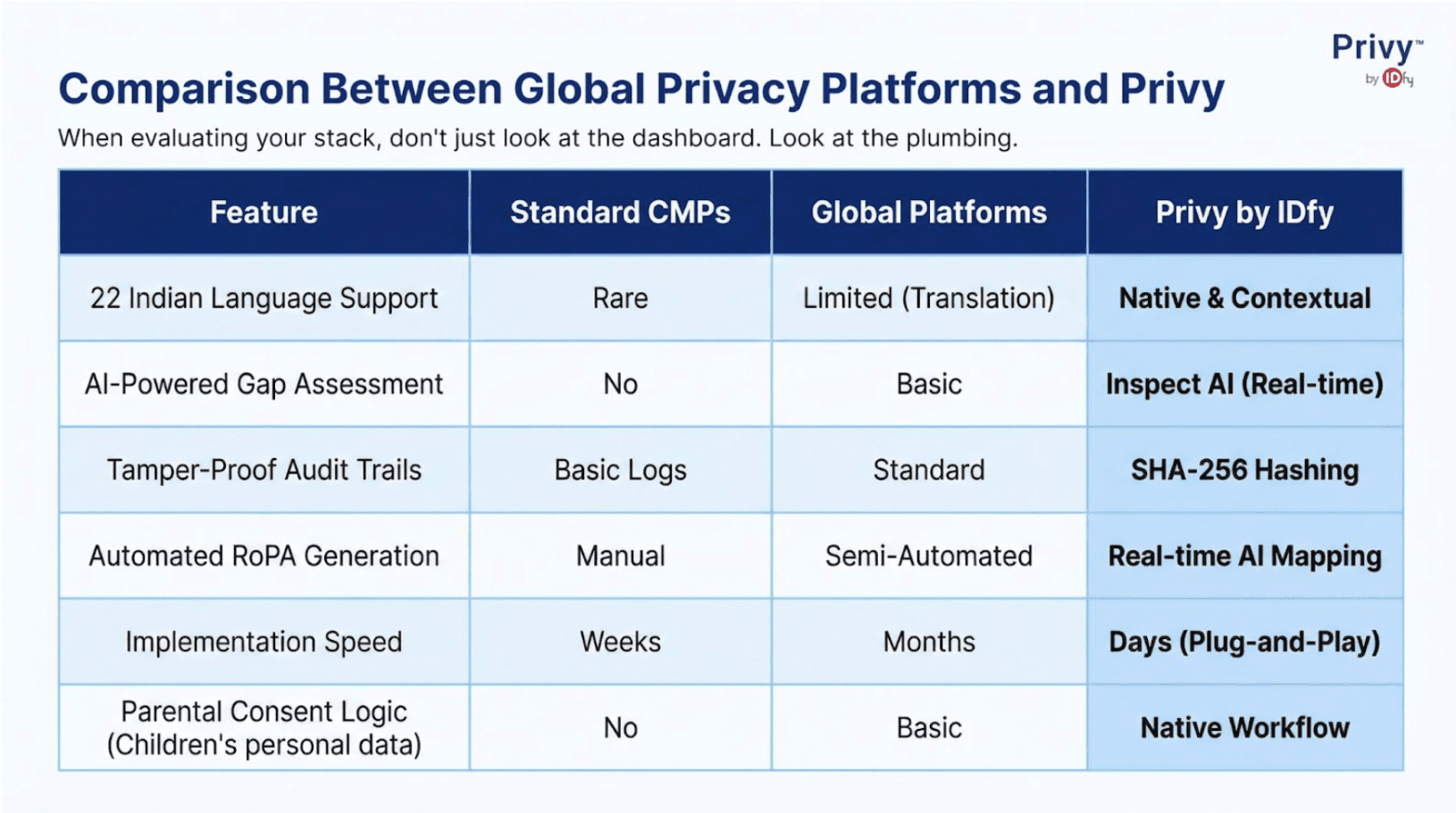
Privy isn't just a consent management platform; it is India’s first comprehensive Consent Governance Platform. While global players try to retrofit GDPR tools for the Indian market, Privy was built from the ground up for the DPDP Act.
Privy uses Inspect AI to scan your digital journeys in real-time. It doesn't just look for cookies; it identifies compliance gaps in your forms, logic, and data flows.
It supports all 22 scheduled Indian languages natively, ensuring your notices are actually informed.
Privy goes way past the banner. It features Data Compass for automated data discovery and Consent Shield, which uses SHA-256 hashing to create tamper-proof audit trails. Whether you are a small startup or a massive BFSI entity, Privy’s API-first approach means you can integrate in days, not months.
2. OneTrust
The global giant. OneTrust is a massive GRC (Governance, Risk, and Compliance) suite. It’s incredibly powerful but can feel like trying to fly a Boeing 747 to the grocery store. It’s highly customizable but often requires a small army of consultants to implement correctly for the specific nuances of the Indian DPDP Act.
3. Cookiebot
Excellent for pure cookie consent. If your only concern is website trackers, Cookiebot is a reliable, automated choice. However, it lacks the deep consent management framework required by the DPDP Act, such as managing consent for offline data or complex API-based data sharing.
4. Didomi
A French-headquartered platform that focuses heavily on the privacy user experience. It’s great for building beautiful consent interfaces. While it has global reach, it lacks the deep integration into the Indian regulatory ecosystem (like RBI/SEBI alignment) that a local specialist provides.
5. Osano
A user-friendly platform that emphasizes simplicity. It provides a solid Consent & Preference Hub. It’s a good middle-ground for mid-market companies, but may struggle with the sheer scale and multilingual complexity of the Indian enterprise landscape.
Comparison Between Global Privacy Platforms and Privy
When evaluating your stack, don't just look at the dashboard. Look at the plumbing.
Privacy as a Business Accelerator
At IDfy, we believe that compliance shouldn't be a speed bump; it should be the high-octane fuel for your brand's trust. Privy by IDfy was designed with a singular focus: Speed and Intelligence.
Traditional compliance involves spreadsheets and hope. Privy replaces hope with Inspect AI. It acts as your automated DPO, scanning every digital touchpoint to ensure that what you say in your privacy policy is actually what you do in your code. This AI doesn't just find errors; it increases implementation efficiency by 10x.
The Indian market is a beast of scale. Privy is built to handle the "Big Billion Day" levels of traffic without breaking a sweat. It provides seamless integration for businesses of all sizes, from the scrappy startup needing a quick API to the legacy bank needing to govern billions of data points.
Most platforms stop at 'Yes', while Privy follows the data. Through its Data Compass module, it maps where the data goes, who processes it, and ensures that if a user revokes consent, the data is actually deleted or "frozen" across your entire ecosystem. This is true DPDP consent management, not just a checkbox but a commitment.
Conclusion
In the digital economy, data is the oil, but trust is the engine. You can choose a tool that helps you get by, or you can choose a platform that helps you get ahead.
The DPDP clock is ticking. A basic cookie consent tool is a temporary fix for a permanent shift in the landscape. To truly enable faster compliance, you need a system that understands the nuances of the Indian market, the power of AI, and the absolute necessity of end-to-end data governance.
Ready to move beyond the checkbox? Build a DPDP-ready infrastructure that scales with your business. For a deep dive into how Privy by IDfy can streamline your privacy operations, reach out to us at shivani@idfy.com.

Consent Governance under the DPDP Act: a transformative approach ensuring compliance, fostering trust, and redefining customer engagement

Learn the difference between explicit consent and implied consent under DPDP and what is considered valid consent in India under the DPDP rules.

Navigate the essentials of the 'Notice' under the DPDP Act 2023: your guide to data collection with clarity and choice. Learn the crucial role of notice in empowering Data Principals and ensuring informed consent.