

Vendor Risk Management Under DPDP: 2026 Compliance Guide
Date Published

Under India's Digital Personal Data Protection Act, a data fiduciary stays accountable for personal data even when a vendor processes it. That single principle turns vendor management from a procurement task into a compliance obligation. When a payroll platform handles employee salaries, a CRM stores customer records, or a cloud provider hosts data collected through your product, the responsibility for lawful and secure processing remains with you.
This guide is written for the DPO, compliance head, or risk owner who has to build a defensible third party risk programme before enforcement tightens. It covers what vendor risk management means under the DPDP framework, where the exposure sits, what due diligence and contracts have to cover, and how to run the programme continuously rather than as a one-time onboarding check.
What Vendor Risk Management Means Under DPDP
Vendor risk management under the DPDP Act is the process of assessing and monitoring the third-party vendors that process personal data on your behalf. The purpose is to confirm that those vendors protect the data, follow reasonable security safeguards, report breaches on time, delete or return data when required, and support your own compliance obligations.
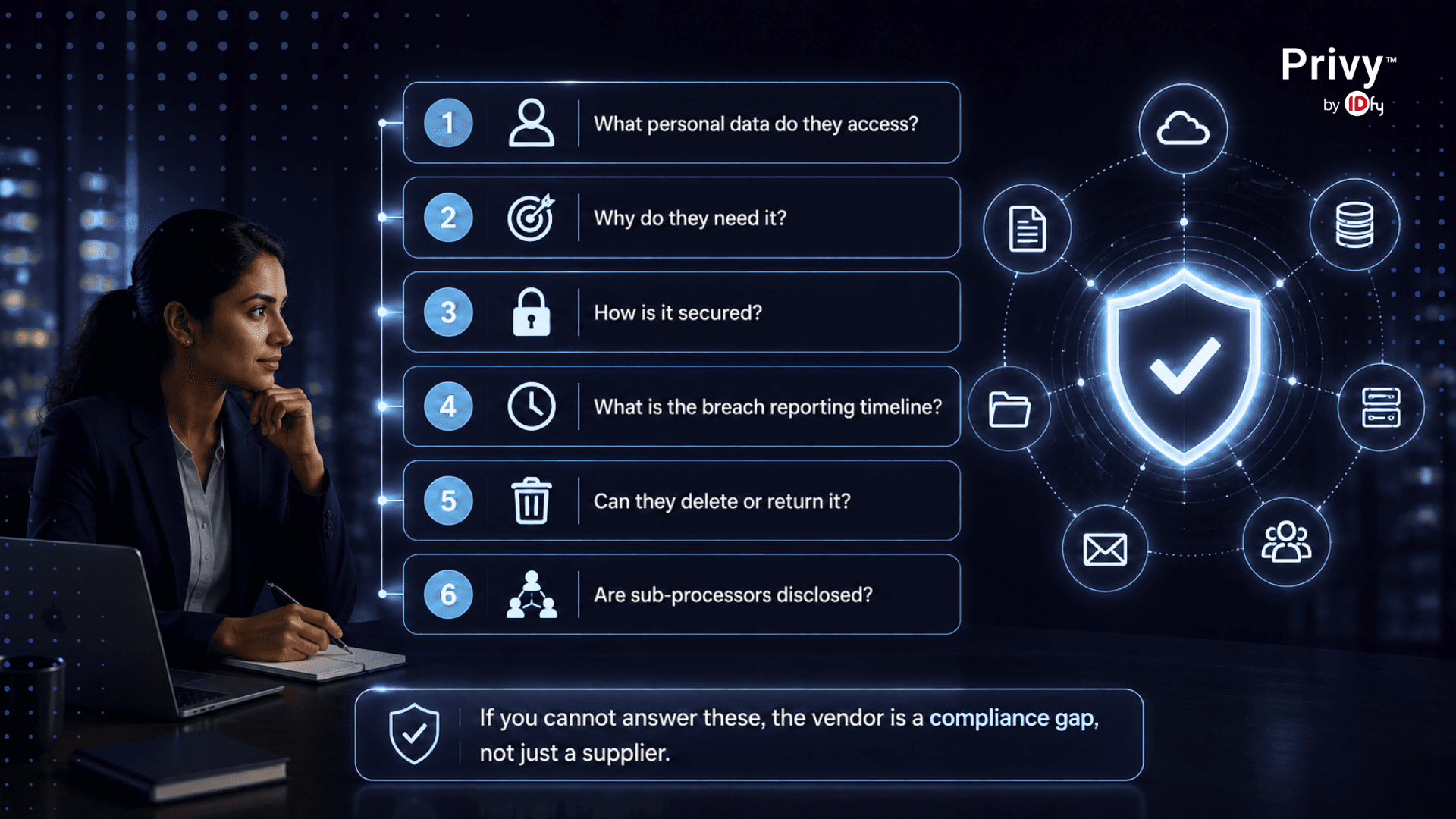
The test is simple to state. If a vendor can access your personal data, you need to know what data they process, why they need it, how they protect it, and what happens when something goes wrong. Most enterprises today depend on vendors for cloud hosting, payroll, HRMS, CRM, payment processing, marketing automation, analytics, customer support, and cybersecurity. Each of those relationships is a potential point of failure that lands back on the fiduciary.
Why Vendor Risk Matters Under the DPDP Act
Businesses share personal data with external systems constantly, usually without full control over how that data is stored, accessed, or protected. The DPDP Act makes the fiduciary responsible for processing done by itself or on its behalf by a data processor, which means you cannot shift the blame to a vendor when personal data is exposed or misused.
That reframes the questions every organisation should be asking. Which vendors process personal data, and what type do they touch? Do they have adequate security safeguards? Are breach reporting timelines defined in the contract? Do the contracts include deletion and audit rights? Are sub-processors disclosed and monitored? Moving from basic vendor onboarding to genuine privacy governance starts with being able to answer those questions for every processor in the estate.
Data Fiduciary and Data Processor: The Relationship That Defines Liability
In most vendor relationships, the business that decides why and how personal data is processed is the data fiduciary. The vendor that processes the data on the fiduciary's behalf is the data processor. If a company uses a payroll platform to run employee salaries, the company is the fiduciary and the payroll platform is the processor. The vendor does the processing, but the company remains responsible for ensuring it is lawful and secure.
This distinction matters because vendor risk management is about more than whether a vendor is reliable. It is about proving that processing is controlled, limited, secure, and accountable. The fiduciary manages consent, notices, safeguards, rights, and breach response. The processor follows instructions and supports compliance. Rule 6 of the DPDP Rules 2025 requires the fiduciary to bind the processor contractually to equivalent security measures, which is what converts that relationship into an auditable control rather than a handshake.
Common Vendor Risks Under DPDP
Vendor risk appears at different points in the data lifecycle. Some risk exists before onboarding, when nobody checks what data the vendor will access. Some appears later, when a vendor quietly adds sub-processors, changes infrastructure, or keeps data past its purpose.
The recurring risks are weak security controls such as poor access management or missing encryption, no clear breach reporting process, unknown sub-processors or embedded third-party tools, excessive access to personal data beyond what the purpose needs, poor deletion and retention practices, no evidence of compliance controls, unclear data storage location, and no support for data principal rights. Any one of these becomes serious during a breach, because the DPDP framework requires the fiduciary to notify both the Board and affected data principals, and how third-party vendors become your biggest data breach risk shows where most of those breaches originate. A structured approach to vendor onboarding risk catches most of these before a contract is signed.
What Vendor Due Diligence Should Include
Due diligence should begin before onboarding any vendor that processes personal data. The point is to understand whether the vendor can handle data safely, lawfully, and responsibly before it ever touches their systems.
A working due diligence process checks what personal data the vendor will process, why they need access, where the data will be stored or transferred, whether they use sub-processors, what security controls are in place, how quickly they report incidents, whether they can delete or return data, and whether audit evidence is available. For high-risk vendors, go deeper: ask for ISO 27001 certification, SOC 2 reports, security policies, incident response documentation, penetration testing summaries, or other privacy control evidence.
Due diligence is not a one-time gate. Vendors should be reviewed periodically, and specifically at contract renewal, on major service changes, when new data access is granted, after a security incident, and whenever sub-processors change. This is where knowing what TPRM is and how organisations get it right pays off, and you cannot assess a vendor's data risk without first knowing what data flows to them, which is why data discovery, mapping, and governance are the foundation of DPDP compliance.
What DPDP Vendor Contracts Should Include
A DPDP-aligned vendor contract defines how personal data will be processed, protected, reported, and deleted. It should not be a generic commercial agreement with one buried privacy clause. It should control the vendor's role as a processor explicitly.
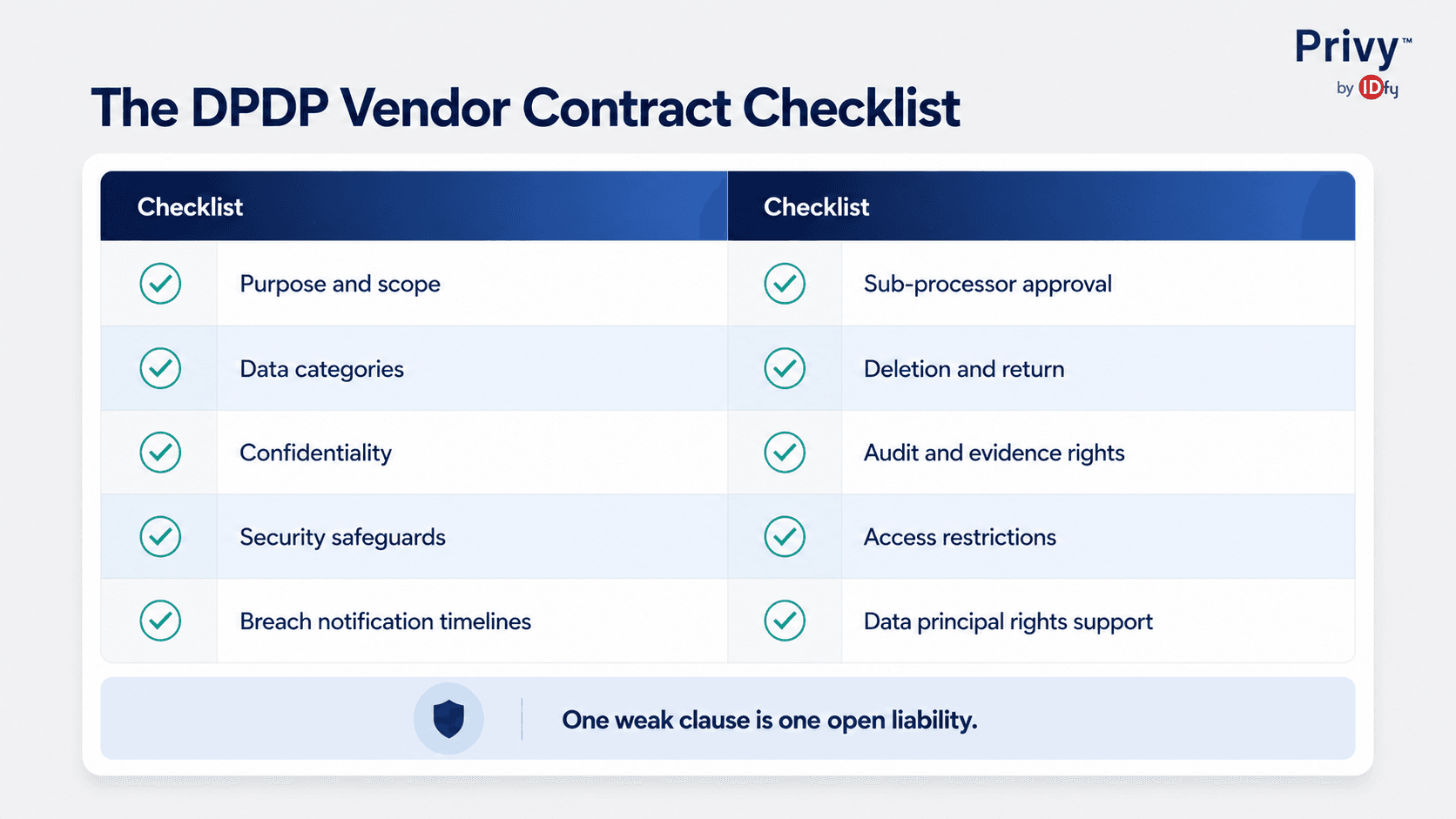
A strong contract covers the purpose and scope of processing, the categories of personal data involved, confidentiality obligations, security safeguard requirements, breach notification timelines, sub-processor approval rules, data deletion or return obligations, audit and evidence rights, access restrictions, support for data principal rights, and post-termination obligations. Treated properly, the contract itself becomes a compliance control. It is the artefact that shows a regulator the vendor's processing is not open-ended, uncontrolled, or undocumented. This is also the most neglected area of most programmes, as to why vendor contracts in TPRM are the biggest blind spot sets out in detail.
Penalties Make Vendor Risk A Board-Level Issue
Vendor failure increases the fiduciary's own exposure. Under the DPDP penalty framework, failure to maintain reasonable security safeguards can attract penalties up to ₹250 crore, and failure to notify the Board or affected individuals of a personal data breach can attract penalties up to ₹200 crore. A vendor that mishandles data or delays breach reporting can put the fiduciary directly in the path of those figures.
That is why vendor risk management cannot sit inside procurement alone. It needs legal, compliance, cybersecurity, IT, procurement, and business teams working from the same vendor inventory and risk model. The objective is not faster vendor selection. It is responsible selection followed by continuous monitoring.
Continuous Monitoring, Not One-Time Onboarding
The most common failure is treating vendor risk as an onboarding checkbox. A vendor assessed once at signup can add sub processors, change where data is hosted, suffer a breach, or drift out of compliance months later, and none of that shows up if nobody is watching. Continuous monitoring keeps risk ratings current, flags high-risk processors, and maintains the audit-ready evidence a regulator will ask for.
Managing this through spreadsheets and email breaks down as vendor numbers grow. Teams need a structured way to track assessments, contracts, risk ratings, evidence, breach readiness, and ongoing reviews in one place. This is where a dedicated third party risk platform earns its cost, by turning a long vendor list into a prioritised, continuously monitored programme.
Where The Platform Fits
Everything above depends on two things most enterprises lack: a single view of every processor, and the ability to keep that view current. The steps to get there are laid out in how to build a privacy-first TPRM program, and Privy's third-party risk management module is built to operationalise it. It provides a unified processor portal that centralises vendor information, documentation, and risk posture, so the scattered lists and manual follow-ups disappear.
Its contract analysis scans processor agreements to detect missing or non-compliant clauses automatically and maintains a live contract inventory with risk tags and alerts, which operationalises the contract checklist above rather than leaving it to a manual legal review. The vendor risk appetite and due diligence feature scores processors on credit, security, and compliance data and identifies high-risk vendors early against thresholds you set. Its purge workflows track processor actions on deletion and revocation requests and generate purge artefacts with audit logs, closing the loop on the deletion obligations that vendors so often ignore.
Because vendor risk is one part of a wider obligation, the module connects into Privy's DPDPA compliance platform, where third party risk sits alongside consent management, personal data discovery, and incident response. When a vendor-related breach does occur, understanding the 72-hour breach notification rule under DPDP and incident management under DPDP is what keeps the Board and data principal notification on time. That connection matters, because a vendor breach is only contained if discovery, notification, and evidence generation all work together. If you are shortlisting tools, the comparison of the best TPRM tools for 2026 sets out what to evaluate.
A Practical Sequence For Vendor Risk
For a team starting now, order the work so each step feeds the next. Build a vendor inventory and flag every processor that touches personal data. Tier vendors by the sensitivity and volume of data they handle rather than by spend. Run due diligence on the high tier first. Rewrite contracts to include the DPDP clauses, starting with the riskiest processors. Set up continuous monitoring and periodic review triggers. Bring legal, security, IT, and procurement onto the same platform and evidence trail. Then rehearse the vendor breach path so notification is fast when it counts.
Done in that order, vendor governance becomes provable. Done as a one-time onboarding form, it produces exactly the gaps that surface during an incident.
Conclusion
Vendor risk management under the DPDP Act comes down to one fact: the data leaves your systems, but the accountability does not. A defensible programme knows which vendors process personal data, tiers them by real data risk, runs genuine due diligence, binds them with contracts that function as controls, and monitors them continuously with audit-ready evidence. Enterprises that build this now will handle a vendor incident as a managed event. Those that keep vendor risk in a spreadsheet will discover the gaps at the worst possible moment, during a breach, with the penalty clock running.
If you are building or auditing a third-party risk programme for the DPDP Act and want to see how vendor assessment, contract analysis, purge workflows, and breach response fit together in one platform, reach out at shivani@idfy.com to book a demo.
FAQ's
Who is responsible for vendor compliance under the DPDP Act?
The data fiduciary remains responsible for personal data processed by itself or on its behalf by a data processor. Engaging a vendor does not transfer that accountability.
What should a DPDP vendor contract include?
Processing purpose and scope, data categories, confidentiality, security safeguards, breach reporting timelines, sub-processor approval rules, audit rights, data deletion or return, access restrictions, and support for data principal rights.
Why is vendor due diligence important under DPDP?
It confirms before onboarding whether a vendor can protect personal data, report breaches on time, apply adequate security controls, delete data when required, and support your compliance obligations. Without it, you inherit their weaknesses.
What are examples of vendors that fall under DPDP vendor risk?
Cloud providers, payroll platforms, CRM systems, HRMS tools, payment gateways, analytics tools, customer support systems, and marketing automation platforms, among others.
How often should vendors be reviewed?
Not just at onboarding. Review at contract renewal, on major service changes, when new data access is granted, after any security incident, and whenever sub-processors change.

Discover the top 3 TPRM software solutions and learn how vendor risk management tools can protect you company from breaches and regulatory hurdles.
-1.jpg&w=3840&q=75)
Learn what Third-Party Risk Management (TPRM) is, why it matters for modern organizations, key third-party risks, and how Privy helps solve TPRM challenges through governance- and consent-driven controls.