

Top 3 TPRM Software for 2026: A Deep Dive into Vendor Risk Management
Date Published

In the modern corporate world, no company is an island. We are more like a densely packed archipelago, connected by a thousand fragile bridges of APIs, cloud storage, and outsourced payroll systems. This interconnectedness is our greatest strength, until one of those bridges collapses.
Enter the world of Third-Party Risk Management (TPRM). If your business were a high-end restaurant, TPRM isn't just checking the freshness of the fish; it’s auditing the boat, the fisherman’s freezer, and the truck driver’s GPS. Because when the fish and chips taste bad, the customer doesn't blame the fisherman; they blame the restaurant.
In 2026, an untracked vendor isn't just a clerical oversight; it’s a compounding risk in real-time. As global regulations like the GDPR and India’s DPDPA (Digital Personal Data Protection Act) tighten the noose, the stakes have shifted from mere operational hiccups to absolute brand trust erosion.
Why Traditional Vendor Risk Management is Failing
Most companies approach a vendor risk management programme the way a teenager approaches a messy room: they shove everything under the bed and hope nobody opens the closet.
The closet, in this case, is your sprawling network of sub-processors and fourth-party vendors. You might trust your primary cloud provider, but do you trust the third-party analytics plug-in they integrated last Tuesday? Probably not, because you don’t even know it exists.
The challenge isn't just risk; it’s the velocity of risk. Static spreadsheets and annual security questionnaires are the equivalent of using a paper map to navigate a city that’s being rebuilt every hour. To survive, you need vendor risk management software that breathes with your business.

The Anatomy of a Modern Vendor Risk Management Program
A robust third-party vendor risk management strategy is no longer a check-the-box exercise for the IT department. It is a continuous lifecycle that spans five critical stages:
- Pre-onboarding due diligence: Investigating historical breach records and AI governance before the ink is dry.
- Onboarding: Setting the ground rules with data minimization agreements and DPDPA-compliant clauses.
- Operational Risk: Continuous monitoring. Think of this as the "security camera" that never blinks, conducting Privacy Impact Assessments (PIAs) in real-time.
- Change Management: What happens when a vendor changes their sub-processor? If your software for vendor risk management doesn't flag this, you’re flying blind. We have also done a detailed blog on the top things to look for while choosing your DPDP vendors.
- Offboarding: Ensuring data is actually deleted and API integrations are severed.
Before we dive into the top 3 TPRM platforms in 2026 in India, let’s first understand the key factors that must be taken into account while you choose a TPRM platform for your organisation.
How to Choose a Third-Party Risk Management Platform Without Losing Your Mind
Choosing a vendor risk management software is a high-stakes decision. It’s the difference between having a digital fortress and a “Beware of Dog" sign on a broken fence. With so many platforms claiming to be AI-powered and end-to-end, how do you cut through the noise?
Think of this process as hiring a Chief Security Officer. You don't just look at their resume; you look at their reflexes. Here is the framework for selecting the right TPRM software for your organization:
1. Assess the Onboarding Velocity
The biggest complaint with legacy vendor risk management tools is that they act as a bottleneck. If your procurement team has to wait three weeks for a manual third-party vendor risk assessment to clear, they will eventually start bypassing the system.
Ask the vendor questions like how long it takes to move a medium-risk vendor from ‘Contract' to 'Active'? If the answer involves manual spreadsheets, you should be looking for an alternative. Look for platforms like Privy that use AI to automate document parsing and risk tiering in hours, not weeks.
2. Regulatory Native vs. Regulatory Tourist
Many global platforms are regulatory tourists; they know the big names like GDPR, but they stumble when they hit local terrain. It's like claiming to provide the facilities for a bullet train for a country like India. While the promise is great, the terrain of the country is not suitable for a bullet train, which is often forgotten. In India, the DPDPA has specific nuances regarding data principal rights and localization that a generic tool might miss.
Your software for vendor risk management must be natively compliant with the laws of the land where you operate. It should understand local consent artifacts and have the ability to manage data residency requirements without needing a custom patch.
3. Integration
A vendor risk management program shouldn't exist in a vacuum. It needs to talk to your existing stack, your Slack/Teams for alerts, and your cloud infrastructure.
Prioritize an API-first architecture. This ensures that as your company grows, your TPRM platform grows with it, rather than becoming a legacy anchor that refuses to sync with your new tools.
4. Beyond the Point-in-Time Assessment
Risk isn't a static snapshot; it’s a live-stream. A vendor that was "Green" in January could be "Red" by March due to a sub-processor change or a fresh data breach.
Look for continuous monitoring capabilities. Does the platform provide real-time alerts for change management (like a sub-processor addition)? If the tool only checks your vendors once a year during audit season, it’s not a risk management tool; it’s a history book.
5. Scalability for All Business Sizes
Whether you are a nimble startup or a sprawling enterprise, your risk is the same: a breach is a breach. However, your budget and headcount are not.
Choose a platform that offers the sophistication of an enterprise tool with the agility of a SaaS product. Privy, for instance, is designed to serve the entire spectrum of Indian businesses, ensuring that "Enterprise Grade" security isn't locked behind an "Enterprise Only" price tag or implementation timeline.
Top 3 TPRM Software for Your Security Arsenal
Choosing the right TPRM software is like picking a bodyguard. You don't want the loudest one; you want the one who has already checked the exits and knows who is coming through the back door. Here are the top three contenders in the market today:
1. Privy by IDfy
While the other platforms focus on being a generalist repository of data, Privy has been engineered specifically for the complexity of the modern regulatory landscape, with a sharp focus on the Indian market and AI-driven efficiency.
Privy doesn't just manage risk; it anticipates it. By leveraging AI across all its modules, it reduces the "onboarding drag" that usually kills business velocity. It is built for speed, making it the go-to for high-growth enterprises that can't afford to wait six weeks for a third-party risk assessment.
In the world of privacy, "Consent" has become a bit of a buzzword, the digital equivalent of "thoughts and prayers." Many vendor risk management tools stop at the consent layer. They tell you if a user said yes, but they don't tell you what happens to that data once it travels to a third party.
Privy is different. It understands that in a DPDPA world, consent is just the entry ticket. The real game is played in data governance. Privy goes beyond the "Yes/No" of consent to manage the entire data lifecycle. It tracks data flows, monitors AI algorithm changes in your vendor's stack, and ensures that "Delete" actually means "Delete" across the entire supply chain.
At Privy by IDfy, we see Third-Party Risk Management not as a defensive hurdle, but as a brand-building opportunity. When a vendor fails, it’s your brand that erodes. Customers don't care about your contractual indemnification clauses; they care that their data is on the dark web.
Privy is designed to solve the compounding risk problem. By using AI to automate the boring stuff, like parsing through hundreds of pages of security documentation, Privy allows your security team to focus on high-level strategy.
For businesses in India, the advantage is two-fold:
- Localization: We understand the nuances of the DPDPA and the specific linguistic and cultural requirements of the Indian market.
- Integration: Whether you are a startup or a legacy giant, Privy’s API-first architecture means it plugs into your existing workflow without needing a "surgical overhaul" of your IT stack.
2. OneTrust
OneTrust is the Goliath of the privacy world. They have built an ecosystem that covers cookie consent to ethics and compliance.
- The Pro: Scale. If you are a multinational conglomerate with a presence in 50 countries, OneTrust offers a "one-size-fits-all" (or rather, "one-size-fits-most") solution.
- The Con: It can be incredibly "heavy." Implementing OneTrust is often a multi-month project that requires dedicated consultants. For many, it feels like buying a Swiss Army knife when you just need a very sharp scalpel.
3. Securiti.ai
Securiti focuses heavily on "Data Command Centers." They are excellent at data discovery and mapping, helping you find where the "bodies are buried" (digitally speaking) across your multi-cloud environment.
- The Pro: Deep technical automation. They are great at the "Data Security Posture Management" (DSPM) side of things.
- The Con: While they are masters of data, the nuanced "human" side of vendor relationships, contractual compliance, and localized regulatory hurdles in markets like India can sometimes feel like an afterthought.
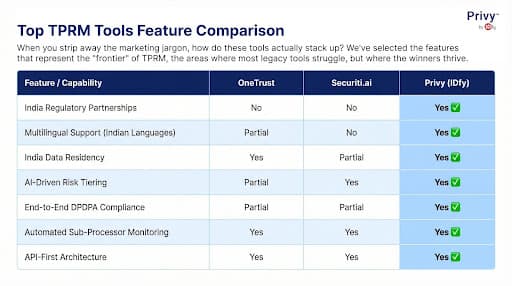
Top TPRM Tools Feature Comparison
When you strip away the marketing jargon, how do these tools actually stack up? We’ve selected the features that represent the "frontier" of TPRM, the areas where most legacy tools struggle, but where the winners thrive.
Conclusion
In the digital economy, your reputation is only as strong as the weakest link in your vendor chain. Investing in high-quality vendor risk management software is no longer optional; it's a prerequisite for staying in business.
While the market is filled with giants, the smart money is on platforms that offer precision, speed, and deep regulatory expertise. Privy by IDfy represents that shift, moving past the era of simple "checklists" and into the era of intelligent, automated, and comprehensive third-party governance.
Ready to secure your ecosystem and build radical trust with your customers? Don't wait for a breach to find out where your gaps are. Reach out to us for a personalized walkthrough of how Privy can transform your vendor risk management program. Contact us at shivani@idfy.com to start your journey toward foolproof third-party governance.
FAQ's
What is TPRM software and what does it actually do?
TPRM software — third-party risk management software — is the technology layer that manages the entire lifecycle of your vendor relationships from a risk and compliance standpoint. It covers pre-onboarding due diligence (assessing a vendor's security posture before you sign), onboarding (establishing data minimization agreements and compliance clauses), continuous monitoring (detecting changes in vendor risk posture after go-live), change management (flagging when a vendor adds a sub-processor or changes their data handling), and offboarding (confirming data deletion and severing integrations). What separates modern TPRM tools from legacy approaches is the shift from point-in-time assessments — annual questionnaires, periodic audits — to continuous monitoring that responds to real-world events rather than calendar dates.
What is the difference between third-party risk and fourth-party risk?
Third-party risk is the risk introduced by vendors you have directly contracted with. Fourth-party risk is the risk introduced by your vendors' vendors — the sub-processors, cloud providers, and software tools that your primary vendors use but that you have no direct relationship with. Most organisations manage third-party risk reasonably well. Fourth-party risk is where programmes consistently break down. You may have a thorough assessment of your primary cloud provider, but have no visibility into the analytics plugin they integrated last week, which now has access to your customer data. Under India's DPDP Act, a Data Fiduciary remains accountable for personal data processed by sub-processors regardless of whether a direct contract exists. Vendor risk management software that cannot surface fourth-party exposure leaves a structural gap in your compliance posture.
How does India's DPDP Act change vendor risk management requirements?
The DPDP Act makes two things explicit that most vendor risk programmes treat as optional. First, under Section 8(1), a Data Fiduciary is responsible for compliance in respect of any processing done by a Data Processor on its behalf — irrespective of what the contract between them says. This means you cannot contractually transfer accountability, only operational responsibility. If a processor breaches, your accountability to the Data Protection Board remains intact. Second, the Act requires that processors be engaged under a valid contract that binds them to the fiduciary's instructions. For Indian enterprises, this means vendor risk management is not a security hygiene exercise — it is a direct legal obligation with penalties up to ₹250 crore for failures in security safeguards. Vendor risk management software that is built around GDPR or SOC 2 frameworks but has not been adapted for DPDP-specific consent artifacts, data localisation requirements, and Data Principal rights obligations will leave India-specific gaps.
What should I look for when evaluating TPRM tools for an Indian enterprise?
Five criteria matter most in the Indian context. First, regulatory nativity — does the platform understand DPDP-specific requirements like consent artifacts, purpose limitation, and data localisation, or is India an afterthought added via a configuration? Second, onboarding velocity — how quickly can a medium-risk vendor move from contract to active status? Legacy tools that require weeks of manual review create procurement pressure that eventually causes teams to bypass the programme entirely. Third, continuous monitoring — does the platform detect sub-processor changes, dark web credential exposures, and breach disclosures in real time, or does it only run assessments on a scheduled cycle? Fourth, integration — does it connect to your existing stack without a multi-month implementation? Fifth, offboarding completeness — can the platform verify that data has actually been deleted and integrations severed, not just mark the vendor as offboarded?
Why do annual security questionnaires fail as a vendor risk management approach?
A questionnaire captures what a vendor is willing to report about itself at the moment they fill it in. Three structural problems compound from there. First, the questionnaire depends entirely on the vendor's self-assessment — it cannot detect the sub-processor change that happened two weeks after submission, the credential dump that appeared on a criminal forum last month, or the internal policy change that the account manager does not even know about. Second, a questionnaire is point-in-time. A vendor that was genuinely compliant in January can have a fundamentally different risk profile by April, and your annual questionnaire will not surface that. Third, questionnaires create a false confidence effect — the compliance team sees a completed assessment and files it as evidence, when what it actually provides is a historical record of what the vendor said. Vendor risk management software built on continuous monitoring does not replace questionnaires, but it ensures the questionnaire is not the only signal you have between assessment windows.
What happens under the DPDP Act if one of our vendors is breached?
Your accountability clock starts when you become aware of the breach — not when the vendor notifies you. Under DPDP, a Data Fiduciary must intimate affected Data Principals without delay and report to the Data Protection Board within 72 hours of becoming aware of a personal data breach. If you learn about a processor breach from a news article or a dark web posting before your vendor tells you, you have learned about it, and the obligation starts from that moment. This is why continuous external monitoring — watching for credential dumps, ransomware leak site postings, and stealer logs associated with your vendors — is not optional for enterprises that want to be ahead of the notification clock rather than scrambling after it. Your vendor risk management software should surface these signals before your procurement team reads about them in the morning news.
What is the risk of choosing a global TPRM platform not built for the Indian regulatory environment?
Global platforms typically model their risk frameworks around GDPR, SOC 2, and ISO 27001. These are valid and important, but they do not cover several India-specific requirements. Data localisation under DPDP applies to certain categories of personal data and may require vendor assessments to include questions about data residency that global templates do not have. Consent artifacts under the DPDP Act must meet MeitY's Electronic Consent Framework standards — a global platform may handle consent records but not in the format Indian regulators will expect. Data Principal rights workflows — access, correction, erasure, nomination — have specific timelines and formats under Indian law that a globally configured tool may not enforce correctly. The risk is not that global tools are bad. It is that using a regulatory tourist as your compliance infrastructure means discovering the gaps when a regulator asks a question the tool was never trained to answer.
How does TPRM software connect to a broader DPDP compliance programme?
Vendor risk management does not exist in isolation from the rest of your DPDP obligations. It connects directly to three other programme areas. Data mapping and lineage — you cannot assess processor risk accurately if you do not know what personal data each processor receives, which requires a live data map rather than a static spreadsheet. Privacy impact assessments — onboarding a new vendor that will process sensitive data should trigger a PIA; the TPRM platform should either conduct that assessment or hand off to the PIA module with the relevant data context already populated. Breach response — when a processor incident occurs, the scope of affected Data Principals depends on which processors hold which data categories, which requires the TPRM inventory to be accurate and current. A TPRM platform that operates as a standalone module without connecting to consent governance, data discovery, and incident management will produce accurate assessments that fail to drive action when they matter most.

Learn how to build a privacy-first TPRM program. Understand third-party risk assessment, vendor risk management best practices, and how to reduce privacy risk at scale.

Modern vendor risks don’t end at onboarding. Learn how continuous Third-Party Risk Management (TPRM) and smarter third-party risk assessment help organizations manage vendor, access, compliance, and AI risks at scale.

Learn how data sharing with vendors creates risk, what third-party risk management (TPRM) involves, and how organizations can reduce vendor risk responsibly.