

Third-Party Risk Management (TPRM) in 2026: Managing Vendor Data Sharing Risks Beyond Contracts
Date Published

Summary
Vendors now sit inside critical business workflows, handling customer data, employee records, analytics, infrastructure, and even AI operations. But every time data is shared externally, organizations lose some level of visibility and control. This blog explores what third-party risk management (TPRM) is, why vendor-related risks are increasing, how incidents differ from breaches, and what organizations must do to build continuous, scalable vendor risk management practices.
Modern businesses don’t operate alone anymore. From payroll providers and customer support tools to cloud hosting, analytics platforms, and AI vendors, third parties are deeply embedded in day-to-day operations. But every time sensitive information is shared externally, organizations lose a degree of control over that data.
This is why Third-Party Risk Management (TPRM) has become a board-level priority across industries. Increasingly, privacy incidents, operational disruptions, and compliance failures originate not from internal systems, but from trusted vendors handling sensitive customer or employee data.
As regulatory scrutiny around privacy and data accountability grows under frameworks like the DPDP Act, organizations are realizing that vendor governance cannot remain a periodic checkbox exercise. It needs to become continuous, operational, and deeply connected to how data actually moves across the enterprise.
If you're evaluating how privacy obligations extend beyond your internal systems, our blog on Privacy Incident Management also explores how organizations can build structured response frameworks for vendor-related incidents and breaches.
What Is Third-Party Risk Management (TPRM)?
Third-party risk management is the practice that organizations use to identify, assess, manage, and monitor risks introduced by vendors, suppliers, and external partners. In practice, TPRM focuses on answering questions such as:
- What data are we sharing with this vendor?
- How is that data stored, processed, and protected?
- What happens if the vendor experiences an incident?
- Are contractual, legal, and regulatory obligations being met?
While TPRM covers many types of risk, operational, financial, compliance, and reputational data risk is often the most critical and the most overlooked.
Why Data Sharing With Vendors Is Inherently Risky
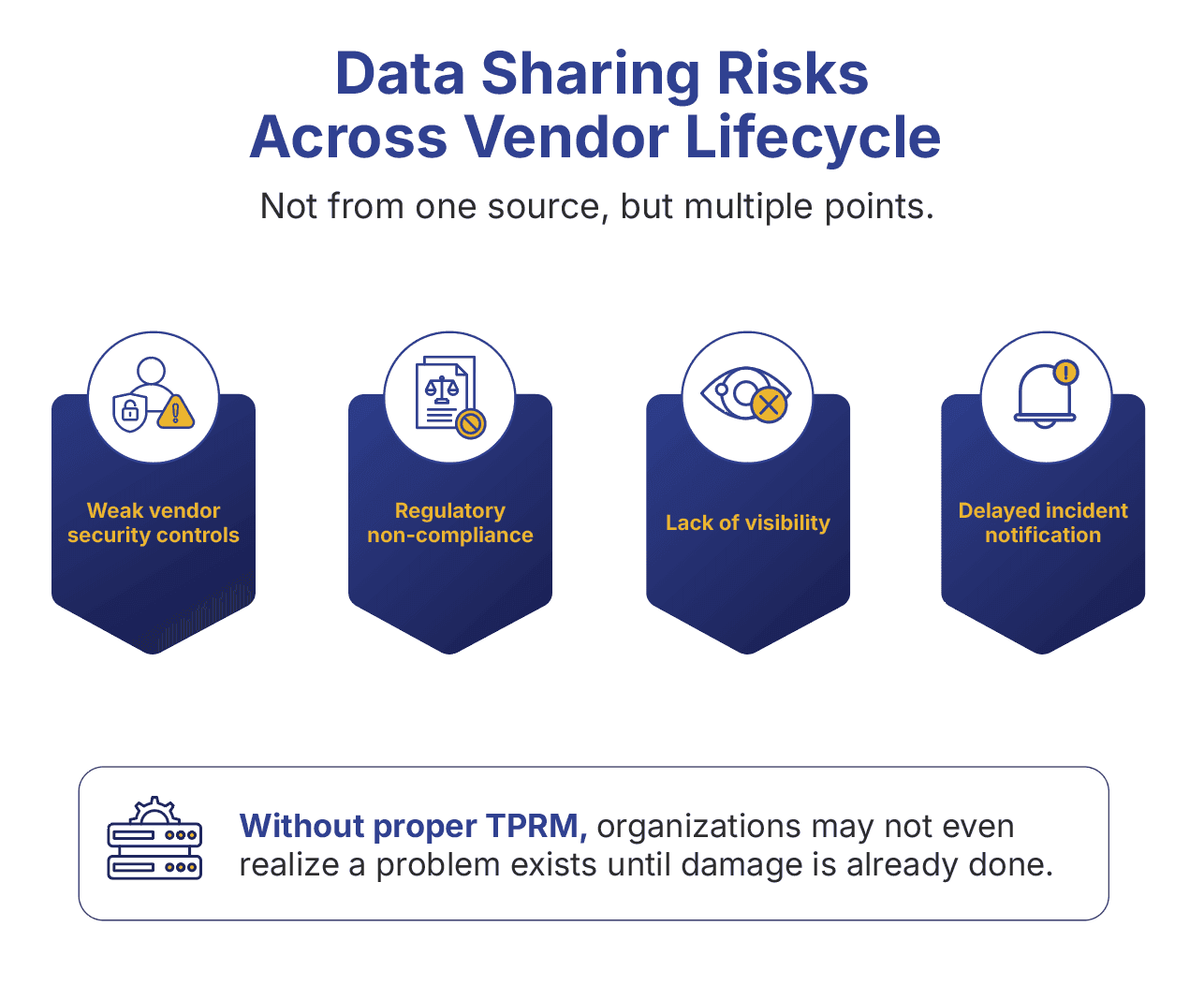
The moment data leaves your systems, visibility starts reducing.
Vendors may:
- Store data across multiple geographies
- Use subcontractors without full transparency
- Retain information longer than expected
- Introduce AI tools into processing workflows
- Operate with weaker internal controls than your organization
Even highly trusted vendors can unintentionally become major exposure points when governance is fragmented.
This becomes especially dangerous in large enterprises where hundreds of vendors interact with customer data simultaneously across legal, procurement, IT, operations, and security teams.
Common Types of Data Shared With Vendors
Organizations often underestimate the scale of sensitive information flowing to third parties. Common categories include:
- Customer personal data
- Financial and payment information
- Employee payroll and HR records
- Authentication credentials and access tokens
- Internal business intelligence
- AI training and analytics datasets
- Consent and communication records
The higher the sensitivity of the data, the greater the need for structured vendor oversight and continuous third-party risk assessment.
The Biggest Blind Spot in Vendor Risk Management
Most organizations perform vendor assessments during onboarding and then rarely revisit them.
This creates significant blind spots because vendor environments evolve constantly:
- Access privileges expand over time
- New tools and APIs are introduced
- Security postures change
- Sub-processors are added silently
- AI models start processing enterprise data
As a result, the original risk assessment quickly becomes outdated.
This is why modern Third-Party Risk Management is shifting from annual reviews to continuous governance models that monitor vendors throughout the relationship lifecycle.
Third-Party Incidents vs Third-Party Breaches: Understanding the Difference
What Is a Third-Party Incident?
A third-party incident is any event at a vendor that could impact the confidentiality, integrity, or availability of your data, even if exposure is not confirmed. Examples include:
- Vendor system outages are affecting data access
- Misconfigurations exposing internal systems
- Suspicious access activity under investigation
Not every incident becomes a breach, but every breach starts as an incident.
What Is a Third-Party Data Breach?
A third-party breach occurs when vendor-held data is confirmed to be accessed, disclosed, or compromised without authorization. These events typically trigger:
- Regulatory reporting obligations
- Contractual escalation requirements
- Customer notifications
- Legal and reputational exposure
This distinction matters because organizations need structured assessment workflows before escalating incidents into reportable breaches.
Our blog on Privacy Incident Management explains how mature organizations investigate incidents carefully before determining legal breach obligations.
Why Traditional Vendor Risk Programs Fail
Most vendor risk programs struggle because risk data remains fragmented across departments.
Legal teams manage contracts.
Procurement manages onboarding.
Security teams manage access reviews.
Privacy teams track compliance obligations.
But no single team has complete visibility into:
- Which vendors access what data
- How sensitive is the shared data
- Whether controls remain effective over time
- Which vendors introduce downstream dependencies
This fragmentation creates reactive governance instead of proactive oversight.
Organizations trying to mature their privacy posture often encounter similar challenges internally as well. Our blog on Privacy Maturity in India explores how leading enterprises are moving from siloed compliance toward system-level governance models.
AI Vendors Are Expanding Third-Party Risk
AI adoption is introducing a completely new layer of vendor complexity.
Organizations now need to evaluate:
- How vendor AI models are trained
- Whether enterprise data is retained
- If outputs can be audited or explained
- Whether customer data enters external models
- How AI-driven decisions impact individuals
Traditional vendor questionnaires are no longer sufficient for these risks.
Modern TPRM frameworks increasingly require:
- AI-specific due diligence
- Ongoing monitoring
- Contractual accountability clauses
- Data lineage visibility
- Strong governance around training datasets
This is becoming especially relevant under DPDP-era accountability expectations, where organizations remain responsible even when processing is outsourced.
What Strong Third-Party Risk Management Looks Like
Mature TPRM programs typically focus on four core areas:
1. Risk-Based Vendor Classification
Not all vendors carry equal risk. Vendors handling sensitive customer or employee data require deeper scrutiny and monitoring.
2. Continuous Monitoring
Risk assessments should evolve continuously based on access changes, incidents, and operational behavior.
3. Clear Data Governance Controls
Organizations need visibility into:
- Data flows
- Retention periods
- Cross-border transfers
- Access permissions
- Processor relationships
4. Defined Incident Response Processes
Vendors should have clear contractual obligations around:
- Incident escalation
- Breach reporting timelines
- Audit cooperation
- Data deletion and exit protocols
If you're building broader privacy governance workflows, our blog on The Role of Grievance Officers Under DPDP also explores operational accountability structures enterprises now need under India's evolving privacy regime.
How Privy by IDfy Helps Strengthen Third-Party Risk Management
Privy approaches third-party risk management with a data-first mindset. By helping organizations:
- Map data flows to vendors
- Assess risk based on actual data exposure
- Centralize vendor risk insights
- Support continuous monitoring and governance
Privy enables organizations to move beyond static assessments toward living TPRM programs that reflect real-world data use. Vendor ecosystems grow over time, new tools are added, data sharing increases, and regulations evolve. Privy helps organizations stay at par with all these evolutions.
Organizations that treat TPRM as a one-time exercise inevitably fall behind. Those who build it as a capability stay resilient. Effective third-party risk management ensures that data sharing supports growth without introducing hidden risk.
Conclusion
Vendor relationships are essential for modern business growth, but they also expand the enterprise risk surface significantly.
Without strong Third-Party Risk Management, organizations lose visibility into how sensitive information is processed, shared, retained, and protected outside their environment.
The organizations that succeed in 2026 will not be the ones with the longest vendor questionnaires. They will be the ones with continuous visibility, operational governance, and structured oversight across the full vendor lifecycle.
If your organization is reassessing how it manages vendor-related data risks, reach out to us at shivani@idfy.com to learn how Privy by IDfy can support scalable, data-driven TPRM and continuous vendor governance.
FAQs
Why is Third-Party Risk Management becoming more important now?
Organizations increasingly rely on cloud vendors, SaaS providers, AI platforms, and outsourcing partners. As more sensitive data moves outside enterprise boundaries, vendor-related privacy and security risks have become harder to monitor using traditional approaches.
What is the difference between TPRM and vendor risk management?
Vendor risk management is often used broadly to assess operational or financial vendor risks. Third-Party Risk Management (TPRM) is a more structured and continuous governance approach that includes privacy, cybersecurity, compliance, access control, and operational oversight across the vendor lifecycle.
Why are annual vendor assessments no longer enough?
Vendor environments change constantly. Access permissions evolve, subcontractors get added, AI tools are introduced, and security postures shift over time. Annual reviews create blind spots because they fail to reflect real-time operational risk.
How do AI vendors change third-party risk exposure?
AI vendors may process sensitive enterprise data, use external training datasets, or generate outputs that are difficult to audit. This creates new governance challenges around transparency, accountability, data retention, and regulatory compliance.
What should organizations prioritize first in a mature TPRM program?
The most important starting point is visibility:
- Understanding which vendors access sensitive data
- Mapping data flows
- Classifying vendor risk based on actual exposure
- Establishing continuous monitoring instead of periodic reviews

Modern vendor risks don’t end at onboarding. Learn how continuous Third-Party Risk Management (TPRM) and smarter third-party risk assessment help organizations manage vendor, access, compliance, and AI risks at scale.

Learn how to build a privacy-first TPRM program. Understand third-party risk assessment, vendor risk management best practices, and how to reduce privacy risk at scale.
-1.jpg&w=3840&q=75)
Learn what Third-Party Risk Management (TPRM) is, why it matters for modern organizations, key third-party risks, and how Privy helps solve TPRM challenges through governance- and consent-driven controls.