

Third-Party Risk Management (TPRM): What It Is, Why It Matters, and How Organizations Can Get It Right
Date Published
Modern businesses don’t operate in isolation. From cloud providers and payment gateways to analytics vendors and customer support partners, organizations increasingly rely on third parties to deliver products and services at scale. While these partnerships unlock speed and innovation, they also introduce significant risk. This is where Third-Party Risk Management (TPRM) becomes critical.
Understanding what third-party risk management is and how to implement it effectively is no longer optional. Regulators, customers, and boards expect organizations to know who their third parties are, what data they access, and how risks are identified and mitigated across the vendor lifecycle.
-2.jpg&w=3840&q=75)
In this blog, we break down what TPRM is, why it matters, the key risks involved, and how organizations can build a sustainable Third-Party Risk Management program, along with understanding how Privy by IDfy approaches TPRM through a governance and consent-first lens.
What Is Third-Party Risk Management?
To put it simply, Third-Party Risk Management is the process of identifying, assessing, monitoring, and mitigating risks that arise from relationships with external vendors, suppliers, and partners.
If you’ve ever wondered what third-party risk management is, the answer lies in accountability. Even if a third party causes a data breach, compliance failure, or operational disruption, regulators and customers will still hold your organization responsible.
TPRM ensures that organizations:
- Understand which third parties they work with
- Know what data or systems those third parties can access
- Assess risks before and after onboarding
- Continuously monitor third-party behavior over time
Why Third-Party Risk Management Is More Important Than Ever
The growing importance of Third-Party Risk Management is driven by three major trends.
1 . Expanding Third-Party Ecosystems
Organizations now work with dozens, sometimes hundreds, of vendors across IT, HR, finance, marketing, and operations. Each relationship expands the attack surface and risk exposure.
2 . Increased Regulatory Scrutiny
Privacy and security regulations increasingly emphasize vendor accountability. Laws such as GDPR, DPDPA, HIPAA, and sectoral regulations require organizations to ensure that third parties process data lawfully and securely.
3 . High-Impact Vendor Failures
Some of the largest data breaches in recent years originated not from internal systems, but from third-party vendors. These incidents highlight why TPRM must be proactive, not reactive.
The Core Risks Addressed by TPRM
Understanding what TPRM is requires understanding the types of risks it is designed to manage. These risks include:
- Data Privacy Risk
Third parties often handle personal or sensitive data. Without proper controls, this data can be misused, over-retained, or exposed, leading to regulatory violations.
- Security Risk
Vendors may have weaker security postures than your organization. A single vulnerable integration can become an entry point for attackers.
- Compliance Risk
Third parties may fail to comply with applicable laws, contractual obligations, or sectoral regulations, creating downstream liability for your organization.
- Operational and Reputational Risk
If a critical vendor goes offline, behaves unethically, or is involved in a public incident, your business operations and brand reputation may suffer.
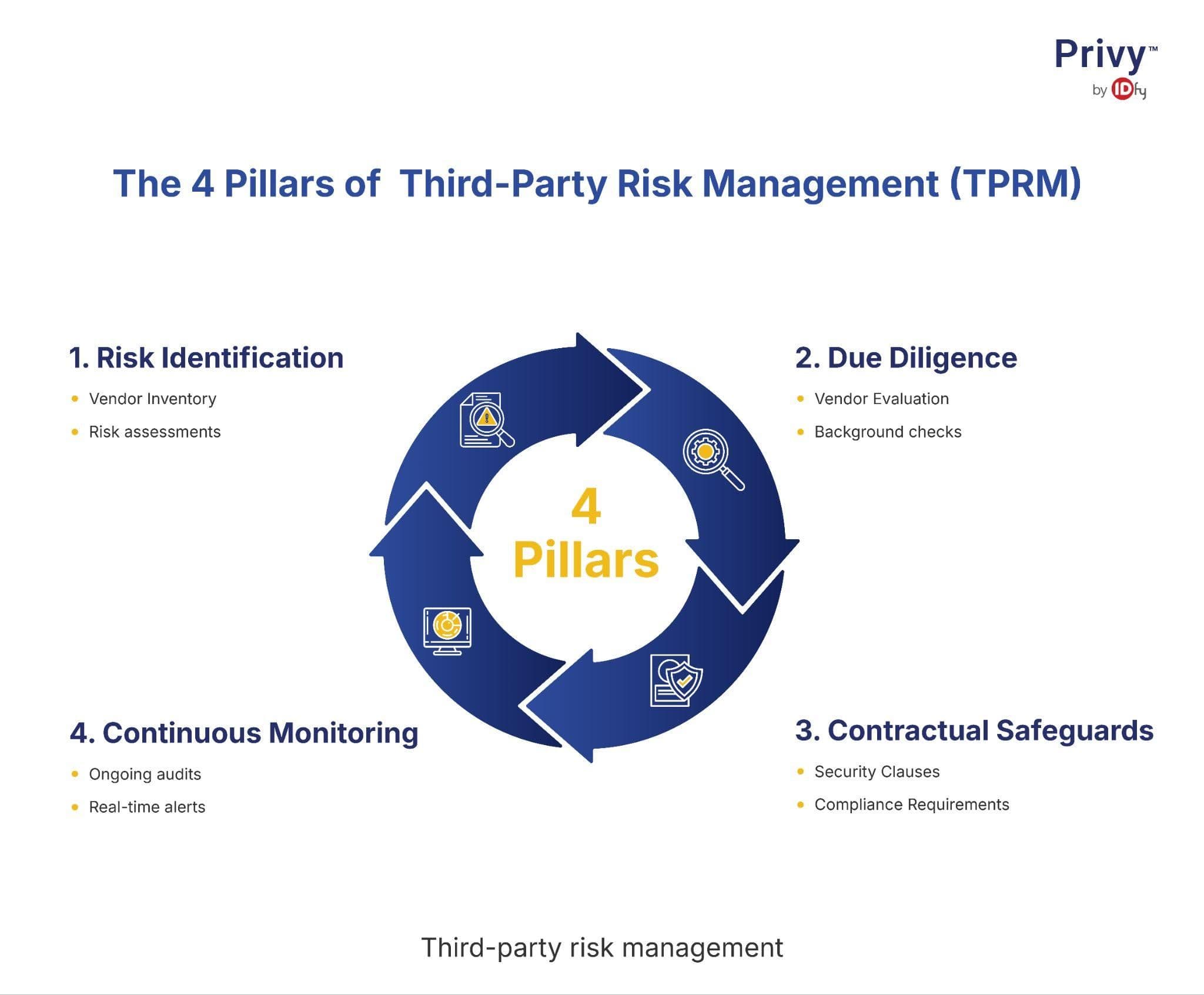
Key Stages of an Effective Third-Party Risk Management Program
A mature Third-Party Risk Management framework typically spans the entire vendor lifecycle.
1 . Risk Identification and Vendor Inventory
Organizations must first know who their third parties are. This includes creating and maintaining a centralized inventory of vendors, along with details about:
- Services provided
- Data accessed
- Criticality to business operations
Without visibility, TPRM efforts are fundamentally incomplete.
2 . Due Diligence and Risk Assessment
Before onboarding a vendor, organizations should assess:
- Data protection practices
- Security controls
- Compliance maturity
- Financial and operational stability
This step answers a critical question: Is this third party safe to work with?
3 . Contractual Safeguards
Contracts play a key role in Third-Party Risk Management. They should clearly define:
- Data usage limitations
- Security obligations
- Audit rights
- Breach notification requirements
4 . Continuous Monitoring
Risks don’t end after onboarding. TPRM requires ongoing monitoring to ensure third parties continue to meet expectations as their operations, scope, or regulations change.
Common Challenges in Third-Party Risk Management
Despite best intentions, many organizations struggle to operationalize TPRM effectively.
1 . Fragmented Ownership
Third-party relationships are often managed by different teams, including procurement, IT, legal, and compliance, leading to inconsistent risk practices.
2 . Manual and Point-in-Time Assessments
Many organizations rely on one-time questionnaires that quickly become outdated. This approach fails to capture evolving risks.
3 . Lack of Data and Consent Visibility
Organizations often don’t know exactly what personal data is being shared with which third party, and under what consent or legal basis.
4 . Audit and Evidence Gaps
When regulators or auditors ask for proof of third-party compliance, organizations struggle to produce defensible records.
The Role of Governance in TPRM
At its core, Third-Party Risk Management is a governance problem.
Strong governance ensures that:
- Third-party risks are assessed consistently
- Responsibilities are clearly defined
- Controls are enforced across the organization
- Evidence is available when needed
This is why TPRM cannot function in isolation; it must be integrated with broader data governance, consent management, and compliance processes.
How Privy by IDfy Addresses Third-Party Risk Management Challenges
At Privy, we approach TPRM from a consent- and governance-first perspective. Instead of treating third-party risk as a standalone checklist, Privy embeds it directly into how organizations manage data, consent, and processing purposes.
Privy’s Governance-Driven Approach to TPRM
1 . Centralized Third-Party Visibility
Privy enables organizations to maintain a structured view of all third parties involved in data processing. Each third party is mapped to:
- Specific processing purposes
- Data attributes shared
- Applicable consent and legal basis
This visibility forms the foundation of effective Third-Party Risk Management.
2 . Purpose and Consent Aware Risk Management
One of the biggest gaps in traditional TPRM programs is the disconnect between vendors and consent. Privy closes this gap by ensuring that third-party access to data is always tied to:
- Explicit processing purposes
- User consent or lawful justification
If consent is withdrawn or a purpose changes, Privy ensures downstream third-party usage is governed accordingly.
3 . Strengthening Compliance and Accountability with Privy
Privy helps organizations operationalize third-party risk management in a way that is defensible and audit-ready.
Key capabilities include:
- Mapping third parties to Records of Processing Activities (RoPA)
- Maintaining versioned audit trails of third-party access
- Enforcing policy-based controls across vendor relationships
- Supporting regulatory audits with clear evidence
This turns TPRM from a reactive compliance exercise into a proactive governance capability.
Reducing Third-Party Risk Without Slowing the Business
A common concern with Third-Party Risk Management is that it slows down vendor onboarding and innovation. Privy addresses this by:
- Standardizing governance workflows
- Automating consent and purpose checks
- Reducing manual back-and-forth between teams
The result is faster onboarding with stronger controls without compromising compliance.
Why Third-Party Risk Management Is a Long-Term Strategy
Understanding TPRM is only the first step. Long-term success depends on embedding Third-Party Risk Management into everyday operations, decision-making, and data governance practices.
Organizations that treat TPRM as a living program, not a one-time task, are better positioned to adapt to regulatory changes, scale vendor ecosystems safely, and build trust with customers and regulators
Conclusion
As organizations become more interconnected, Third-Party Risk Management is no longer optional; it is foundational. Knowing what third-party risk management is and implementing it effectively can mean the difference between controlled growth and uncontrolled exposure.
Privy by IDfy helps organizations reimagine TPRM through governance, consent, and accountability, ensuring that third-party relationships remain enablers of growth, not sources of risk.
Write to us at shivani@idfy.com to explore how Privy can help you strengthen Third-Party Risk Management and bring greater visibility, governance, and control across your vendor ecosystem.

Modern vendor risks don’t end at onboarding. Learn how continuous Third-Party Risk Management (TPRM) and smarter third-party risk assessment help organizations manage vendor, access, compliance, and AI risks at scale.

Learn how data sharing with vendors creates risk, what third-party risk management (TPRM) involves, and how organizations can reduce vendor risk responsibly.

Learn how to build a privacy-first TPRM program. Understand third-party risk assessment, vendor risk management best practices, and how to reduce privacy risk at scale.