

DPDP for Board: A Leadership Framework
Date Published

Most Indian enterprises have done the obvious things. Privacy policies have been updated. Legal teams have been briefed. Some organisations have appointed a Data Protection Officer. A few have reviewed their consent flows. On paper, the boxes appear to be ticked.
But here is the question boards should be asking: Will this hold when tested at scale?
Will it hold when a regulator asks for evidence? When a large enterprise customer makes a data privacy framework a condition of contract? When a breach occurs, and the organisation must notify the right parties, within the right timeframe, with the right records? When a Data Principal exercises the right to erasure and that request routes through six systems owned by four teams with no clear workflow?
The Digital Personal Data Protection Act is not a documentation exercise. It is an operational commitment. And in 2025, it has formally moved from the legal team's task list to the board agenda - not because DPDP penalties are large, but because the execution gap between intent and infrastructure is now a measurable business risk.
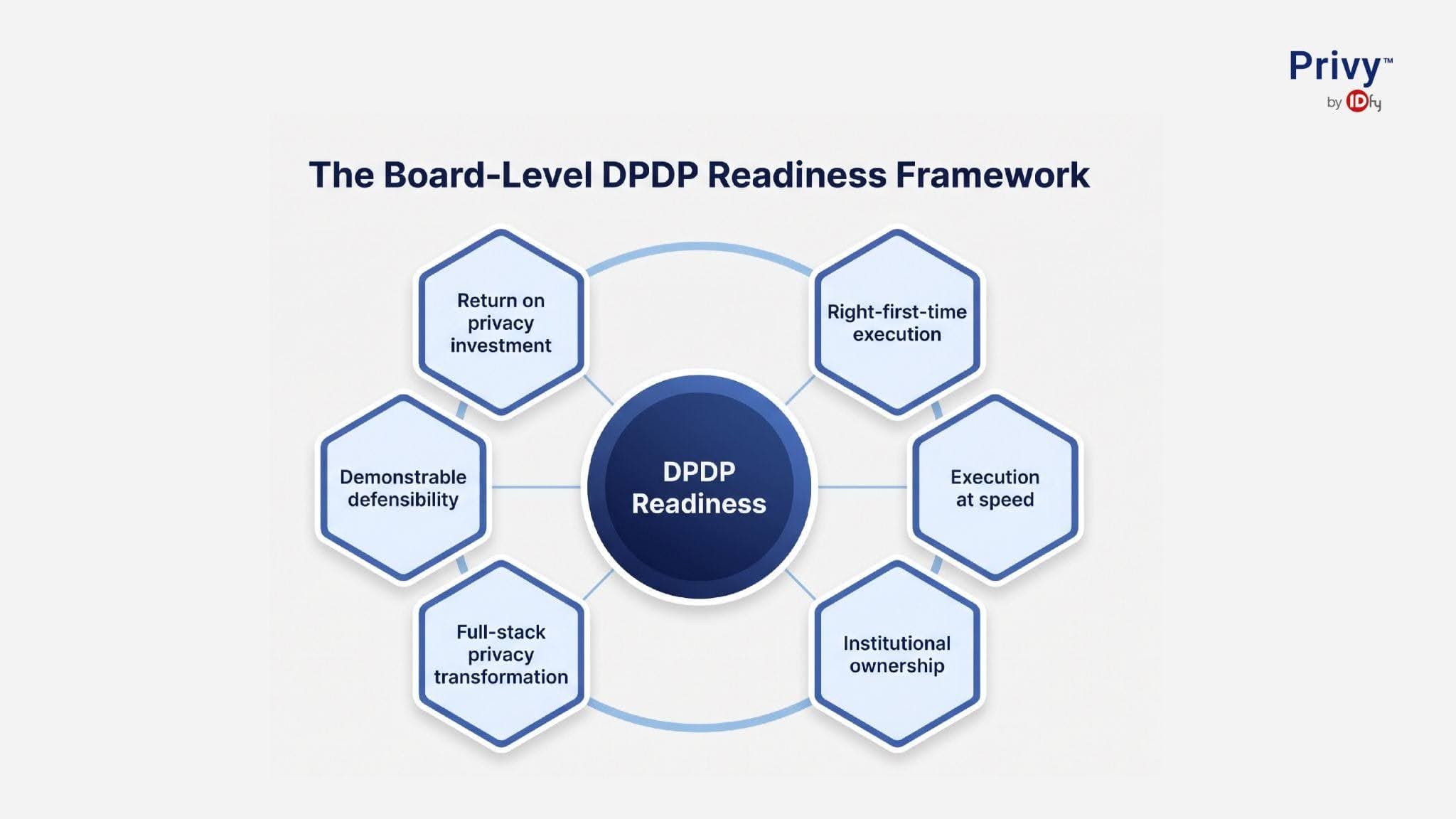
This article presents a board-level privacy governance framework across six dimensions: full-stack privacy transformation, right-first-time execution, speed without rework, institutional ownership, demonstrable defensibility, and return on privacy investment. Each dimension reflects what boards should be governing, not just what compliance teams should be managing.
Why DPDP Has Moved From Legal Readiness to Board Accountability
Many organizations are still treating DPDP in one of two ways: as a compliance cost centre, or as a deadline-driven project that can begin closer to enforcement. Both approaches miss the real issue.
DPDP is not only about what an organization documents. It is about what leadership can prove, govern, and sustain across the business. When DPDP readiness is delayed until the end of the compliance window, organizations lose the time needed to build connected systems, assign clear ownership, test workflows, and create evidence that will hold up under scrutiny.
There is a familiar pattern across Indian enterprises preparing for DPDP. Legal teams interpret the law. Compliance teams manage documentation. IT responds to implementation requests. Marketing owns consent touchpoints. Procurement handles vendor contracts. Customer service may receive rights requests. Each function may be doing its job, but the organization still lacks one connected thread of accountability.
That is where DPDP becomes a board issue.
The Act requires personal data to be governed consistently across collection, consent, use, sharing, retention, vendor access, breach response, and Data Principal rights. These obligations cannot be executed through isolated team-level actions. They require enterprise-wide ownership, clear decision rights, operational workflows, and evidence-grade reporting.
Policy updates can create the appearance of readiness. But they cannot prove that consent was collected for a specific purpose, that data was not retained beyond that purpose, that a vendor had adequate safeguards, or that a Data Principal's request for erasure was fulfilled completely and verifiably.
This is why boards need to challenge DPDP plans that are built only around minimum DPDP compliance guidelines or last-mile implementation. The question is not whether the organization has started preparing. The question is whether it has built the privacy governance infrastructure to execute DPDP at scale, across every system, function, vendor, and customer touchpoint.
DPDP readiness is no longer a legal update to be reviewed periodically. It is a leadership accountability framework that boards must actively oversee.
1. Right-First-Time Execution
The foundational question is not how quickly an organisation can claim DPDP readiness. It is whether the readiness being built will actually work when pressure is applied - at regulatory scrutiny, at the scale of live operations, and across the full complexity of a real enterprise.
Sequence It Right
Sequencing is where most programmes go wrong. Organisations that begin with consent banners before mapping their data flows are building without foundations. The correct order is: understand what data exists and where it flows, then design the consent architecture around that reality. Attempting to layer consent onto unknown data flows produces a consent framework that is technically present but substantively disconnected.
Expert-led scoping at the outset avoids the expensive discovery-by-accident pattern. Organisations that invest in a rigorous initial assessment - covering data flows, system inventory, vendor ecosystem, and processing activities - build a programme grounded in their actual operating reality, not a generalised template. This is the starting point of any credible DPDP transformation roadmap.
Quick wins matter for momentum. Early, visible progress on discrete obligations - cookie consent deployment, vendor contract review - creates organisational confidence that the programme is moving and builds the muscle memory of cross-functional execution.
Design It Right: Privacy by Design
Privacy by design is not a slogan. It is an architectural commitment. It means that when a new product is built, a new data pipeline is created, or a new vendor is onboarded, privacy requirements are embedded at the design stage - not retrofitted after launch. This requires that the DPIA process be triggered at project initiation, not at project completion.
Designing for reality, not for a controlled pilot, is essential. A pilot that runs on one product and one dataset teaches the organisation something. It becomes a liability when the pilot's architecture defines the enterprise implementation. Enterprise privacy governance runs across multiple products, multiple data types, multiple geographies, and multiple vendor relationships simultaneously. The architecture must be designed for that reality.
Accuracy and precision in implementation matter because imprecision creates risk. A consent record that does not capture which version of the notice the individual saw is not accurate. A Data Principal Rights workflow that fulfils the access request but fails to locate data in one legacy system is not a complete fulfilment. The standard is not approximate - it is verifiable. This is the core of privacy-first design.
Execution Assurance
Operational discipline means defined processes are followed consistently, accurately, and with precision. Policies that are documented but not operationalised are not policies. A data retention schedule that is not enforced at the system level is only a statement of intent.
Execution assurance requires that the programme is monitored, deviations are identified, evidence is recorded correctly, and corrective action is taken systematically. This is what makes DPDP readiness verifiable, not just documented. It is the foundation of information security compliance in practice.
Scalable by Design
Automation is what makes privacy governance scalable. Manual consent management, manual rights request routing, and manual vendor assessments are expensive, inconsistent, and impossible to scale. Organisations that build automation into their privacy infrastructure from the outset - rather than adding it later - create operating leverage that grows with the business rather than constraining it. This is what a mature DPDP automation platform delivers.
Rapid iteration and replication mean that what works in one part of the business can be applied across the enterprise without rebuilding from scratch. Organisations that treat DPDP implementation as a bespoke exercise for each business unit lose the efficiency of a common framework. A standardised but configurable approach allows each function to be compliant within a shared architecture.
Scaling to the organisation's full size and complexity - across geographies, products, digital channels, and vendor relationships - is the ultimate test of whether the design is right. If the architecture cannot absorb a new acquisition, a new product launch, or a new regulatory requirement without a significant rebuild, the design is not yet right.
Board-Level Questions
- Have we mapped our actual data flows before designing our consent and rights architecture?
- Is our DPDP programme designed to operate at enterprise scale, or is a pilot being incrementally extended?
- Where have we made architectural shortcuts that will require expensive rework as the regulatory framework matures?
- Is the DPIA process embedded at the beginning of product development, or is it appended at the end?
2. Execution at Warp Speed - Without Creating Future Rework
Boards are right to ask for speed. Moving slowly on DPDP accumulates both regulatory exposure and the compounding cost of retrofitting privacy governance into systems that have already embedded non-compliant behaviours. But speed without structure produces point solutions and fragmented implementations that become liabilities. The cost of ignoring DPDP compounds with every month of delay.
Immediate Momentum
Immediate momentum requires three things at the outset: clearly defined milestones that translate the abstract programme into concrete, time-bound deliverables; a rapid baseline of the current compliance posture and risk exposure that establishes where the organisation actually stands rather than where it assumes it stands; and a leadership-aligned execution start that means functional owners know their responsibilities and are resourced to meet them.
The baseline is non-negotiable. Organisations that begin implementation without understanding their starting point - which data flows exist, which consent mechanisms are active, which vendors have access to personal data, which rights workflows are operational - are building on assumptions. The cost of those assumptions becomes visible at the first regulatory interaction or the first complex rights request. Establishing this baseline is the first step of any serious DPDP readiness checklist.
Compressed Execution Cycles
Compressed execution cycles break what would otherwise be a multi-year waterfall programme into ninety-day delivery cycles. Each cycle produces something that works - not something that is planned. In the first cycle: data discovery initiated, consent architecture designed, vendor inventory completed. In the second: consent deployed, rights workflows operational, high-priority vendor assessments completed. The organisation makes demonstrable progress on a schedule that compresses time to readiness without sacrificing quality.
Catch-up is achievable, but only through genuine parallelism. Organisations that run consent governance, data discovery, vendor risk management, and rights management as sequential workstreams will not catch up. These workstreams must run simultaneously, with defined handoffs and shared data infrastructure.
Short sprints and rapid iterations mean that each cycle ends with a review: what was built, does it work, what needs to change, what is next? This review discipline prevents the programme from drifting - either by expanding scope beyond what can be executed or by narrowing scope so much that obligations go unaddressed.
Continuous Visibility and Recalibration
Readiness is not a state that is achieved and then maintained passively. As systems change, new vendors are onboarded, new products launch, and new data flows emerge, the privacy posture changes. Continuous visibility - through monitoring, dashboards, and regular management reporting - means the organisation knows its current posture at any point, not just at the last audit. This is the operating principle of the privacy control tower model.
Recalibration is permanent. Organisations that embed recalibration into their operating rhythm - treating it as a continuous operational function rather than a periodic audit exercise - sustain DPDP readiness continuously rather than scrambling before a regulatory interaction or a customer due diligence exercise.
Board-Level Questions
- Do we have a factual baseline of our current privacy posture, established through evidence rather than self-assessment?
- Are our DPDP workstreams running in genuine parallel, or is sequencing slowing us down?
- What are our defined milestones for the next 90 days, and who is accountable for each?
.png&w=3840&q=75)
To learn more about Board-level accountability in the DPDP era, watch the full webinar here.
3. Institutional Ownership - Making Privacy Everyone's Accountability
One of the most consistent gaps in enterprise DPDP programmes is the absence of clear ownership below the DPO level. The DPO coordinates the programme. But who owns the consent flow for the mobile app? Who owns the data inventory for the CRM? Who owns the vendor assessment for the analytics platform? Who owns the rights workflow when a request arrives outside business hours, and how is it coordinated or escalated?
When these questions have no clear answers, the organisation has awareness of its obligations but not institutional accountability for executing them.
Executive Accountability - A Named Owner for Every Risk
Leadership sponsorship at the executive level is the precondition for everything else. Without a C-suite owner who is visibly committed to the programme, DPDP implementation becomes a compliance team exercise that struggles to secure cross-functional cooperation, budget, and prioritisation against competing operational demands.
The organisation's responsibility structure - which function owns which privacy obligation, who reports to whom, and how escalations reach the board - needs to be documented and understood across the enterprise. Ambiguity in this structure produces inconsistent decisions, missed obligations, and accountability gaps that are only discovered when something goes wrong. Defining privacy governance roles clearly is not optional - it is foundational.
Enterprise Alignment
Cross-functional governance creates the connective tissue. A privacy governance committee - with representation from legal, technology, risk, operations, and business units - meets regularly to resolve cross-functional decisions, review emerging obligations, and escalate material risks to the board. Without this committee, DPDP decisions that require cross-functional input are deferred, decided informally, or not made at all.
Decision rights and RACI need to be explicit. Who decides whether a new data use requires fresh consent? Who approves a vendor being granted access to personal data? Who signs off on a DPIA before a product goes live? These decisions happen constantly in a live enterprise. Undefined decision rights produce inconsistent outcomes and create gaps that regulatory investigations are well-equipped to identify.
Workforce capability and skills matter. The DPO cannot be the only person in the organisation who understands privacy obligations. Business unit owners, product managers, technology teams, and customer-facing functions all need enough literacy to identify privacy-relevant decisions when they arise - and to escalate rather than improvise. This is the privacy office India mandate in practice.
Board Level Oversight
Individual KPIs and performance monitoring make privacy ownership visible. Boards should expect to see metrics: consent capture rates by channel, Data Principal Rights request volumes and fulfilment timeframes, vendor assessment coverage percentages, DPIA completion rates for new products, and incident detection and response times. If the board is not seeing these numbers, it is not governing DPDP governance - it is trusting that someone else is.
Governance and Assurance Charters establish the formal structure through which the board exercises its privacy oversight responsibility. This includes the terms of reference for the privacy governance committee, the reporting cadence and format for board-level privacy reporting, and the escalation protocols for material privacy risks and incidents. Together, these form the privacy control tower model that boards need.
Board-Level Questions
- Is there a named C-suite owner for DPDP readiness, and how does that accountability connect to the board?
- Do we have documented decision rights for privacy-relevant decisions across the enterprise?
- Does our cross-functional governance committee have the authority and cadence to resolve material privacy decisions promptly?
- What privacy KPIs does management report to the board, and do they reflect actual operational readiness?
4. Full-Stack Privacy Transformation - Beyond Consent Management
Many organisations have deployed a consent management tool and consider themselves substantially prepared. Consent management is necessary. It is not sufficient. DPDP creates obligations across the entire data lifecycle - from the design of collection to the execution of deletion - and across every dimension of how personal data is used, shared, and protected.
Responsible Data Collection
Transparent notices are the starting point. A notice that is technically accurate but practically incomprehensible fails the transparency standard. Notices need to be specific about what data is collected, for what purpose, for how long, and with whom it is shared - and they need to be presented in a way that a reasonable person can understand before giving consent.
Purposeful consent interactions mean that consent is specific to each processing purpose. Bundled consent - a single checkbox that covers multiple unrelated processing activities - fails the purposefulness standard. Each material processing purpose requires its own consent. Organisations that have not reviewed their consent architecture against this standard may find that their existing consent records are not valid under DPDP. This is one of the core DPDP compliance steps organisations must address.
Unbundled consent across the lifecycle means that when a new processing purpose arises after the initial consent, fresh consent is obtained for that specific purpose. It also means that records of each consent transaction - the version of the notice the individual saw, the timestamp, the specific purposes consented to - are maintained with the precision that a regulatory audit would require.
Governed Data Lifecycle
Discovery and governance are the foundation. Organisations cannot consent to data they do not know they collect. They cannot govern data they cannot locate. A comprehensive data discovery exercise - covering structured databases, unstructured repositories, cloud environments, analytics platforms, and vendor systems - is the prerequisite for every other element of full-stack privacy execution. Without it, every downstream decision is made on assumptions. This is why data discovery sits at the top of every DPDP readiness checklist.
Responsible AI and data use is an emerging and rapidly material obligation. As enterprises deploy AI for credit decisions, customer segmentation, fraud detection, and product personalisation, the personal data used to train, evaluate, and operate those models carries full DPDP obligations. Boards approving AI initiatives without asking about the data security governance of those initiatives are approving an unexamined category of privacy risk.
Retention and minimisation require that data is held only for as long as the purpose requires - and deleted when that purpose expires. This is not a documentation requirement. It is an operational requirement. Retention schedules need to be technically enforced at the system level and verified periodically. Data that is retained beyond its stated purpose is a regulatory liability and an unnecessary cost.
Privacy-enhancing techniques - masking, encryption, pseudonymisation, tokenisation, and differential privacy - reduce the surface area of risk. These are not theoretical tools. They are practical measures that should be embedded into data pipelines, analytics environments, and vendor data sharing arrangements as a matter of standard architecture.
Enabling Data Principal Rights as a systemic capability - not just a form on a website - means that the infrastructure to fulfil rights requests across all relevant data systems is built, tested, and operational before a request arrives.
Rights and Controls Infrastructure
A privacy-embedded operating model means that privacy is not a layer added on top of existing processes - it is built into how the organisation operates. New product development has DPIA requirements. New vendor onboarding has data protection assessment requirements. New data uses have consent review requirements. These requirements run automatically in the operating model, not as manual interventions after the fact. This is privacy by design in its operational form.
Vendor accountability requires that every vendor who processes personal data on behalf of the organisation has been assessed, has a data processing agreement in place, and is managed through an ongoing governance process. A Data Accountability Score framework - rating vendors on their data protection posture - enables prioritised assessment effort and creates a consistent standard for vendor selection and management. This is vendor risk management operationalised.
Third-party risk and governance extend beyond direct vendors to the full ecosystem of data sharing arrangements: analytics platforms, advertising technology, cloud infrastructure providers, payment processors, and data brokers. Each of these relationships creates privacy obligations that need to be governed, not assumed.
Cross-regulatory implications matter particularly for financial services, healthcare, telecom, and e-commerce enterprises where DPDP sits alongside RBI, SEBI, IRDAI, and TRAI requirements. A data privacy framework that addresses only DPDP may be compliant with the Act, but non-compliant with the sector. Impact assessments - DPIAs - need to consider this layered regulatory environment. For DPDP compliance banking and DPDP compliance for fintech organisations, especially, this cross-regulatory layer is not optional.
Continuous Compliance Loop
The continuous compliance loop is the operating mechanism that ties it all together. Remediation and change management ensure that when gaps are identified - through monitoring, audit, regulatory guidance, or incident - they are addressed systematically and the resolution is documented. The loop runs continuously: collect, consent, classify, govern, respond, remediate, recalibrate. Organisations that design this loop into their operating model sustain DPDP readiness. Those that treat it as a project deliver a point-in-time snapshot.
Board-Level Questions
- Is our consent management connected to actual data use, or does it operate as a standalone front-end layer?
- Have we completed data discovery across all systems, including cloud, analytics, and vendor environments?
- Are our AI initiatives subject to privacy impact assessment and data governance oversight?
- Are retention schedules technically enforced, or are they documented policies that are not operationalised?
- Does our vendor governance cover the full data sharing ecosystem, not just first-tier direct vendors?
5. Minimising Risk, Demonstrable Defensibility
Risk reduction is necessary. Defensibility is the higher standard. An organisation that has genuinely reduced its privacy risk but cannot demonstrate how - cannot produce the records, the artefacts, the audit trails - is not in a materially better position when facing a regulatory investigation than one that has done little. The burden of demonstrating compliance requires evidence, not assertion.
Risk Modelling and Mitigation
Boards should expect privacy risk to be modelled across multiple dimensions - not just breach scenarios. This includes consent compliance risk, where personal data may be used without valid, traceable, and provable consent; DPR fulfilment risk, where requests may be delayed, partially fulfilled, or incorrectly executed; third-party risk, where vendors process personal data without adequate controls; PII exposure risk, where personal data is not fully identified, tracked, or protected; cross-border data flow India risk, where data flows without validated approvals or transfer mechanisms; and AI data risk, where personal data in AI systems lacks sufficient control, transparency, or protection.
Regulatory and allied risk extends to sectoral regulators and international partners. Organisations with cross-border data flow, India arrangements, international business relationships, or regulated sector operations carry privacy risk across multiple regulatory frameworks simultaneously. Data transfer compliance with India requirements adds another layer of obligation that must be addressed alongside DPDP.
Insurance alignment is an emerging dimension. As cyber and privacy insurance products evolve, the underwriting criteria increasingly reflect the quality of an organisation's privacy controls. Demonstrable DPDP readiness - with evidence-grade documentation - may become a factor in insurance cost and coverage.
Evidence-Grade Compliance
Demonstrable compliance artefacts are the foundation of defensibility. This means maintaining consent records at the individual level, with timestamps, version history, and purpose specificity. It means maintaining DPIA documentation for every high-risk processing activity. It means maintaining audit logs of Data Principal Rights requests and their fulfilment - including any requests that were refused, and why.
Audit readiness means that these records are organised, accessible, and current - not assembled under pressure after a regulatory interaction is announced. Organisations that maintain audit-ready evidence as a continuous operational output rather than a reactive exercise are in a fundamentally better position when scrutiny arrives.
Incident and Regulatory Response
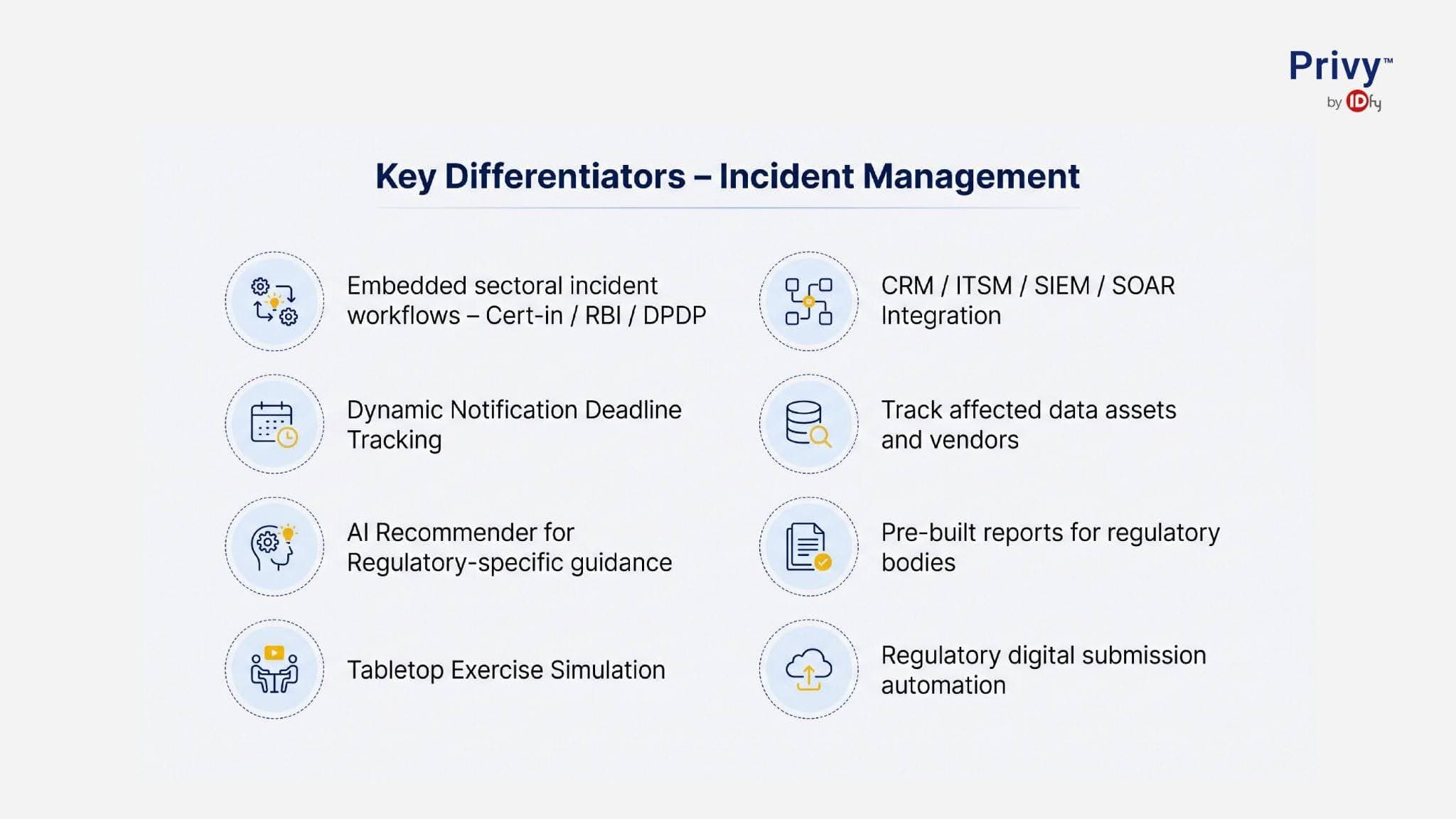
Breach detection and incident lifecycle management need to be operationalised before an incident occurs. Incidents may be reported by a data processor, internal team, auditor, or through ITSM/SIEM systems. The organisation must be able to validate the breach, assess its scope, nature, root cause, impacted processes, affected Data Principals, and third-party processors involved.
The response workflow should cover preliminary investigation, initial notification to affected Data Principals and the Data Protection Board, secondary investigation, remediation steps, final notification, and report generation. Preparedness also requires sectoral incident workflows across DPDP, CERT-In, and RBI requirements, dynamic notification deadline tracking, CRM/ITSM/SIEM/SOAR integrations, tracking of affected data assets and vendors, pre-built regulatory reports, and tabletop exercise simulations.
Without these workflows in place, organisations may detect an incident but fail to respond, escalate, notify, and evidence the response within the required timeframe.
Cross-Regulatory Alignment
Sectoral nuances create compliance layers that a DPDP-only framework may not address. Financial services organisations operate under the RBI's data localisation and customer data protection frameworks. Healthcare organisations have sector-specific health data obligations. Telecom operators have TRAI requirements. Digital commerce platforms face layered DPDP and consumer protection obligations. A data privacy framework that is not designed with these sectoral nuances will create gaps that are invisible until they are not. DPDP obligations for banks, NBFCs and BFSI data privacy compliance India organisations face the most complex version of this challenge.
Industry standards - ISO 27701, SOC 2, and emerging Indian privacy certification frameworks - provide a reference architecture that maps well to DPDP obligations and creates internationally credible evidence of the organisation's privacy posture.
Digital-First Regulatory Interactions
Reporting automation is the operational capability that enables organisations to respond to regulatory requests accurately and quickly. Manual compilation of compliance evidence is slow, error-prone, and resource-intensive. Automated reporting - pulling from live operational systems rather than static documentation - produces accurate, current evidence on demand. This is where DPDP compliance technology creates direct operational value.
Readiness for digital adjudication means that when the Data Protection Board becomes operational and begins processing complaints and conducting investigations, the organisation can engage with that process credibly and efficiently - because its records are current, its processes are documented, and its evidence is accessible.
Board-Level Questions
- Can we produce evidence of our privacy compliance at the individual transaction level - not just at the policy level?
- Have we modelled privacy risk across AI, vendors, operations, and customer trust - not just data breach scenarios?
- Have we rehearsed our breach notification process, including who notifies the Data Protection Board and within what timeframe?
- Does our privacy framework address our sectoral regulatory obligations alongside DPDP?
- Are our compliance artefacts maintained continuously, or are they assembled reactively when needed?
6. Return on Privacy Investment - Making the Business Case
The business case for DPDP readiness is not built on fear of penalties. It is built on the operational, commercial, and strategic value that a well-governed privacy function creates. Boards that approve privacy investment only to the extent necessary to avoid regulatory exposure are underinvesting in a function that creates material returns across multiple business dimensions. The business value of privacy is real, measurable, and growing.
Cost Efficiency and Operating Leverage
DPDP automation reduces the cost of running privacy operations. Manual consent management, manual rights request fulfilment, manual vendor assessments, and manual audit preparation are expensive at enterprise scale. Automating these processes - through integrated privacy infrastructure - reduces cost per transaction, improves consistency, and frees DPO and compliance teams to focus on higher-value governance and strategic work.
Operational simplification through standardised processes reduces the operational complexity that fragmented, function-by-function privacy approaches create. When every business unit has its own approach to consent, its own vendor assessment process, and its own rights request workflow, the DPO must coordinate across incompatible approaches. A standardised framework reduces coordination costs and improves reliability.
Reduced people dependency means that the organisation's privacy posture does not depend on specific individuals retaining institutional knowledge. Documented, systemised processes work consistently regardless of staff turnover - a material consideration in a market where experienced privacy professionals are in demand.
Tooling rationalisation and infrastructure optimisation through a unified privacy governance tool reduces the total cost of maintaining multiple point solutions. Organisations that have acquired separate tools for cookie consent, data subject requests, vendor assessments, and DPIA management often find that the integration cost and maintenance burden of those separate tools exceeds the cost of a unified approach.
Process standardisation - applying consistent methods across all functions and geographies - creates the economies of scale that make DPDP compliance steps increasingly efficient over time.
Investment Efficiency
Capex versus Opex optimisation is a real consideration for boards making privacy investment decisions. Cloud-based privacy platforms with subscription pricing convert what would be significant capital expenditure on bespoke systems into manageable operational expenditure - and provide faster access to new capabilities as the regulatory environment evolves.
A phased investment model allows organisations to prioritise the highest-risk obligations first, deploy working solutions in compressed timeframes, and then expand coverage systematically. This approach demonstrates progress to regulators and boards while managing total investment.
Faster time to value - in risk reduction, operational efficiency, and compliance evidence - comes from building on proven infrastructure rather than developing bespoke solutions. Every month of delay in achieving operational DPDP readiness carries regulatory exposure that can be avoided. This is the core of the ROI of privacy compliance argument.
Trust-Led Growth and Strategic Upside
Brand trust and credibility are commercially material in an environment where customers are increasingly aware of and concerned about how their personal data is used. Organisations that can credibly demonstrate responsible data practices - not just assert them - create a trust premium that supports customer acquisition, retention, and willingness to share data voluntarily. This is the privacy ROI India story that boards should be communicating.
Customer experience uplift comes from consent and rights management that is genuinely transparent and frictionless. A consent experience that is clear, specific, and easy to manage builds customer trust in digital finance and digital services. A rights fulfilment process that is prompt and verifiable builds customer loyalty. These are not just compliance outcomes - they are customer experience outcomes.
Ecosystem trust is increasingly a commercial requirement. Enterprise customers, particularly in financial services, healthcare, and technology sectors, assess the privacy governance of their vendors and partners as part of their own risk management. A demonstrable DPDP readiness posture is a commercial differentiator in these procurement conversations.
Growth and innovation are enabled, not constrained, by a strong privacy foundation. Organisations with robust data security governance can explore new data uses, new AI applications, and new partnerships with confidence - because they have the infrastructure to assess privacy implications, obtain appropriate consent, and demonstrate compliance. Organisations without that foundation face the opposite: every new initiative requires a slow, expensive risk assessment from scratch.
Fine Avoidance
It is factually accurate that the DPDP Act provides for significant financial penalties for serious violations - the Act prescribes DPDP penalties and DPDP fines that can reach up to ₹250 crore for individual violations. This is relevant context, not the primary argument for investment. Penalty avoidance is a floor. The ceiling is the competitive, operational, and trust value of building privacy into the enterprise properly. Organisations that build their DPDP programme primarily around fine avoidance typically underbuild - and typically need to rebuild. The DPDP non-compliance cost over time always exceeds the cost of getting it right the first time.
Board-Level Questions
- Have we quantified the cost of our current privacy gaps - in risk exposure, operational inefficiency, and future rework?
- Are we building privacy infrastructure that creates sustainable operating leverage, or are we creating manual processes that will not scale?
- How does our privacy posture affect our ability to win enterprise customers, partner with ecosystem players, and retain customer trust?
- Is our privacy investment structured to deliver value across risk reduction, cost efficiency, and commercial growth - or only to satisfy a minimum compliance threshold?
What Boards Should Ask Management Now
The following checklist is designed for boards and independent directors who want to move beyond status updates and ask substantive questions about DPDP readiness. These are not questions that require technical expertise to ask. They require governance commitment to ask them consistently.
Strategy and Ownership
- Who is accountable for DPDP readiness at the executive level, and how does that accountability connect to the board?
- Has the board approved a DPDP readiness strategy with defined milestones, or has implementation been delegated without defined outcomes?
- Is there a cross-functional governance structure with clear decision rights, or does the DPO carry the full weight of the programme?
Execution
- What is the current state of implementation against our DPDP compliance steps - measured by evidence, not by self-assessment?
- Are workstreams running in parallel, or is the programme sequential and therefore slower than it needs to be?
- What are the three largest execution gaps, and what is the defined plan to close each?
Data and Consent
- Have we completed data discovery across all systems - including cloud, analytics, and vendor environments?
- Is our consent architecture purposeful, unbundled, and connected to actual data use - or is it a documentation layer?
- Are data retention schedules technically enforced at the system level, or are they documented but not implemented?
Data Principal Rights
- How does the organisation receive, route, and fulfil Data Principal Rights requests end-to-end?
- What are our current fulfilment timeframes, and do they meet regulatory expectations?
- Can we demonstrate fulfilment with verifiable evidence at the individual transaction level?
Vendors
- What percentage of vendors who process personal data have been assessed against our data protection requirements?
- Do all material vendor engagements have data processing agreements that reflect our DPDP obligations?
- How do we manage vendor offboarding, including deletion of personal data?
Defensibility
- If a regulatory investigation commenced today, what evidence could we produce, and how quickly?
- Have DPIAs been completed for all high-risk and AI-driven processing activities?
- Have we rehearsed our breach notification process - who notifies, what is reported, and within what timeframe?
ROI and Business Value
- What is the total investment in DPDP readiness, and what is the expected return across risk reduction, operational efficiency, and commercial value?
- Are we building privacy infrastructure that will scale, or are we creating point solutions that will require expensive replacement?
- How does our privacy posture compare to the expectations of our largest enterprise customers and partners?
How Privy by IDfy Helps Organisations Operationalise DPDP
The challenge most organisations face is not a shortage of DPDP guidance. It is a shortage of operational infrastructure - systems, workflows, and evidence mechanisms that make DPDP readiness consistent, scalable, and demonstrable across the full framework described above.
Privy by IDfy is built for this specific problem: the gap between policy intent and operational reality in Indian enterprises. As India's purpose-built DPDP enterprise privacy platform, it is the best DPDP platform in India for organisations that need to move from intent to execution.
Consent Governance Connected to Actual Data Use
Privy's consent management capability goes beyond capturing a checkbox. It connects the consent record to the data flow it governs, so organisations can demonstrate not just that consent was collected but that data was used within the scope of what was consented to - the standard that full-stack execution requires. This is DPDP compliance technology working at the data level, not just the form level.
Data Discovery and Lineage
Privy provides the tools to identify where personal data lives across the enterprise - structured and unstructured, on-premise and cloud - and to trace how it moves between systems. This is the foundation on which every other privacy capability rests, and the starting point for the sequenced, right-first-time execution the DPDP transformation roadmap demands.
Data Principal Rights Workflows
Rights requests are received, routed, tracked, and fulfilled through structured workflows with built-in timeframe management and evidence capture. Whether the request is for access, correction, erasure, or grievance, the fulfilment process is consistent, auditable, and connected to the underlying data systems - not dependent on manual coordination across teams. This is how the DPDP grievance officer role and the data fiduciary grievance officer function are operationalised.
Cookie Consent Management
For digital-first enterprises, cookie governance is a front-door privacy obligation. Privy's cookie management capability scans, classifies, and manages cookie consent across web properties - keeping the consent layer accurate as the technology stack evolves, without requiring manual inventory maintenance.
Vendor and Third-Party Risk Governance
Privy enables organisations to assess vendors against defined data protection criteria, maintain data processing agreement coverage, and track vendor data practices across the full lifecycle of the engagement - including offboarding and data deletion verification. This is vendor risk management and data security governance applied to the entire third-party ecosystem.
DPIA Workflows
Privacy Impact Assessments are supported through a structured workflow designed to be triggered at project initiation - before data processing begins. This makes DPIA a part of the product development and change management process, not a retrospective audit. It is privacy by design made operational.
Incident and Breach Workflows
When a personal data incident occurs, Privy provides structured workflows for classification, internal escalation, and breach notification - with evidence capture at every stage of the incident lifecycle.
Evidence and Audit Trails
Every action across Privy's modules - consent granted, rights request fulfilled, vendor assessed, DPIA completed, incident responded to - is logged with the specificity required for regulatory defensibility. Evidence is created in the course of normal operations, not assembled under pressure after the fact. This is the DPDP automation platform advantage.
Board-Ready Visibility and Reporting
DPOs and compliance leaders can generate reports calibrated for board consumption - covering readiness across all framework dimensions, flagging material risks, tracking KPIs, and providing the DPDP governance visibility that board oversight requires. Privacy becomes governable at the board level, not just manageable at the operational level. The privacy office in India gets the board-grade reporting infrastructure it needs.
Conclusion: DPDP Readiness Needs to Be Governed, Not Assumed
Boards do not need to manage every privacy workflow. They do not need to review every consent record, approve every DPIA, or oversee every vendor assessment. What they do need is confidence - grounded in evidence, not assurance - that the organisation's approach to DPDP readiness is scalable, connected, owned, and defensible.
Scalable means it works across every product, data type, vendor, and customer journey - not just the parts of the business where implementation has begun. Connected means the consent layer talks to the data layer, the rights workflow talks to the data systems, and the vendor assessment talks to the procurement process. Owned means there is a named individual accountable for every material privacy obligation, with the authority and resources to fulfil it. Defensible means there is evidence - not assertion - that obligations are being met and can be demonstrated on demand.
DPDP readiness must move from intent to infrastructure. The organisations that will navigate this regulatory environment with confidence are not those with the best legal interpretation of the Act. They are those who have built the operational systems to execute it consistently, govern it visibly, prove it evidentially, and generate real business value of privacy from doing it well.
That is the standard boards should hold their management teams to. And it is the standard every Indian enterprise should be building toward now.
Frequently Asked Questions
What does it mean for DPDP to be on the board agenda?
It means that DPDP readiness is no longer solely a legal or compliance responsibility. Boards need to oversee whether the organisation can execute its obligations, govern its data practices, produce evidence of readiness, and manage privacy risk at enterprise scale. This involves asking substantive questions of management, receiving meaningful KPIs, and ensuring that investment in privacy governance infrastructure is adequate and appropriate.
What is the difference between DPDP policy readiness and DPDP operational readiness?
Policy readiness means the organisation has documented its privacy obligations - updated its privacy policy, appointed a DPO, and described its data practices. Operational readiness means the organisation can actually execute those obligations consistently: collecting consent correctly, fulfilling rights requests end-to-end, governing vendor data practices, running DPIA processes, maintaining evidence, and responding to incidents. Most enterprises have achieved the former. Far fewer have built the latter. This is the gap that the DPDP maturity model is designed to measure and close.
What is full-stack privacy execution?
Full-stack privacy execution refers to the ability to manage privacy obligations across the entire data lifecycle - from collection through consent, classification, governed use, rights management, retention, and deletion - using connected systems and defined workflows. It extends to vendor risk management, AI risk management, incident response, and continuous compliance monitoring. It is the operational counterpart to a policy commitment, and it is what the DPDP transformation roadmap must be built to deliver.
Why is data discovery foundational to DPDP readiness?
You cannot consent to data you do not know you collect. You cannot govern data you cannot locate. You cannot delete data you have not mapped. Data discovery - identifying where personal data exists across all systems, including cloud and vendor environments - is the prerequisite for every other element of DPDP governance. Without it, every downstream compliance decision rests on assumptions rather than facts.
How does vendor governance fit into a DPDP readiness framework?
Every vendor who processes personal data creates an obligation to ensure that data is handled appropriately. This means assessing vendors against data protection criteria, maintaining data processing agreements, managing data sharing throughout the vendor relationship lifecycle, and verifying that personal data is deleted when the relationship ends. Vendor risk management is not a peripheral concern - it is a core DPDP obligation. Organisations with large vendor ecosystems often carry significant unmanaged privacy risk in this dimension.
What does evidence-grade compliance mean in practice?
Evidence-grade compliance means maintaining records that would satisfy a regulatory investigation - consent records with timestamps and version history, DPIA documentation for high-risk processing, audit logs of rights request fulfilment, records of vendor assessments and data processing agreements, and breach notification records. It is fundamentally different from asserting compliance through policy or attestation. Evidence is created in the course of operations, not assembled after the fact. A mature DPDP enterprise privacy platform generates this evidence automatically.
What is the return on investment for DPDP readiness?
The ROI of privacy compliance operates across multiple dimensions: cost efficiency through DPDP automation and operational simplification; investment efficiency through phased deployment and faster time to value; risk reduction through evidence-grade controls and demonstrable defensibility; and commercial value through customer trust, enterprise customer credibility, and ecosystem positioning. The privacy investment benefits far exceed fine avoidance - penalty avoidance is one dimension of the return. It is not the most important one.
How should organisations approach the DPDP Rules that are still being finalised?
The absence of finalised Rules is not a reason to delay. The substantive obligations of the DPDP Act - consent, rights, vendor governance, security, and breach notification - are clear. Organisations should implement the Act now while designing their frameworks to be adaptable to the Rules as they are finalised. Architecture built for adaptability requires less rework than point solutions built around a specific current interpretation. Waiting is itself a form of DPDP non-compliance cost.
Take the Next Step With Privy by IDfy
If your organisation is moving from DPDP intent to DPDP infrastructure, Privy by IDfy is built for that journey. From consent governance and data discovery to rights management, vendor risk management, DPIA, incident response, and board-ready audit trails - Privy is designed to help Indian enterprises operationalise their DPDP readiness at scale, with the evidence-grade rigour that regulatory confidence requires.
Speak with our team to understand where your organisation stands, where the critical gaps are, and what a structured path to scalable, governed, and defensible DPDP governance looks like for your specific context.
Request a DPDP Readiness Assessment
Ready to get your DPDP implementation right the first time? Don't let manual processes and fragmented designs slow you down. Reach out to us to see how Privy can accelerate your compliance journey. Contact us at shivani@idfy.com, and we shall be more than happy to help.

Learn how Indian enterprises can operationalize DPDP compliance at scale through privacy operations, consent governance, breach readiness, and automated workflows.
Analyze the implications of the allocation of ₹10 crore in the FY 2026-2027 budget for the Data Protection Board. Understand the shift from setup to activation, the digital-first operating model, and what enterprises must do to prepare for the DPDP Act enforcement