

10 Must-Have Features of a DPDPA Compliance Platform (2026 Buyer's Guide)
Date Published

Most DPDP content explains the law. This explains the tool you need to comply with it. With the DPDP Rules 2025 notified and the core obligations enforceable from 13 May 2027, the real decision for most Indian enterprises has shifted from whether to comply to which platform actually gets them there. The market has filled fast, and the feature lists on vendor sites all start to look the same.
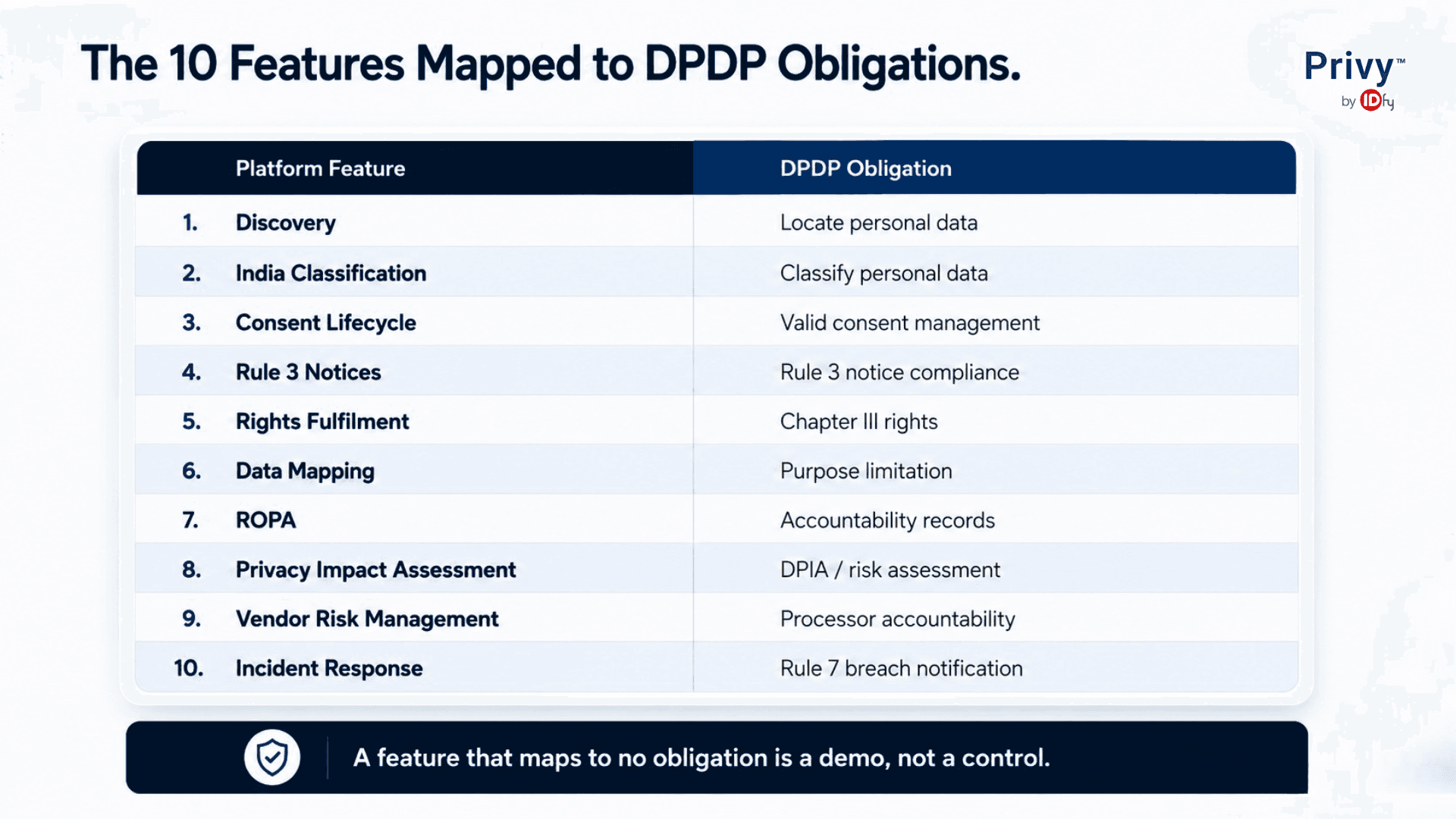
So here is a buyer's checklist that separates the features that satisfy a real DPDPA obligation from the ones that just demo well. Ten of them, each tied to a specific thing the Act requires and a specific question to put to any vendor. If a platform cannot do these, it is documentation software, not compliance software.
1. Personal Data Discovery Across Every System
You cannot protect, delete, or report on data you cannot find. Before consent, before rights, before breach response, a platform has to locate personal data wherever it lives: structured databases, cloud storage, SaaS tools, on-premise file shares, and the unstructured document repositories where most forgotten sensitive data hides.
The test: does the platform scan structured and unstructured sources automatically, or does it rely on a team manually tagging what it already knows about? Automated discovery is the foundation the other nine features stand on, which is why data discovery and mapping are treated as the foundation of DPDP compliance rather than a nice-to-have. A tool that only inventories what you point it at will miss the exported spreadsheet in a forgotten folder, and that is exactly the file a breach or an erasure request exposes.
2. India-Native Data Classification
Finding data is half the job. The platform then has to classify it correctly, and correctly for India specifically. A classification engine built for GDPR will not reliably detect Aadhaar with its Verhoeff checksum, PAN with issuer encoding, Voter ID, NACH mandate codes, UPI IDs, or IFSC codes, because none of those formats appear in a global PII taxonomy. Caste is a sensitive category under Indian law and appears in no Western framework at all.
The test: does classification use deterministic patterns and checksum validation for structured Indian identifiers, and does its taxonomy cover the DPDP Act's sensitive personal data categories natively? A platform leaning on generic AI inference for structured Indian PII trades near-certainty for a 90 to 95 percent guess, and the gap between Indian PII and generic classification tools is where global tools quietly fail.
3. Consent Lifecycle Management, Beyond Capture
Consent under the DPDP Act has to be free, specific, informed, and as easy to withdraw as it was to give. Capturing a click is the easy part. The hard part is managing that consent across its full life: recording exactly what each data principal agreed to, versioning the notice each time it changes, and propagating a withdrawal through every downstream system, not only the one where the user clicked.
The test: when a user withdraws consent, does the platform push that change everywhere the data flows, and can it prove which version of a notice a user saw? Real consent management is infrastructure that maps what was promised against what is actually being done with the data, not a banner bolted onto a website.
4. Rule 3 Compliant Consent Notices
On notices, the DPDP Rules 2025 are specific. A notice has to be a standalone communication, in plain language, itemising the data collected and the purpose for each use, available in English and the languages of the Eighth Schedule, with a clear route to withdraw and to raise a grievance.
The test: can the platform generate and serve multilingual, purpose-specific notices that meet Rule 3, and version them over time? A guide to what Rule 3 actually demands of a consent notice is worth checking any vendor's notice module against, because a generic cookie banner does not clear this bar.
5. Data Principal Rights Fulfilment
The Act gives individuals enforceable rights: access to a summary of their data, correction, erasure, grievance redressal, and nomination. A platform has to service these within the timelines the Rules set, and grievance redressal has to be completed within 90 days.
The test: can the platform take a data principal request, find every copy of that person's data across all systems, and action access or erasure completely and on time? This is where discovery and classification pay off, because fulfilling a data subject request is impossible if you cannot locate the data in the first place. A rights request that returns an incomplete picture is a compliance failure waiting for an audit.
6. Data Mapping and Lineage
Knowing you hold personal data is not the same as knowing where it came from, where it flows, and who it is shared with. Data mapping traces that movement across systems and vendors, and lineage keeps the map current as data moves. Without it, every rights request, breach scope, and retention decision becomes a fresh investigation.
The test: does the platform build a live data map that updates as data moves, or a static snapshot that is stale the day after the scan? The difference between static and dynamic data mapping decides whether the inventory is useful for compliance or merely decorative.
7. Records of Processing Activities (ROPA)
A data fiduciary has to be able to show what personal data it processes, for what purpose, on what lawful basis, and who it is shared with. That record is the ROPA, and it is the first thing an auditor or the Data Protection Board asks to see. Assembled by hand, it is out of date the moment it is finished.
The test: does the platform generate and maintain the ROPA automatically from the live data map, or does it hand your team a spreadsheet template? A platform that keeps a record of processing activities current on its own turns audit preparation from a scramble into a lookup.
8. Privacy Impact Assessments
Significant Data Fiduciaries are required to conduct periodic Data Protection Impact Assessments, and any high-risk processing is a candidate for a PIA regardless of designation. A platform should make this a repeatable workflow, not a consulting engagement every time.
The test: does the platform offer a structured PIA and DPIA workflow that connects to the actual data map, so an assessment reflects real processing rather than a questionnaire filled from memory? Understanding how PIAs work under the DPDP Act sets the baseline for what a good assessment module should cover.
9. Third Party and Vendor Risk Management
Personal data leaves the enterprise constantly, to cloud hosts, payment processors, analytics tools, and marketing platforms. Under the DPDP Act, the fiduciary stays accountable for what those processors do. A platform has to bring vendor risk inside the compliance system, not leave it in a procurement spreadsheet.
The test: can the platform inventory every processor, score its risk, check contracts for the required clauses, and monitor vendors continuously rather than once at onboarding? Vendor gaps cause a large share of real breaches, which is why third-party risk management belongs in the platform rather than alongside it.
10. Incident Response and Audit-Ready Evidence
When a breach happens, the DPDP Rules require a two-stage notification: notify the Data Protection Board, then notify affected data principals within 72 hours. A platform has to turn that from a panicked improvisation into a rehearsed workflow, and it has to produce, on demand, the evidence trail that shows every obligation was met.
The test: does the platform run a structured breach workflow to the 72-hour timeline, and does every module feed one shared audit trail? A platform where incident management connects to the same evidence record as discovery, consent, and rights is what lets a fiduciary answer a Board inquiry with one record instead of seven spreadsheets assembled under pressure.
The Feature Nobody Lists: One Connected System
Those ten features are necessary, but a platform that delivers them as ten disconnected modules recreates the problem it was meant to solve. The value is in the connection. A classification finding should immediately tell you which consent obligation applies, which rights requests could touch that data, and how a breach involving it would be scoped. That only happens when discovery, consent, rights, vendor risk, and incident response share one data model and one audit trail.
This is the difference between a platform and a toolkit. A full data security posture management approach connects the findings so the output is actionable, not a set of reports that each require someone to interpret and stitch together.
How Privy by IDfy Covers the Checklist
Privy by IDfy was built as an India-native DPDPA platform rather than a global tool adapted for India. Data Compass handles discovery, India-specific classification, mapping, and retention across structured and unstructured systems. The consent governance layer manages Rule 3 notices, multilingual consent, versioned records, and data principal rights. Privacy impact assessments, third-party risk management, and incident response sit in the same platform, and InspectAI, the AI layer described on the Privy platform overview, monitors live data flows and connects findings across every module so the output shares one audit trail.
That last part is the point of the checklist. Any vendor can claim ten features. What matters is whether they add up to an evidence system that holds when the Data Protection Board asks a question.
Conclusion
The DPDP platform market rewards good marketing, so the feature lists all read alike. This checklist is a way to cut through that. Ask each vendor the ten questions above, and press on the eleventh: do these features connect into one evidence system, or are they ten tools with gaps between them? The platforms that will carry an enterprise through a Data Protection Board inquiry are the ones where discovery, consent, rights, and breach response draw on a single, current record of where personal data lives.
To see how Privy by IDfy covers this checklist across your systems, and how the modules connect into one audit trail, write to shivani@idfy.com
FAQ’s
What should I look for in a DPDP compliance platform?
Automated personal data discovery, India-native classification with checksum validation, full consent lifecycle management, Rule 3 compliant notices, data principal rights fulfilment, live data mapping, automated ROPA, privacy impact assessments, third party risk management, and a breach workflow tied to one audit trail. A feature that does not map to a DPDP obligation is a demo, not a control.
What is the difference between a consent management platform and a DPDP compliance platform?
A consent management platform handles consent capture, notices, and records. A DPDP compliance platform covers that plus discovery, classification, data principal rights, mapping, ROPA, PIAs, vendor risk, and incident response, all connected to a shared audit trail. Cookie banners alone do not amount to DPDP compliance.
Why does India-specific data classification matter?
Indian identifiers such as Aadhaar, PAN, Voter ID, NACH codes, UPI IDs, and IFSC codes have formats and checksums absent from global taxonomies. A platform without India-native classification either misses these or relies on probabilistic AI where near-certain deterministic detection was possible.
When do DPDP obligations take effect?
The DPDP Rules 2025 were notified on 13 November 2025. Most substantive obligations, including security safeguards, consent, and data principal rights, take effect around 13 May 2027. Consent manager registration opens around November 2026.
Does a DPDP platform remove our legal accountability?
No. The data fiduciary remains accountable under the Act. A platform gives the compliance, legal, and security teams the workflows and the evidence to exercise that accountability, but it does not transfer it.

DPDP readiness is no longer a legal exercise it’s board's responsibility. Governance, maturity, roadmap, full-stack privacy execution. Privy by IDfy

GDPR took 8 months to land its first major fine. India's DPDP enforcement will follow. Here's what operational readiness for DPDP actually means.