

Aftermath of DPDP In 2027, What Happens After the Deadline
Date Published

GDPR has collected more than €6.1 billion in fines since it came into force in 2018. India's journey toward DPDP compliance is just beginning, but the trajectory is the same. India's data protection law is still finding its footing, and DPDP readiness is now a live question for every enterprise that holds personal data. If Europe's experience tells us anything, it's that the real story begins after the law goes live.
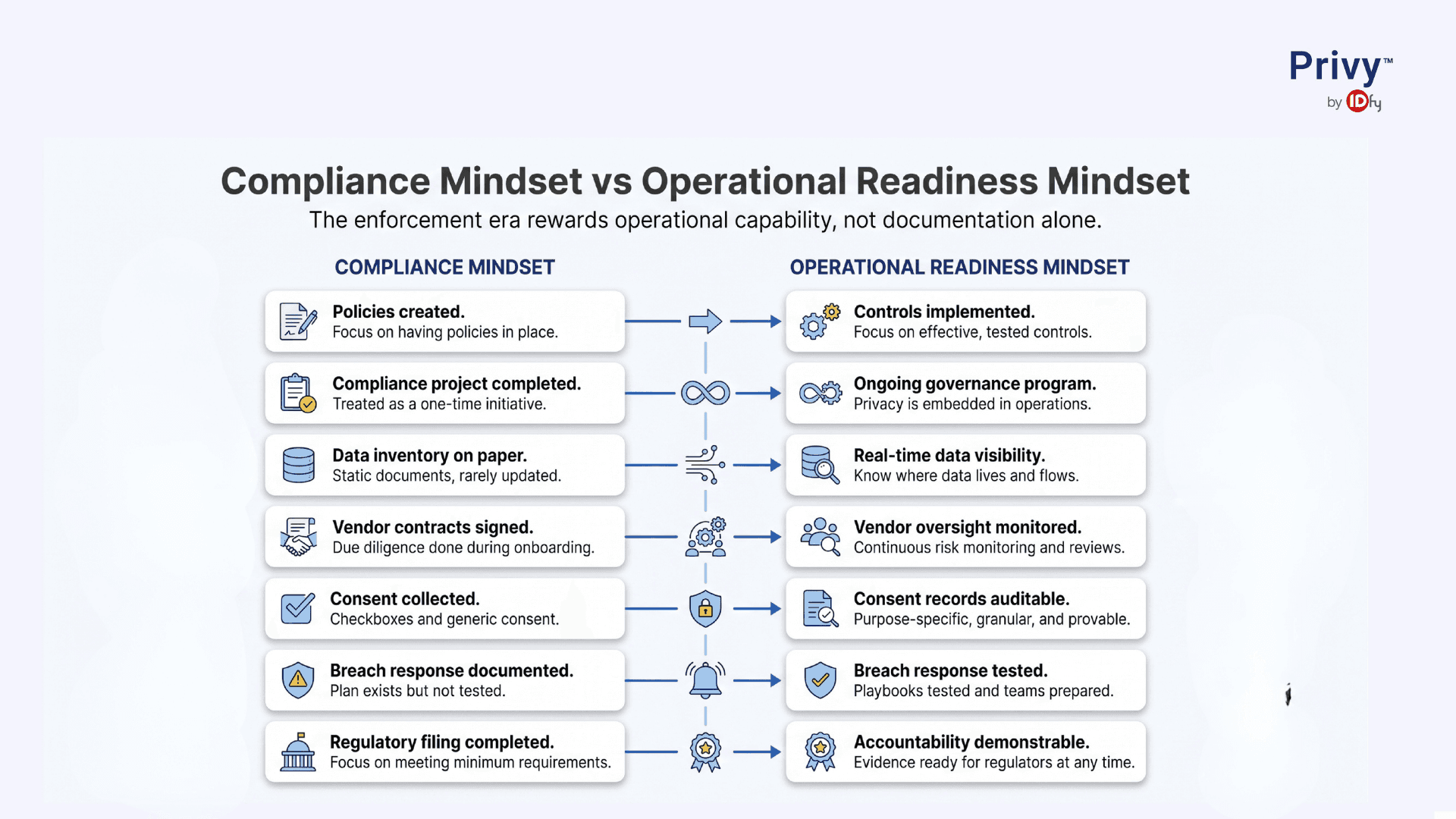
Most organisations spend the lead-up to a deadline focused on penalties. GDPR showed that the harder challenge is operational accountability. The companies that struggled most weren't always the ones with the weakest intentions. They were often the ones with the weakest data protection governance: they didn't know where their data lived, how it moved through their systems, which vendors had access to it, or how to respond when customers exercised their rights. That's the lesson Indian enterprises should be paying attention to.
The GDPR Precedent
The first major GDPR fine arrived in January 2019 when French regulators fined Google €50 million over transparency and consent practices. What followed wasn't a series of isolated penalties. It was a steady stream of investigations involving global technology companies, financial institutions, healthcare providers, retailers, and telecom operators. The common thread was rarely malicious intent. It was weak data protection governance. It was an inability to demonstrate accountability.
DPDP compliance creates a similar challenge for Indian businesses. The legal architectures differ, but the accountability gaps are nearly identical. For a side-by-side read, see GDPR vs DPDP: what Indian enterprises need to understand. The highest DPDP compliance penalty under the framework, ₹250 crore, applies to failure to implement reasonable security safeguards. Failure to notify regulators or affected individuals about a breach can attract penalties of up to ₹200 crore. Violations involving children's data carry similar consequences.
These numbers attract headlines. Focusing only on them misses the larger point.
Where Enforcement Actually Starts
Most enforcement actions begin somewhere else. A breach exposes weaknesses in security controls. A customer complaint raises questions about consent or data usage. An employee discovers a process gap. For a full picture of what incident response looks like under DPDP specifically, read our complete guide to incident management under DPDP. A regulator starts investigating a specific incident and eventually uncovers broader governance failures underneath. The penalty is often the final chapter. What precedes it is a failure of operational readiness for DPDP, not malicious intent.
For Indian enterprises, that distinction matters. Data incidents are becoming more complex, and DPDP compliance requires being ready for them before they happen. Customer data now flows across cloud environments, analytics platforms, AI systems, third-party vendors, customer support tools, marketing platforms, and business applications. Every handoff creates another point of exposure. Every vendor relationship creates another layer of accountability.
Under DPDP, that accountability doesn't disappear as data moves downstream. At Privy, we work with enterprises across BFSI, fintech, insurance, and digital services on exactly this. What we see consistently is that most organisations can answer broad questions about their data. Far fewer can confidently answer specific ones.
What personal data do we hold? Where did it come from? Why are we processing it? Which third parties can access it? Can we delete it if a customer requests it? Can we prove any of that to a regulator? If those questions feel harder than they should, it helps to start with the basics. Our piece on what personal data actually covers under DPDP is a good place to begin. Those questions get significantly harder when data volumes scale into millions of customers and hundreds of interconnected systems.
Data Governance Is The Real Work
One of the most important lessons from GDPR was that privacy compliance quickly became a data governance challenge. Organisations had to build capabilities around data discovery, processing inventories, vendor oversight, retention policies, consent management, and rights fulfilment. Privacy stopped being a legal exercise and became an operational function. India is heading toward the same reality. DPDP readiness means building the same operational depth that GDPR forced European enterprises to develop.
The organisations that struggled under GDPR were the ones that tried to treat board-level data privacy governance as a one-time compliance project. They drafted policies, appointed owners, and assumed the hard work was done. When regulators came looking for evidence, what they found was documentation without operational depth. Policies without proof.
DPDP readiness is the same challenge reframed for the Indian context. Operational readiness for DPDP means demonstrating at any point that personal data is collected lawfully, processed for stated purposes, governed through clear ownership, protected through reasonable safeguards, and deletable when required.
That's not a policy question. It's an infrastructure question, and it sits at the heart of what data protection governance in India now requires. Privy's full-stack privacy solutions are built around exactly this: consent lifecycle, risk management, and data governance working together.
The Investment Frame
A decade ago, cloud migration was often treated as a discretionary technology investment. Then organisations realised the operational cost of not modernising was greater than the cost of doing it. Cybersecurity followed a similar path. Today, few boards debate whether security investment is necessary. The discussion is about how much resilience is enough. Data protection governance in India is approaching the same point.
The business case extends beyond risk reduction. Strong data protection governance in India reduces the likelihood of breaches. They lower remediation costs when incidents occur. They reduce the operational burden of responding to data principal rights requests. They create consistency across business units and vendor ecosystems. Clean data retention policies are a significant part of this. Read what data retention means for modern data governance for a practical breakdown. They provide visibility into data assets that organisations depend on to operate.
Consumers are also more aware of how their information is collected and used. Transparency and accountability are becoming competitive differentiators. Organisations that can clearly explain their data practices and demonstrate responsible stewardship are likely to earn higher levels of trust than those that can't.
The AI dimension
This becomes more relevant as AI adoption accelerates, particularly for enterprises building DPDP readiness alongside their AI governance programmes.
AI systems rely heavily on data. Whether organisations are building recommendation engines, fraud models, underwriting systems, or personalised customer experiences, questions about data provenance, user consent, DPDP compliance, and accountability are inseparable from questions about AI performance and risk.
The organisations that build strong board-level data privacy governance today will find themselves better positioned to govern AI tomorrow. The data infrastructure required for DPDP compliance, clean data inventories, purpose-mapped processing, vendor accountability, and consent records is the same infrastructure that responsible AI governance requires.
This isn't a coincidence. It's why digital transformation leaders and CISOs who are serious about AI need to take DPDP compliance seriously, not just as a legal obligation, but as the foundation for how they use data going forward.
What The Next Twelve Months Should Look Like
The conversations in boardrooms are already changing. DPDP is increasingly discussed alongside cybersecurity, financial controls, and enterprise risk. That shift will accelerate as enforcement approaches. At Privy By IDfy, we see two types of organisations right now. The first is building governance frameworks, improving data visibility, strengthening vendor oversight, and operationalising privacy controls. They're treating the current window as preparation time. The second is treating it as breathing room.
GDPR's first major enforcement action arrived within 8 months of implementation. India's DPDP compliance enforcement will follow. India's will arrive too. When it does, the real differentiator won't be who read the law first or who filed the earliest DPDP readiness assessment. It will be those who built the operational capability to comply with it who treated DPDP compliance as an infrastructure investment rather than a filing exercise.
The organisations in the first group will enter the enforcement era with confidence. Their DPDP readiness will be demonstrable, not just claimed. The ones in the second group will discover that privacy programmes are considerably harder to build under regulatory pressure than before.
Conclusion
India's data protection governance moment is here. DPDP compliance is now an operational question, not a future one. The question for every board and leadership team is whether their organisation can demonstrate operational readiness, not just policy coverage.
On the product side, Data Compass handles data discovery and governance across 150+ systems, while our incident management product keeps your breach response regulator-ready inside 72 hours. We are already live with Axis Bank, helping one of India's largest financial institutions build DPDP compliance infrastructure at scale. Whether you're a large enterprise, a fast-growing fintech, or a digital platform building DPDP readiness, we can help you build the operational layer that makes your data protection governance in India auditable and defensible.
Ready to understand where your DPDP compliance gaps are before a regulator does? Reach out to us at shivani@idfy.com. We'd be happy to help.

A joint MIT Sloan Management Review India and IDfy study reveals how large enterprises are operationalizing privacy beyond consent under India’s DPDP regime.

Analyze the implications of the allocation of ₹10 crore in the FY 2026-2027 budget for the Data Protection Board. Understand the shift from setup to activation, the digital-first operating model, and what enterprises must do to prepare for the DPDP Act enforcement