

What Does DPDPA Compliance Actually Cost? A CFO's Guide for Indian Enterprises
Date Published

DPDPA compliance in India can cost a mid-market or enterprise organisation anywhere from ₹5 crore to ₹9 crore in the first year if built internally, once privacy hires, engineering effort, consent systems, data discovery, legal reviews, audit trails, and implementation work are included. The larger financial risk, however, is not just the implementation cost. Under the Digital Personal Data Protection Act, 2023, penalties can extend up to ₹250 crore for certain contraventions, making data privacy in India a CFO-level risk decision rather than a legal checkbox. For Indian enterprises, the real question is no longer whether to comply. It is whether to build privacy infrastructure in-house, buy a DPDPA compliance platform, or risk a fragmented approach that becomes more expensive to fix later.
Data privacy has spent years being treated as a legal department problem. The Digital Personal Data Protection Act has changed that. For Indian enterprises navigating AI adoption alongside regulatory enforcement, the financial implications of getting privacy compliance wrong are now squarely a CFO conversation.
This is not about compliance for its own sake. It is about understanding where money is quietly leaking through redundant tooling, underestimated implementation costs, rushed vendor decisions, and the creeping liability of AI workflows that have not been mapped to a consent record. Globally, organisations evaluating GDPR compliance cost as a benchmark are finding that India's DPDP Act creates comparable and in some cases steeper obligations for enterprises operating at scale. The organisations that figure this out early will have a structural cost advantage. The ones that do not will spend significantly more fixing it later.
Why Privacy Governance Is Now a Financial Line Item
The DPDP Act introduces penalties of up to ₹250 crore per violation. Phase 3 enforcement begins May 2027. Those numbers tend to focus minds quickly. But the penalty risk is actually the most visible part of the cost equation, not the largest. The higher costs are operational, and they are already accumulating. According to IBM's Cost of a Data Breach Report 2024, the average cost of a data breach globally is $4.88 million, a figure that includes detection, containment, legal response, regulatory engagement, and reputational damage.
For Indian enterprises, Cloudflare's 2023 data put the average breach cost at approximately $2.7 million, with detection and escalation alone accounting for nearly a third of that. These numbers do not yet reflect the additional liability layer the DPDP Act introduces. For enterprises already investing in data security compliance, this is the moment to ensure that investment extends into privacy governance.
What Does It Cost to Build DPDPA Compliance In-House?
Many enterprises default to the assumption that building privacy governance in-house gives them control and saves money. In practice, it does neither particularly well. A functional in-house privacy stack typically requires a Data Protection Officer or equivalent senior hire, a dedicated privacy engineering function, consent management infrastructure, data discovery and mapping tooling, audit logging systems, and legal and compliance resourcing to keep pace with regulatory updates. In India's current market, a mid-senior DPO hire commands between ₹40 and ₹80 lakh annually. A privacy engineering team of three to four people adds another ₹1.2 to ₹2 crore per year before infrastructure and tooling costs. According to the International Association of Privacy Professionals (IAPP), organisations globally spend an average of $2.7 million annually on privacy programmes when built and managed internally. That figure scales with organisational complexity, data volumes, and the number of third-party integrations involved.
For Indian enterprises in the mid-market to enterprise segment, a realistic internal build for an organisation of 500 to 2,000 employees runs between ₹5.3 crore and ₹8.75 crore over the first twelve months, once personnel, technology implementation, data governance, external consulting, and audit costs are factored in. That is, before the hidden cost that rarely appears in any budget conversation: time to value. Building takes 12 to 18 months before anything resembling a functional compliance posture is in place. Enforcement does not wait for internal timelines. Industry benchmarks suggest DPDP compliance programmes typically consume 2 to 5% of an organisation's annual IT budget, a figure boards should be pressure-testing now, not in 2026.
DPDPA Compliance Cost Model: Build vs Buy
For CFOs, the build vs buy decision should not be evaluated only on software cost. It should be evaluated on total cost of ownership, implementation time, internal bandwidth, regulatory adaptability, and the cost of getting the first decision wrong.
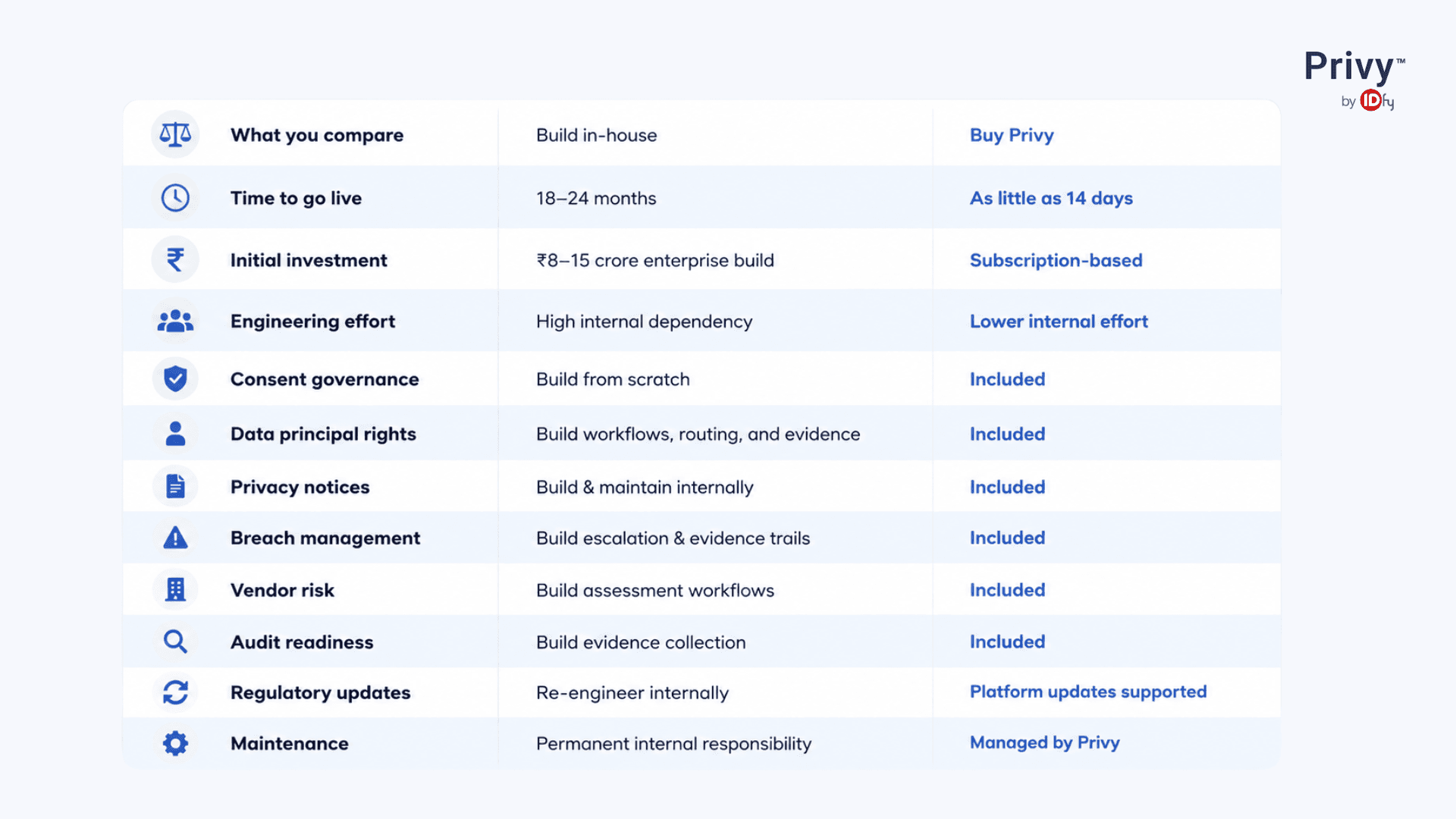
The buy decision is not about outsourcing accountability. Under the DPDP Act, Data Fiduciaries remain accountable for how they process personal data. The question is whether they want to spend internal capital building every layer from scratch or deploy that capital against a compliance management software platform that already supports core DPDP workflows.
The Wrong Product Problem: Why Cheap Can Become Expensive
The risk is compounded for enterprises with complex, multi-property structures. Legacy international compliance management software India deployments are typically priced by domain, meaning a holding company or conglomerate with thirty to fifty digital properties can find itself looking at licensing costs of ₹30 to ₹40 lakh annually just for consent management infrastructure, before a single rupee of implementation work begins. Organisations with existing security frameworks, such as ISO 27001, can reduce overall compliance costs by 30 to 50% by building on what they already have, but only if the data protection software they choose is architected to integrate with those frameworks rather than run parallel to them.
There is a second cost scenario that CFOs tend to underestimate because it does not appear until later: the cost of integrating the wrong privacy management software and having to replace it. Privacy governance platforms vary significantly in how deeply they integrate with existing enterprise systems. A tool that works well for consent banner management on a website is a different product from one that can map data flows across cloud environments, link consent records to AI processing activities, and produce audit-ready evidence for a regulator.
Many enterprises, under time pressure to show DPDP readiness, integrate a lighter tool quickly. Twelve months later, they discover it cannot handle the complexity of their actual data environment. The rework cost at that point includes migration, reintegration with existing systems, retraining, and, in many cases, re-scoping the DPDPA implementation programme entirely.
Gartner estimates that poor technology decisions in enterprise software result in rework costs of 2 to 3 times the original implementation spend. In privacy infrastructure, where integrations touch CRMs, data warehouses, cloud environments, and vendor ecosystems simultaneously, that multiplier is realistic. The cheaper product is rarely the less expensive decision.
AI Budgets Are Rising, Privacy Governance Needs To Be Part Of That Budget.
Indian enterprises are committing serious capital to AI. IDC projects AI spending in India will reach $6 billion by 2027, growing at a compound annual rate of over 33%. Boards are approving AI budgets. Technology teams are building AI roadmaps. Business units are adopting AI tools faster than IT can track. What is not happening consistently is the corresponding investment in compliance automation infrastructure to ensure that AI adoption is legally defensible.
This matters for CFOs because the two budgets are not as separate as they appear. Every AI system that processes personal data creates a DPDP obligation. Every employee using a generative AI tool with customer data is creating a processing activity that needs a consent basis. Every AI vendor embedded into an enterprise workflow is a data processor relationship that needs to be documented, assessed, and managed. The cost of ignoring that connection does not show up in the AI budget. It shows up in legal costs, regulatory response costs, and, in the worst case, penalty exposure. The DPDP Act does not distinguish between an AI-driven breach and any other kind. The liability is the same.
The smarter framing for CFOs is this: if you are already spending on AI, data privacy in India is not an additional cost line. It is the risk management layer that makes the AI spend defensible. Enterprises that integrate privacy compliance into their AI infrastructure from the beginning avoid the far more expensive process of retrofitting compliance after the fact. McKinsey estimates that organisations that embed governance into technology programmes from the start spend 40% less on compliance remediation than those that address it reactively. The number is directional, not precise, but the principle is consistent with how compliance costs behave across industries.
The ROI Of Buying A DPDP Compliance Platform
For CFOs, the ROI of a DPDP compliance platform is not simply lower software cost. It comes from reducing the cost of delay, rework, fragmented tooling, and audit uncertainty. A platform like Privy by IDfy helps enterprises reduce four categories of cost:
Cost of building from scratch: Consent governance, data principal rights, incident workflows, data discovery, and audit trails do not need to be engineered separately. Purpose-built data protection software replaces the need for multiple disconnected tools.
Cost of regulatory rework: As DPDP requirements evolve, a purpose-built platform can absorb changes through product updates instead of repeated engineering sprints.
Cost of fragmented evidence: CFOs, DPOs, CISOs, and boards need audit-ready evidence. A single privacy management software layer reduces the effort of proving what happened, when, and why.
Cost of AI-related privacy exposure: As AI adoption grows, enterprises need to know which personal data is being processed, where consent exists, which vendors are involved, and whether the use case is defensible.
Privy's ROI is strongest for enterprises that need more than a consent banner. It is built for organisations that need data discovery, consent governance, data principal rights management, incident workflows, and compliance evidence in one DPDP-focused platform.
What Good Looks Like From A CFO's Seat
The enterprises managing this well are not necessarily spending the most. They are spending with clarity. They have a single, auditable view of where personal data lives, how it moves, which AI systems touch it, and what consent exists for each processing activity. When a regulator asks a question, they have an answer. When a customer exercises a right, they can respond within the statutory timeline. When the board asks whether AI is creating unmanaged liability, the answer is grounded in data rather than assumptions.
That posture is not free. But it is significantly less expensive than the alternative, and it compounds in value as AI adoption scales. The CFOs who are ahead of this are treating privacy compliance the same way they treat cybersecurity infrastructure: not as a cost to be minimised, but as a risk-adjusted investment with a calculable return.
Conclusion
The DPDP Act has made data privacy in India a financial risk question, not just a legal one. The cost of inaction is measurable. The cost of the wrong decision is measurable. And as AI budgets grow, the cost of not connecting the two is becoming increasingly difficult to justify to a board.
Privy by IDfy is built for enterprises that want to get this right the first time with the data discovery, consent governance, and compliance automation infrastructure to handle DPDP in the age of AI, without the overhead of building it from scratch or the risk of outgrowing a lighter tool. If you are evaluating your organisation's privacy governance posture, the economics of build vs. buy, or your exposure under the DPDP Act, we would be glad to walk through it with you. Reach out at shivani@idfy.com.
FAQ's
What does DPDPA compliance cost in India?
DPDPA compliance costs vary by organisation size, data volume, number of digital properties, third-party vendors, and existing privacy maturity. For mid-market and enterprise organisations, an internal build can run into several crores once people, engineering, tooling, legal reviews, and implementation are included.
Is it cheaper to build or buy a DPDPA compliance platform?
Building can appear cheaper initially, but it usually requires dedicated privacy engineering, consent infrastructure, data discovery, audit logging, incident workflows, and ongoing regulatory updates. Buying a DPDP-focused platform can reduce time to value and rework.
What is the penalty for non-compliance under the DPDP Act?
The DPDP Act includes penalties that may extend up to ₹250 crore for certain contraventions, including failure to take reasonable security safeguards to prevent a personal data breach.
Why should CFOs care about DPDPA compliance?
DPDPA compliance affects financial risk, audit readiness, vendor risk, AI governance, customer trust, and potential regulatory exposure.
What costs are usually missed in DPDPA budgeting?
Commonly missed costs include internal engineering time, data mapping, consent record maintenance, privacy impact assessments, vendor reviews, incident response workflows, and future rework.
How does AI increase DPDPA compliance costs?
AI increases compliance complexity because personal data may flow into models, GenAI tools, third-party vendors, and automated decisioning systems. Each of these flows needs governance, consent linkage, and evidence.
What should enterprises look for in a DPDP compliance platform?
They should look for consent governance, data principal rights workflows, data discovery, incident management, third-party risk management, audit trails, and India-specific DPDP readiness.
How does Privy by IDfy help with DPDPA compliance?
Privy helps enterprises manage DPDP compliance through data discovery, consent governance, data principal rights management, incident workflows, and privacy governance infrastructure built for Indian enterprises.
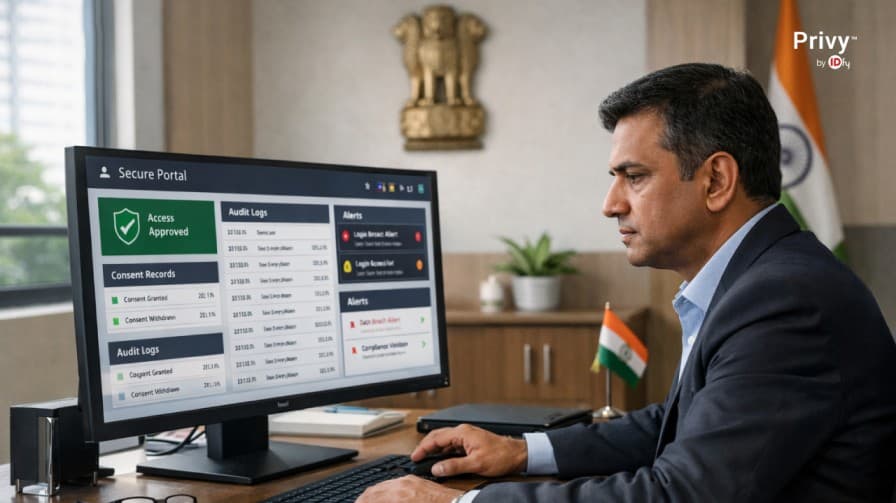
Analyze the implications of the allocation of ₹10 crore in the FY 2026-2027 budget for the Data Protection Board. Understand the shift from setup to activation, the digital-first operating model, and what enterprises must do to prepare for the DPDP Act enforcement
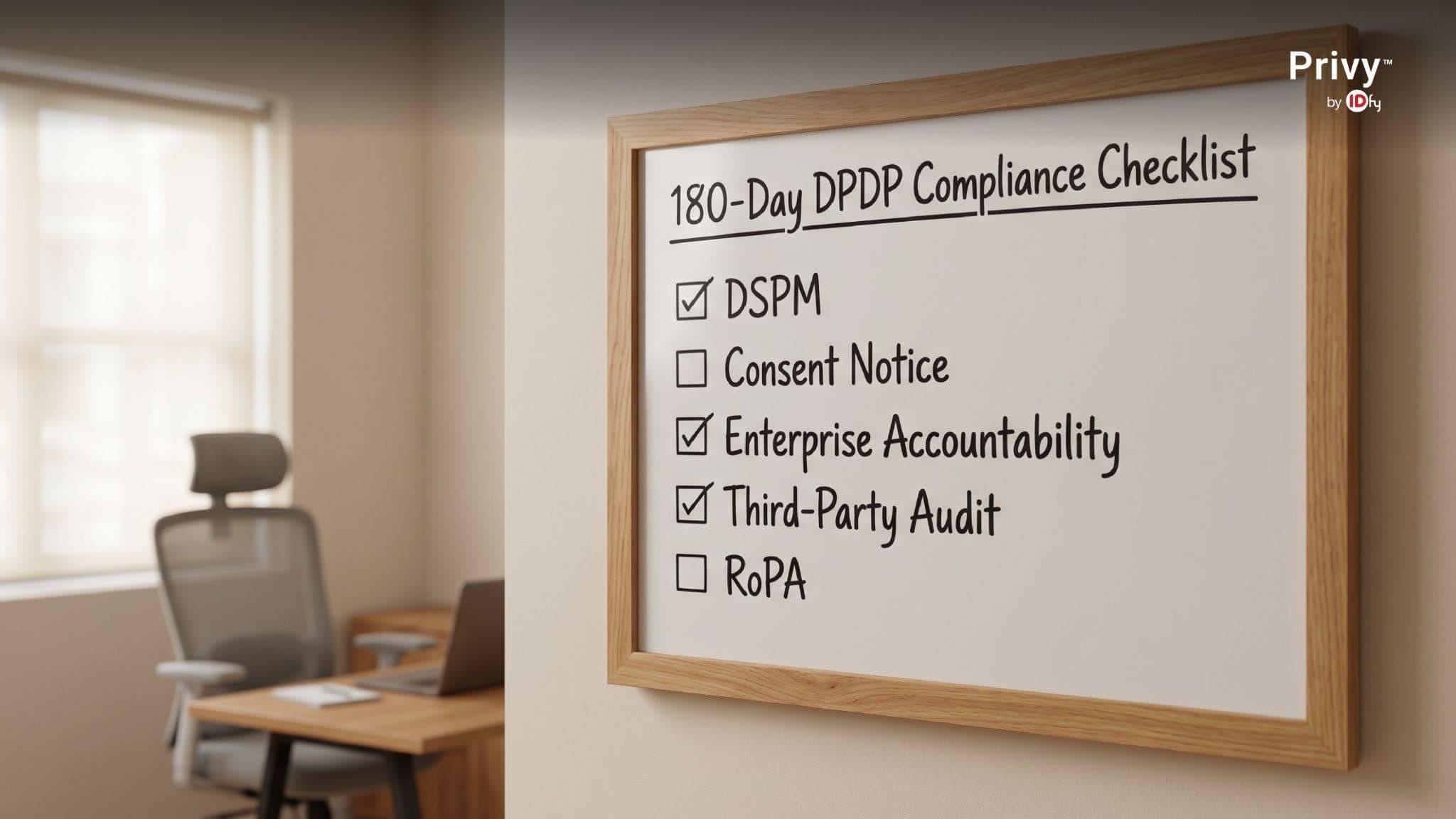
Master DPDP compliance with our 180-day checklist for Indian firms. Mitigate risks, avoid ₹250Cr fines, and leverage AI-powered privacy tools.