

Static vs. Dynamic Data Mapping: Why Your Data Discovery Needs an Upgrade
Date Published
%2520(1).jpg&w=3840&q=75)
In the boardroom, data mapping is often treated as a "check-the-box" compliance exercise, a static snapshot of your organization’s data flows taken once a year. However, in a post-DPDPA landscape, relying on static maps isn't just outdated; it’s a high-stakes gamble with your brand’s reputation and bottom line.
Consider this scenario: Your engineering team migrates a legacy database to a new cloud instance to improve latency. Simultaneously, your marketing department integrates a third-party analytics tool to track user behavior. If you are relying on manual, static data mapping, these shifts go undocumented.
For the modern CXO, data governance is no longer about having a document that says you are compliant; it is about having a system that proves it in real-time. In an ecosystem as volatile as the Indian digital market, a static map is just a historical record of where you used to be safe. To lead, you need a dynamic system that discovers data as fast as your team creates it.
If your data governance strategy relies on quarterly spreadsheets and manual interviews, you aren’t managing risk; you’re documenting history. To stay compliant and competitive, the shift from static to dynamic data mapping isn't just a technical upgrade; it’s a survival instinct.
When Data Mapping Becomes a Historical Artifact
%2520(1).jpg&w=3840&q=75)
In the context of modern data governance, data mapping is the foundational process of identifying how personal data enters your organization, where it is stored, who accesses it, and how it flows across systems until it is eventually deleted.
Historically, organizations have treated this as a point-in-time project. Typically, a consultant or an internal auditor interviews department heads, documents workflows in complex spreadsheets, and delivers what is deemed a "complete" data map.
The problem is that this approach assumes your business environment is fixed. In reality, modern enterprises are constantly evolving ecosystems. A static data map is essentially a snapshot of a moving target; the moment the document is saved, it begins to lose its accuracy.
Where Traditional Data Mapping Breaks Down
When you rely on manual, static records, you create a dangerous gap between your perceived compliance and your actual risk. Consider how quickly your data environment changes in a single quarter:
- Marketing Integration: The growth team plugs in a new SaaS tool for lead generation or customer engagement without notifying the privacy team.
- Engineering Updates: Developers push a new API update or modify a database schema, changing exactly how PII (Personally Identifiable Information) is stored or encrypted.
- Vendor Onboarding: A new third-party vendor is granted access to customer data for cloud analytics or operational support.
None of these shifts is captured in a static spreadsheet. This lack of visibility leads to a state where an organization believes it is in control because it has a document on file, yet it remains completely exposed to "shadow data" and undocumented flows.
The Real-World Risk of Accuracy Gaps
Under the DPDPA and other global mandates, "we didn't know that database existed" is not a valid legal defense. If a regulator requests an immediate Record of Processing Activities (RoPA) or if a customer exercises their right to data erasure, a static map will fail you. You cannot protect, delete, or report on data that you haven't discovered.
True data discovery requires shifting away from manual interviews toward automated, continuous visibility. Without live tracking of how data moves across your systems, your governance framework is built on outdated information, leaving your organization vulnerable to both regulatory penalties and security breaches.
What Data Mapping Should Actually Do
To build a functional data governance framework, you must look beyond simply listing your databases. Effective data mapping should provide a transparent, end-to-end view of your information lifecycle. If your current process isn't answering the following questions accurately and in real-time, it isn't fulfilling its purpose:
- Source and Origin: Where exactly is the data coming from? Is it through a mobile app, a website form, or a third-party API?
- Purpose and Usage: Why are we collecting this specific piece of data? Does the usage align with the consent provided by the user?
- Storage and Location: Where is this data physically and virtually residing? Is it in a local server, a cross-border cloud, or a forgotten test environment?
- Access Control: Who has the permission to view or edit this data? This includes internal employees and external vendors.
- Retention and Deletion: How long are we keeping this data, and is there an automated process to purge it once its purpose is served?
Ultimately, the goal is to create a single source of truth. When a regulator asks for a report or a customer asks for their data to be deleted, you shouldn't have to start an investigation; you should already have the answer.
The Problem With Static Data Mapping
Many organizations rely on manual surveys and spreadsheets to track their data. While this might seem cost-effective initially, it creates significant operational risks that can lead to heavy penalties under the DPDPA.
- High Decay Rate: Businesses change every day. A static map is a snapshot that becomes obsolete the moment a developer adds a new field to a database or a marketer tries a new email tool.
- Human Error and Subjectivity: Static mapping relies on interviews. People often forget to mention shadow systems, temporary files, or manual workarounds they use to get their jobs done. This leaves massive gaps in your data discovery process.
- Operational Drain: Manually updating spreadsheets is a tedious, recurring task. It pulls your legal, IT, and compliance teams away from strategic work to perform data hunting exercises that offer no long-term value.
- Ineffective Incident Response: If a data breach occurs, a static map cannot help you quickly identify which systems were compromised. By the time you verify your manual records, the window for damage control has closed.
Static vs. Dynamic Data Mapping
Choosing between static and dynamic methods is the difference between being reactive and proactive. Here is how they compare across key operational pillars:
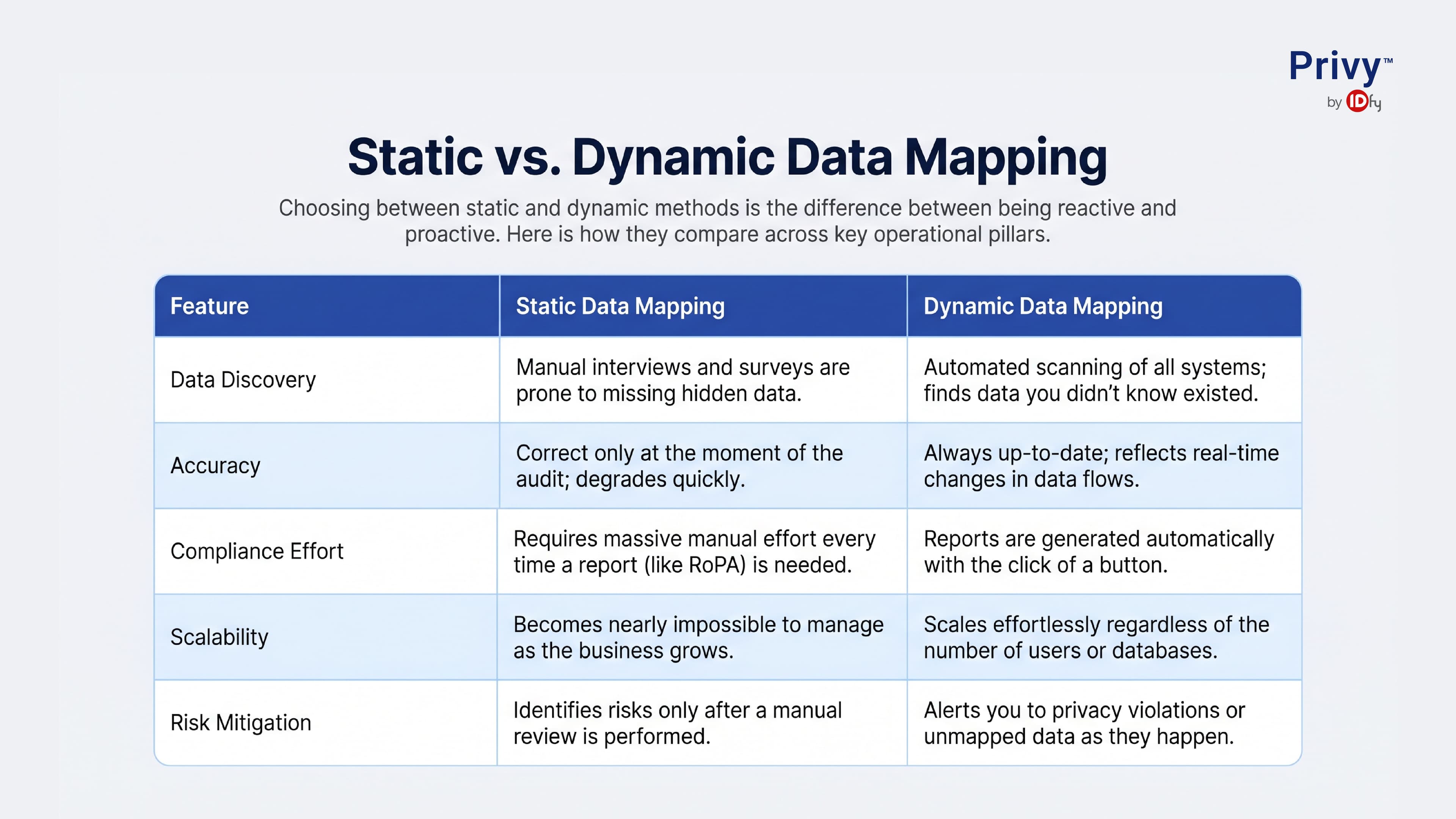
The Dynamic Shift: Real-Time Data Discovery
If static mapping is a photograph, dynamic data mapping is a live CCTV feed. It uses automated data discovery to constantly scan your structured and unstructured databases, identifying sensitive data as it moves.
Think of dynamic mapping like a modern warehouse tracking system. A static system counts the boxes on Monday and assumes they stay there. A dynamic system uses RFID tags (AI-powered metadata) to track every box as it moves from the loading dock to the shelf to the delivery truck.
Why Dynamic Data Mapping Wins:
- Elimination of "Shadow Data": Manual interviews only capture what employees remember. Automated discovery finds the databases your dev team created for a "quick test" three years ago and forgot to delete.
- Instant Impact Analysis: When a schema changes, a dynamic map updates the lineage instantly. You don't have to guess which downstream systems are affected; the map tells you.
- Audit Readiness on Autopilot: Under the DPDPA, "I'll get back to you in two weeks" isn't an acceptable answer to a data principal request. Dynamic mapping ensures your documentation is always current.
Data Discovery: The Engine Under the Hood
You cannot map what you haven't discovered. Data discovery is the investigative arm of your governance framework. While traditional discovery was a manual search-and-find mission, modern discovery is driven by AI.
In the Indian context, where data is often fragmented across legacy systems and modern cloud stacks, AI-driven discovery is the only way to achieve speed. Whether you are a small fintech or a giant NBFC, the volume of records, often in the millions, makes manual discovery a mathematical impossibility.
Dynamic discovery tools don't just find "data"; they understand context. They can differentiate between a random string of numbers and an Aadhaar number, or between a generic email and a customer’s health record. This classification is the bedrock of effective data governance.
Integration and Speed: The New Currency of Trust
For a long time, robust data governance was seen as a "big company" luxury, something only those with massive legal budgets could afford. But the DPDPA is an equal-opportunity regulator. Whether you’re a 10-person startup or a 10,000-person enterprise, the rules of consent and data protection apply.
This is where the "Ken-style" reality check comes in: Compliance that slows you down is a bad product. The goal of dynamic mapping and automated discovery is to increase the velocity of trust. If your integration process takes months, you lose the market. If your data mapping is dynamic, integration becomes "plug-and-play." You can onboard new vendors, launch new products, and enter new markets with the confidence that your privacy "GPS" is recalibrating in real-time. We have also done a detailed blog on how data mapping helps in privacy audits.
How Privy by IDfy Redefines Data Mapping
At IDfy, we realized that the traditional way of doing privacy was broken. It was too slow, too manual, and too disconnected from the actual data flows. That’s why we built Privy by IDfy.
Privy isn't just a tool; it's an intelligent layer that sits across your entire privacy stack. It leverages Inspect AI to perform what we call "Privacy on Autopilot."
How Privy Redefines the Narrative:
- AI-Powered Efficiency: Privy doesn't wait for you to tell it where the data is. Its AI modules scan your digital journeys, detect non-compliant statements in policies, and identify PII fields across structured and unstructured data with pinpoint accuracy, helping in robust data visibility.
- India-First Engineering: We know the Indian landscape, from the nuances of the DPDPA to the specific sectoral mandates of the RBI, SEBI, and IRDAI. Privy offers multilingual support in 22 regional languages, ensuring your consent notices are as inclusive as your customer base.
- Scale Agnostic: Whether you are a mid-scale business looking for quick integration or a large enterprise needing deep-stack governance, Privy’s modular architecture fits your world. We’ve seen it reduce the time for gap assessments from weeks to mere minutes.
- Dynamic Lineage: With Privy’s Data Compass, your data mapping isn't a static document; it’s a living, breathing visualization of your data's journey. It surfaces exposure risks and auto-resolves vulnerabilities before they become headline-grabbing breaches.
In short, Privy transforms your privacy posture from a reactive firefighting mode to a proactive control tower view. We help you move from proving we didn't break the law to proving we are the most trusted partner in the ecosystem.
Conclusion
The choice between static and dynamic data mapping is essentially a choice between being a historian or a navigator. Static mapping tells you where you were. Dynamic mapping tells you where you are and alerts you to the risks ahead.
In an era where data is the new oil, but privacy is the new global currency, you cannot afford to navigate with outdated maps. It’s time to automate your data discovery, fortify your data governance, and let AI-driven mapping handle the heavy lifting.
Because at the end of the day, compliance shouldn't be a hurdle you clear; it should be the track that allows you to run faster.
Ready to move from static spreadsheets to dynamic intelligence? Don't let your data governance be an afterthought. Reach out to us to see how Privy by IDfy can put your compliance on autopilot and build lasting trust with your users. Contact us at shivani@idfy.com for any further queries.

Learn how AI detects hidden privacy risks, strengthens AI data privacy, and supports AI and compliance programs. Discover what AI governance means and how Privy enables proactive AI inspection.
Discover how data mapping simplifies privacy audits, improves data governance, enhances data classification, and builds a structured data catalog.