

How AI Inspection Helps Detect Hidden Privacy Risks Before They Become Compliance Failures
Date Published

Your privacy policy says one thing. Your digital products are doing another. In most enterprises, nobody knows the gap exists until a regulator asks, a researcher publishes, or a customer notices something they never consented to.
This is not a documentation problem. It is a visibility problem. And it is getting harder to manage as AI adoption accelerates across every function: customer support, fraud detection, onboarding, analytics, internal productivity. Each new AI integration adds another surface where personal data moves in ways the compliance team did not design and may not be tracking.
The question is no longer whether AI introduces privacy risk. Every enterprise that has deployed AI tools already knows the answer to that. The question is whether your organisation can detect those risks before they surface as regulatory failures, customer complaints, or breach disclosures. This is where AI governance and AI inspection become operational requirements, not features of a mature programme, but foundations of any programme that will hold up to scrutiny.
The Visibility Gap Nobody Talks About
Most organisations know where their structured enterprise systems are. They have mapped their CRM, their data warehouse, their customer database. What they have not mapped is how AI tools interact with personal data across digital journeys, APIs, plugins, and third-party processors, because that layer changes faster than any manual mapping process can follow.
Consider what is actually happening across a typical enterprise:
- Sensitive customer data is being fed into AI tools that were never reviewed for data protection compliance
- Shadow AI platforms are being adopted by business teams without any oversight from legal or privacy
- Machine learning models are being trained on datasets whose consent scope was never evaluated
- Automated profiling is running on customer segments without a consent record that covers it
None of these appear in the annual privacy audit. They are invisible to questionnaires. They do not show up in a policy review. They accumulate quietly, and they create liability that grows with every additional data principal affected. For a DPDP compliance programme to be more than policy documentation, it needs to see the actual state of the digital environment, not the state teams believe it to be in.
What AI Governance Actually Means
AI governance is not a document. It is not a committee, a policy, or a one-time risk assessment. It is the operating system that keeps AI deployments aligned with data protection obligations as those deployments evolve.
In practice, it addresses four questions continuously, not at the point of product launch, but as long as the system operates:
- Is personal data being collected only for purposes the consent record authorises?
- Is processing staying within the boundaries of what was declared to data principals?
- Are automated decisions affecting individuals in ways that require disclosure or redress?
- Are AI tools and third-party integrations operating within the organisation's consent and regulatory framework?
Without an operational answer to each of these questions, AI becomes a structural blind spot. And the DPDP Act does not excuse blind spots: a data fiduciary is accountable for how personal data is processed, whether or not the fiduciary was aware of the processing happening.
This is why AI governance is moving beyond policy documentation into operational oversight. The organisations treating it as an ongoing capability, closer to financial controls or cybersecurity monitoring than to a periodic compliance review, are the ones that will be able to respond credibly when the Data Protection Board asks how they managed AI-driven data flows. Those that kept governance at the policy layer will be searching for answers in a document that stopped being accurate the day after it was written.
The Shadow AI Problem
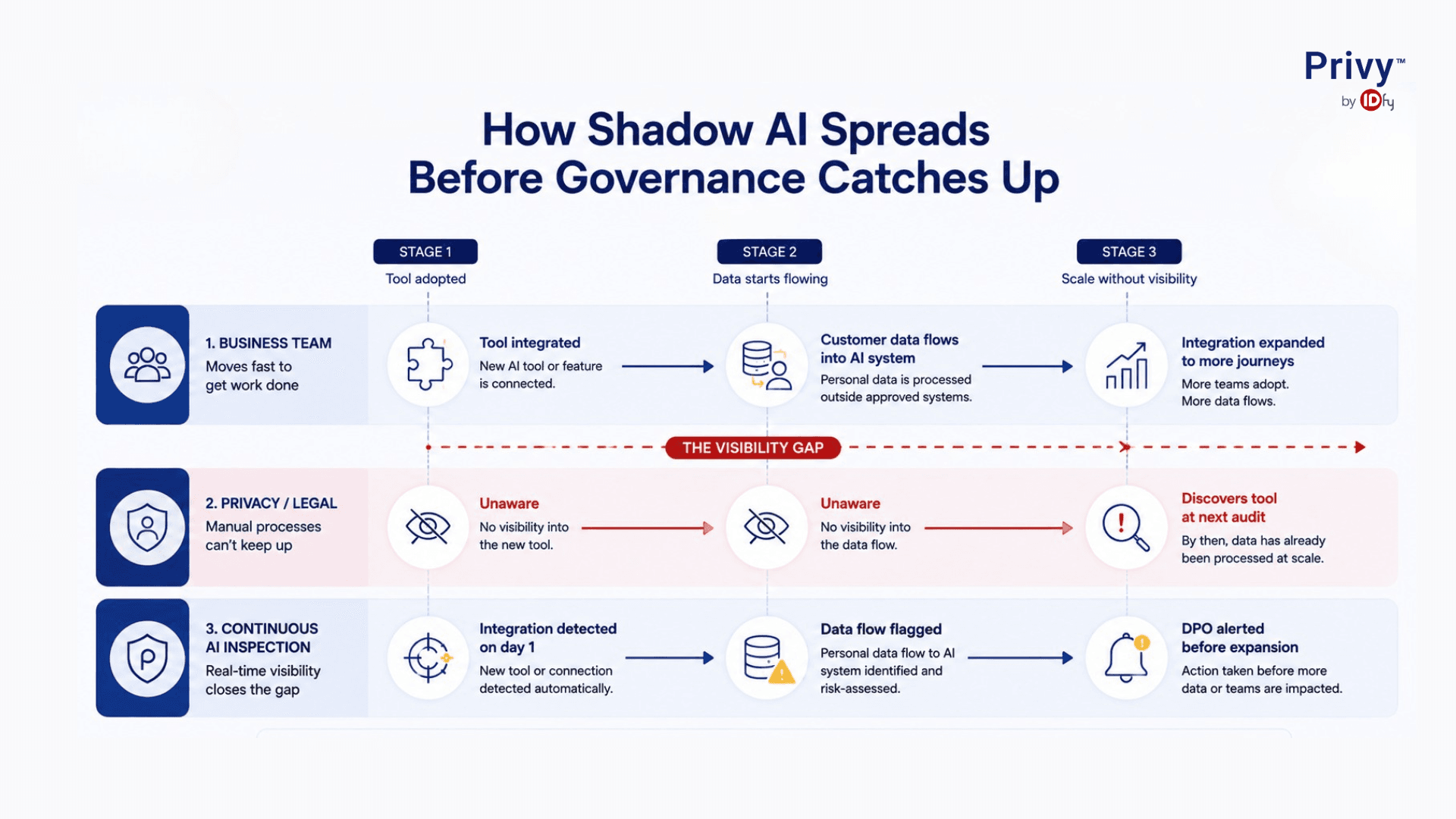
Shadow AI is what happens when the pace of AI adoption inside a business outpaces the governance function's ability to track it.
It looks like this:
- A team lead integrates a generative AI tool into a customer-facing workflow because it is faster than the approved stack
- A vendor quietly embeds a machine learning capability into a platform update that processes personal data under an existing agreement
- A developer connects a customer service chatbot to a third-party AI API without triggering a privacy impact assessment
Each of these happens with good intentions. Each of them bypasses the compliance and data protection review that would determine whether the tool handles personal data appropriately — whether it transfers data outside India, whether it retains data beyond its stated purpose, whether it uses personal data to train models beyond the scope of the original consent.
What makes shadow AI particularly difficult to govern:
- It spreads quietly across business teams before privacy or legal functions become aware of it
- By the time it is discovered, sensitive information may already have been processed, retained, or shared externally
- The processor or vendor controls the infrastructure — the enterprise has no direct visibility into what happened
- Traditional cybersecurity tools identify malware; they cannot determine whether personal data was used beyond its lawful purpose
The answer is not slower AI adoption. It is continuous AI inspection that detects shadow integrations the day they appear, rather than months later when a periodic audit catches up with them.
How AI Inspection Works
AI inspection is the continuous, automated monitoring of digital journeys, data flows, and AI-enabled processes to identify compliance gaps as they form rather than after they have accumulated.
It is categorically different from a manual audit. A manual audit examines what an organisation says it does, declared processing activities, submitted policies, and vendor agreements reviewed by counsel. AI inspection examines what the organisation is actually doing in its live digital environment.
What AI inspection does that no audit can:
- Analyses live user journeys and extracts every data field being collected — including fields that were never documented in the privacy notice
- Determines whether collected fields contain personally identifiable information and classifies them by sensitivity
- Checks whether the privacy notice accurately reflects actual collection practices, surfacing mismatches in real time
- Detects hidden third-party trackers, unapproved AI integrations, and automated profiling triggers that accumulate without any team deliberately adding them
The high-risk patterns AI inspection surfaces:
- Excessive data collection relative to declared purpose
- Consent mismatches where the notice was written before a new integration was added
- Data transfers outside declared purposes or outside approved geographies
- Automated profiling triggers that affect data principal rights without a corresponding disclosure
- Undocumented AI integrations receiving personal data outside any processing agreement
For data visibility programmes that rely on periodic discovery scans, AI inspection operates as the real-time layer that keeps that visibility current between scans, surfacing new data flows and new collection practices the moment they appear in a live digital journey.
Modern AI inspection systems are also beginning to generate automated compliance documentation. Rather than privacy teams manually maintaining records of processing activities, AI inspection tools produce structured visibility into how data is collected, processed, and shared, significantly reducing the risk of undocumented processing that a regulator might later ask to see.
From Static Audits to Continuous AI Compliance
Historically, AI compliance relied on manual reviews: examining policies, evaluating vendor agreements, conducting periodic assessments. That work is necessary. It is also structurally slow in an environment where AI deployments change continuously.
The shift modern AI compliance programmes are making is from episodic reviews to continuous monitoring. AI systems can now:
- Analyse privacy notices for inconsistencies between declared and actual processing
- Flag risky consent flows where the user's understanding may not match what is actually happening
- Identify excessive data collection practices across customer journeys
- Surface gaps in processor accountability as vendor ecosystems expand
- Generate risk prioritisation scores so DPOs concentrate attention where it is most needed
The organisations maturing fastest in AI compliance are not the ones slowing AI adoption. They are embedding governance directly into digital operations, so that privacy review happens continuously alongside product development and deployment, rather than as a checkpoint that follows months behind.
This operational model is what separates AI governance as a functioning capability from AI governance as a document. Risks are caught when they are small rather than after they have affected thousands of data principals.
Proactive AI Governance: What It Enables
When AI inspection is integrated into the governance framework rather than running as a standalone audit tool, the whole programme changes character.
For data protection officers: Real-time visibility into evolving digital interactions replaces reliance on business teams self-reporting what AI tools they have deployed. The DPO's picture of the organisation's processing activities is current, not historical.
For compliance teams: AI inspection surfaces when a new processing activity may trigger additional regulatory obligations - before the product ships, not after an inquiry arrives.
For leadership: Risk posture becomes measurable and current rather than a point-in-time snapshot. When the Data Protection Board asks questions, the answers come from live data, not from a report that was accurate last quarter.
The result is not slower innovation. It is AI adoption that can be defended — because the governance infrastructure to support it was built alongside the deployment, not after it.
As AI ecosystems grow more interconnected, AI governance cannot exist separately from vendor governance and consent governance. AI systems increasingly depend on third-party APIs, external models, analytics processors, and vendor ecosystems. Without unified visibility across these dependencies, privacy risks fragment across the organisation and become difficult to govern coherently.
How InspectAI Delivers This in Practice
InspectAI is Privy's AI compliance copilot, built for exactly the visibility problem described above.
Through Chrome-based inspection capabilities and in-house AI models trained for DPDP regulatory alignment, InspectAI extracts data input fields from digital journeys without capturing personal data itself. It categorises personal information by sensitivity, maps processing purposes against declared privacy commitments, identifies compliance gaps, and flags high-risk scenarios that require further assessment or remediation.
What InspectAI produces for the compliance programme:
- Automated RoPA documentation - reducing the manual burden on data protection officers while improving accuracy
- Continuous compliance scores that give DPOs a live risk signal rather than a post-audit snapshot
- Real-time alerts on consent mismatches, excessive collection, and undocumented AI integrations
- Findings that feed directly into connected workflows - consent governance, PIAs, TPRM, incident management - rather than sitting in a standalone audit report
Privy's Consent Governance Platform works alongside InspectAI, ensuring that consent collection, purpose mapping, and processor management align with what InspectAI is detecting in the live environment. When inspection surfaces a mismatch between what the notice says and what the digital journey collects, the consent governance workflow is where the remediation happens, with tamper-proof consent artefacts and version-controlled audit trails as the evidence layer.
Together, they operationalise AI governance. AI inspection is not a one-time exercise run at product launch. It is a continuous practice embedded into digital ecosystems where AI deployments change faster than any manual review can track. The full-stack DPDP compliance platform that Privy delivers through IDfy connects AI inspection with data discovery, consent lifecycle management, breach response, and third-party risk, so findings from InspectAI drive action across the compliance programme rather than sitting in a queue.
Conclusion
The most dangerous privacy risks in an AI-enabled organisation do not announce themselves. They accumulate in integrations nobody has reviewed, in data fields nobody has documented, in automated decisions nobody has mapped to a consent record. Manual audits find them only after they have matured. Continuous AI inspection finds them when they are still small enough to fix without regulatory consequence.
AI governance that operates only at the policy layer will always lag behind the deployments it is meant to govern. Operational AI governance, inspection, continuous monitoring, and automated documentation are what convert a privacy programme from a document into a defence. To strengthen your AI governance framework and understand how Privy by IDfy improves AI data privacy controls and brings structure to your AI compliance programme, write to shivani@idfy.com.
FAQ’s
What is AI governance and why does it matter under the DPDP Act?
AI governance refers to the systems, policies, and accountability structures that ensure AI operates responsibly and in compliance with data protection obligations. Under the DPDP Act, data fiduciaries are accountable for how personal data is processed — including when it is processed through AI systems, automated decision-making tools, or third-party AI processors. Governance must therefore extend beyond traditional enterprise systems to cover AI integrations, generative AI tools, and vendor-embedded AI capabilities. Without structured AI governance, an organisation cannot demonstrate that personal data is being used within the consent and purpose boundaries the Act requires.
What is shadow AI and why is it a serious privacy risk?
Shadow AI refers to AI tools adopted within an organisation without formal compliance review. It typically appears when business teams integrate AI tools for efficiency without going through privacy or legal assessment. The risk is that sensitive data may be uploaded to third-party systems without proper safeguards, personal information may be used to train models beyond the scope of original consent, and cross-border data transfers may occur without required mechanisms. Shadow AI is particularly difficult to govern because it spreads quietly — by the time compliance teams discover a tool, the exposure may already have affected a large number of data principals.
How is AI inspection different from a traditional privacy audit?
A traditional audit examines what an organisation says it does — declared processing activities, submitted policies, vendor agreements. AI inspection examines what the organisation is actually doing in its live digital environment. It analyses real user journeys, extracts data fields being collected, checks whether privacy notices accurately reflect actual collection practices, and surfaces consent mismatches, undocumented integrations, and high-risk data flows in real time. The core difference: audits examine representations. AI inspection examines reality.
How does AI inspection support data protection officers specifically?
DPOs under the DPDP Act are responsible for maintaining accurate records of processing activities, ensuring consent aligns with actual processing, and overseeing data principal rights. All of these obligations depend on having current visibility into how personal data moves across digital environments. AI inspection provides that visibility continuously — so the DPO's picture of processing activities is based on what is actually happening, not on what teams have self-reported or what was documented at the last audit cycle.
Can AI inspection automate RoPA documentation?
Yes. InspectAI generates structured visibility into how data is collected, processed, and shared across digital environments, which supports automated or semi-automated Records of Processing Activities documentation. The result is a RoPA that reflects actual processing rather than declared processing — more accurate for compliance purposes and significantly less burdensome to maintain than a manually assembled record.
How does AI inspection connect to consent governance?
Consent governance establishes what an organisation has committed to do with personal data. AI inspection determines whether the live digital environment matches those commitments. When InspectAI detects a data field being collected that is not covered by the current consent notice, or a third-party integration receiving personal data not reflected in the processor disclosure, those findings flow directly into the consent governance workflow — triggering notice updates, processor agreement reviews, or remediation steps. Without inspection, consent governance operates on policy documentation. With it, it operates on evidence.
What kinds of organisations benefit most from AI governance tools?
Any organisation that has deployed AI tools in customer-facing journeys, automated decision-making, fraud detection, or analytics — and cannot currently answer with certainty what personal data those tools are collecting, how it is being used, and whether it is being processed within the boundaries of existing consent records. In India, this includes BFSI, fintech, insurance, telecom, healthcare, and e-commerce enterprises where AI adoption has moved faster than governance infrastructure.

On 8th October, at the Global Fintech Fest in Mumbai, regulators and industry leaders debated how fintechs can navigate the DPDPA era. From consent orchestration to purpose mapping and trust accountability, DPDPA compliance will test how fintechs build visibility and integrity into India’s digital finance ecosystem

Unravel the nuances of Personal Data under the DPDP Act 2023, from Direct Identifiers like Aadhaar to quasi-identifiers like buying habits. Learn to shield your digital identity.

What exactly is Personal Data? Is it just the details printed on Government ID cards such as Aadhaar, PAN, Voter ID, and Driving License? Does it also include your phone or Laptop’s IP addresses? Does it include data collected by your smartwatch? What about your medical records such as CT scans?
%2520(1)-1.jpg&w=3840&q=75)
Compare static vs dynamic data mapping. See how Privy by IDfy enables automated discovery and real-time governance for faster compliance. (