

Privacy by Design: A Practical Guide to Implementing It Under DPDP in 2026
Date Published
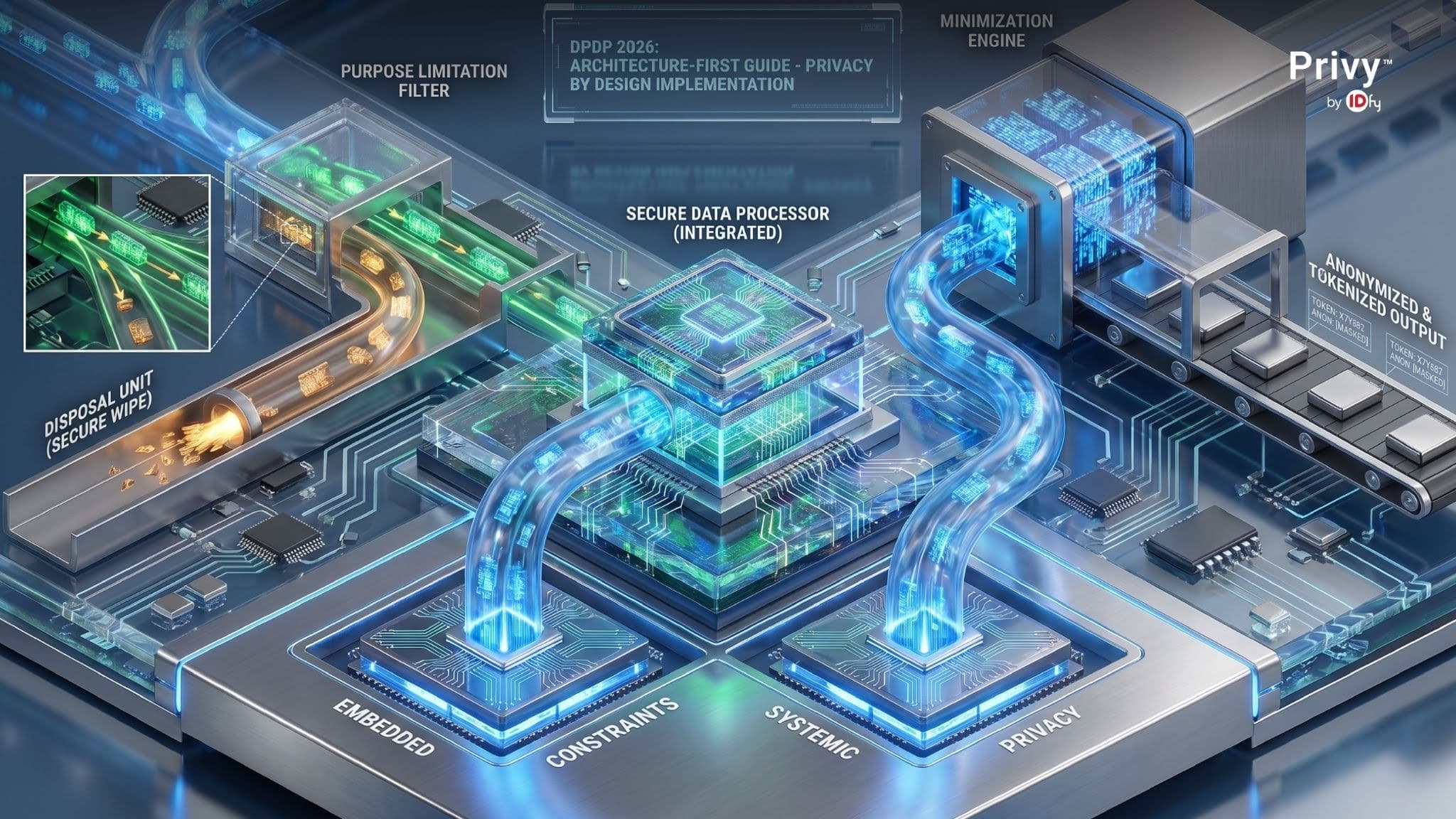
Across industries, privacy by design is no longer a fringe concept. In fact, a recent study by MIT Sloan Management Review India in collaboration with IDfy found that 87.5% of organizations report having internal privacy by design frameworks in place to embed privacy into their business and technology processes.
At first glance, this suggests strong progress. Enterprises appear to be investing in frameworks, policies, and governance structures to align with evolving data protection expectations.
But the same body of research points to a more nuanced reality. While frameworks exist, far fewer organizations have translated them into systems that consistently enforce privacy in real-world operations. This gap reveals a deeper issue. Privacy is not determined by the existence of frameworks, but by how systems are actually designed and behave. This guide breaks down what privacy by design really means in 2026, why it matters, and how to implement it in a way that aligns with evolving DPDP rules and real-world operational constraints.
Understanding Privacy by Design
Before getting into implementation, it is worth grounding what privacy by design actually looks like in practice. It is easy to treat it as a philosophical idea or a compliance buzzword, but in reality, it is a set of very concrete decisions that shape how your system behaves long before a user ever interacts with it.
At its core, privacy by design is about building systems where user privacy is not an afterthought but a constraint that informs every architectural choice. To make that more tangible, here is what it typically involves:
- Defining purpose before collecting data
Every data point in the system should exist for a clearly defined reason. If a purpose cannot be articulated upfront, the data has no place in the system.
- Designing data flows intentionally
Data should not move arbitrarily across systems. Each flow, from collection to storage to processing, must be mapped and justified as part of the system design.
- Embedding data minimization into architecture
Instead of collecting everything and filtering later, systems should be designed to capture only what is necessary from the start. This reduces both risk and operational overhead.
- Linking consent directly to system behavior
Consent should not sit as a static record. It must actively govern what the system does, determining which processes are allowed to run and which are not.
- Ensuring auditability by design
Systems should automatically generate traceable records of actions, showing what happened, when, and why. This is essential for demonstrating compliance under evolving regulatory expectations.
- Making privacy a cross-functional responsibility
Privacy by design does not sit only with legal teams. Product, engineering, and even marketing functions must align to ensure that privacy decisions are consistently implemented.
- Planning for change and reversibility
Systems should be able to respond to consent withdrawal, data correction, or deletion requests without requiring manual intervention or structural changes.
Taken together, these are not isolated practices. They form a cohesive way of thinking about systems where privacy is built into the foundation rather than layered on top.
Once this mindset is in place, compliance stops being a reactive exercise and starts becoming a natural outcome of how the system operates. And that shift, from patching gaps to building with intent, is what makes privacy by design so critical for modern organizations.
With that understanding in place, the next step is to examine why this approach is no longer optional, especially under the expectations set by the DPDP Act.
Where Privacy Fails Without Design: Six Risks That Scale Faster Than You Expect
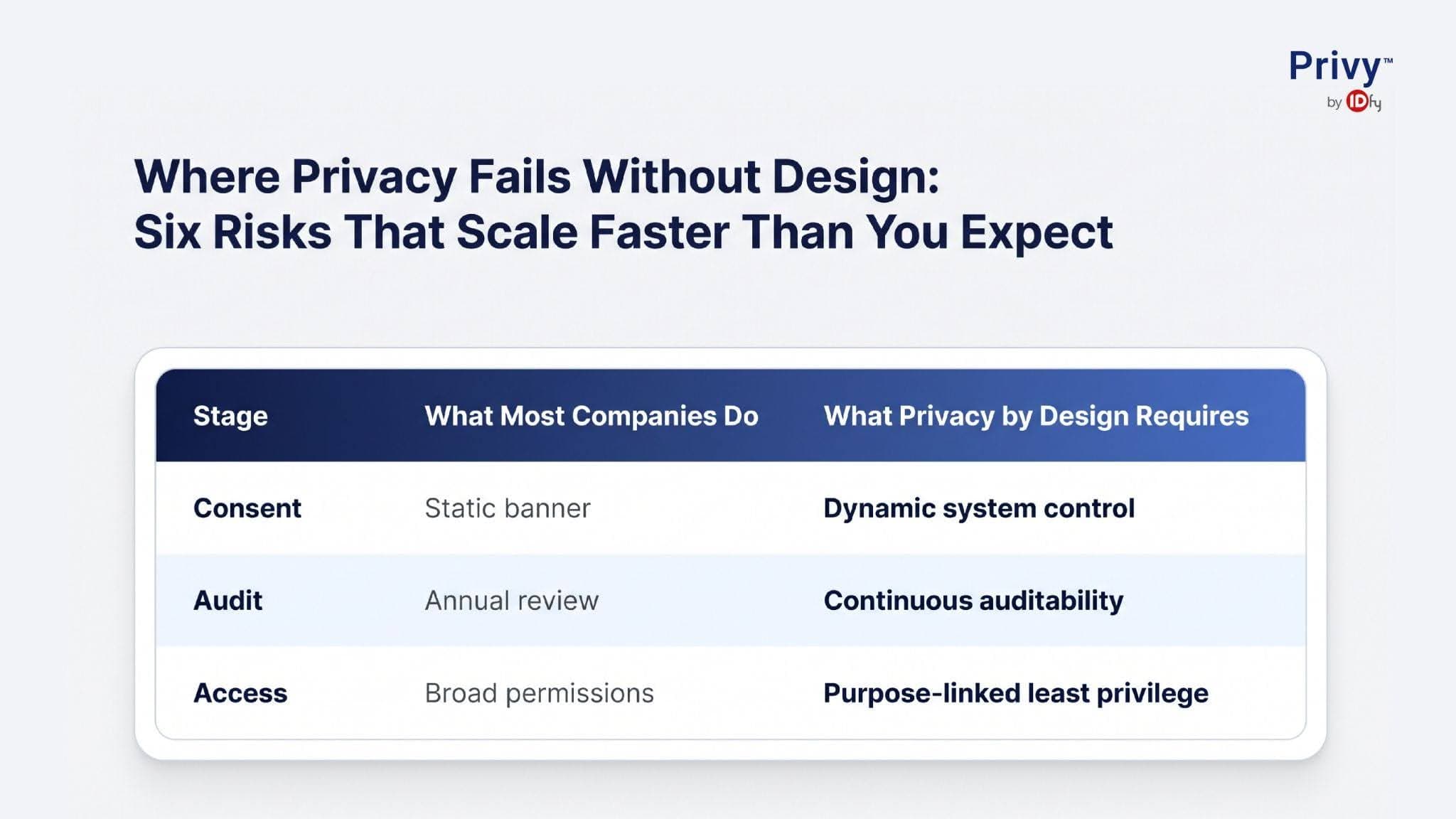
Once privacy by design is understood at a conceptual level, the more practical question is this: what actually happens when it is not embedded into the system?
In most organizations, the early signs are subtle. A workaround here, a manual override there. Nothing that appears catastrophic in isolation. But as systems grow, these small gaps don’t stay contained. They scale, compound, and eventually define how the system behaves. The result is not just non-compliance. It is structural instability. Here are six risks that consistently emerge when privacy is treated as an afterthought rather than a design constraint.
You don’t scale systems. You scale inconsistency.
When privacy is not built into the architecture, there is no single source of truth governing how data is classified, processed, or used. Different parts of the system begin to interpret data differently. What follows is predictable:
- Data classification becomes inconsistent across services
- Processing decisions vary depending on context or team
- Compliance outcomes become difficult to predict or defend
At a small scale, this looks like operational noise. At a larger scale, it becomes systemic unreliability.
Exposure grows faster than the system itself
Every new integration, feature, or partner expands the data surface area. Without strong design controls, these expansions are rarely governed with the same rigor as the original system. Over time:
- Data gets shared without revalidating its original purpose
- Access defaults lean toward convenience rather than least privilege
- External systems begin to reuse data in ways that were never intended
This is where risk stops being linear. It compounds across systems, especially those outside your direct control.
Fragmentation becomes the default operating model
In the absence of a unified design approach, privacy controls tend to emerge in pockets. One tool for consent, another for access control, a separate system for audit logs. Individually, each may work. Together, they rarely align.
- Controls operate in isolation
- Data moves across gaps that no system fully governs
- Data protection rigour is different across teams
- There is no single layer enforcing a consistent policy
Complexity does not reduce. It gets redistributed across systems, making failure harder to detect and even harder to fix.
Compliance becomes a manual exercise
If consent and purpose are not enforced at the system level, teams are left to bridge the gap operationally. That typically means:
- Consent is captured, but not actively enforced
- Teams rely on manual checks and coordination
- Fixes are applied after issues surface, not before
This approach may hold at low volumes. At scale, it introduces delays, errors, and growing operational overhead that is difficult to sustain.
Governance turns reactive
Without built-in visibility into how data moves and changes, governance loses its footing. Decisions are made after something goes wrong, not as part of how the system operates. Common symptoms include:
- Limited traceability of who did what, and why
- Audit preparation that relies on reconstruction rather than records
- Slow response to user requests like access, correction, or deletion
At that point, governance is no longer proactive. It is a response function.
Trade-offs become embedded in the system
Perhaps the most subtle risk is also the most pervasive. When privacy is not part of the design, it begins to compete with other priorities. You start to see decisions like:
- Relaxing controls to move faster
- Expanding access to improve user experience or conversion
- Treating compliance as a constraint rather than a baseline
Individually, these decisions may appear reasonable. Collectively, they shape a system where privacy is continuously deprioritized. And those trade-offs do not remain contained. They scale with the system.
Across each of these risks, a pattern becomes difficult to ignore. The issue is rarely a lack of intent or even awareness. Most organizations today have invested in privacy frameworks, defined policies, and formalized their commitments to data protection in some way. Where things begin to break down is in how these expectations are translated into the systems themselves.
This is where the conversation needs to shift. The presence of a privacy framework, however well-articulated, is no longer sufficient. What increasingly matters is whether the system can uphold those principles consistently, without relying on manual intervention or interpretation.
That raises a more precise and necessary question: what does privacy by design actually look like when it is embedded into the way modern digital systems are built and operated?
Defining Privacy by Design in Today’s Digital Systems
At an operational level, privacy by design is not something you declare. It is something your systems demonstrate. Policies and consent screens may signal intent, but regulators and enterprise customers increasingly look at how data actually moves, changes, and gets used within your systems.
This means privacy decisions have to be translated into architecture. The question shifts from “Are we compliant?” to “Is our system built in a way that makes non-compliance difficult by design?” In practice, that shows up through a few core characteristics:
- Every data element is tied to a clearly defined purpose
Data collection is deliberate, not exploratory. Each field exists because it supports a specific workflow or outcome. This clarity prevents unnecessary accumulation and limits downstream misuse.
- Data flows are mapped and governed end-to-end
Data does not move informally between systems or teams. Its journey, from collection to storage to sharing, is predefined and controlled. This makes it easier to enforce boundaries and avoid unintended reuse.
- System logic enforces privacy constraints automatically
Rules around purpose limitation, retention, and consent are built into how the system operates. Instead of relying on people to remember policies, the system ensures those rules are followed consistently.
- Consent directly influences system behavior
Consent is not a passive record stored for audit purposes. It actively determines what actions the system can take at any given point. When consent changes, the system responds without requiring manual intervention.
- Auditability is built into everyday operations
Systems generate structured, time-stamped records of key actions as they happen. This creates a reliable trail that can be used to demonstrate compliance under the DPDP rules without reconstructing events later.
When these elements are in place, privacy is no longer dependent on periodic reviews or corrective action. It becomes part of how the system functions daily, across scale and complexity.
This is also where the real value of privacy by design starts to show. Beyond meeting regulatory expectations, it creates systems that are easier to manage, extend, and trust over time. That naturally leads to the next discussion: what tangible advantages organizations see when they adopt this approach early.
The Measurable Value of Getting Privacy by Design Right
It is one thing to position privacy by design as a principle. It is far more compelling when the impact shows up in how large, complex organizations actually operate.
Recent research by MIT Sloan Management Review India in collaboration with IDfy offers that perspective. The study draws on inputs from 75+ CXOs across enterprises with over USD 1 billion in revenue, many with workforces exceeding 20,000 employees. The focus is not theoretical. It examines how privacy is operationalized under India’s data protection landscape, particularly in the context of the Digital Personal Data Protection Act 2023. What stands out is not just adoption, but how privacy begins to influence system design, risk posture, and business outcomes when implemented with intent.
Privacy Moves Beyond Consent into System Visibility
Organizations that take privacy by design seriously tend to start with one fundamental shift: they make data visible before trying to control it.
- ~75% use automated tools for data discovery and classification
- Data is treated as a mapped asset, not an abstract concept
- Visibility reduces ambiguity in how data is collected, processed, and reused
This is often the first inflection point. Without visibility, privacy remains a policy exercise. With it, privacy starts becoming enforceable.
Privacy Becomes an Institutional Capability, Not a Policy Layer
A large majority of organizations report having internal frameworks that embed privacy into both business and technology processes.
- ~87.5% have structured privacy-by-design frameworks
- Privacy decisions are distributed across product, engineering, and data teams
- Frameworks begin to influence how systems are built, not just how they are reviewed
At this stage, privacy stops being episodic and starts becoming part of the operating model.
Risk Extends Beyond the Enterprise Boundary
One of the more definitive signals from the study is how organizations are approaching third-party risk.
- 100% track the effectiveness of privacy controls in vendor evaluations
- Data sharing is increasingly tied to measurable control standards
- Partner ecosystems are treated as extensions of the system, not external abstractions
This reflects a more mature understanding of exposure. Risk is no longer confined to internal systems.
Technology Becomes the Enforcement Layer
There is near-universal alignment on one point: privacy cannot be sustained manually at scale.
- 100% rely on technology to implement privacy frameworks
- System-level enforcement replaces policy-driven interpretation
- Continuous monitoring begins to replace periodic audits
At the same time, execution challenges remain visible:
- 100% cite developer bandwidth and awareness as constraints
- ~50% report legacy systems and fragmented tooling as barriers
This is where many organizations stall. The intent is clear, but architecture has not fully caught up.
Privacy Starts Influencing AI and Data Strategy
Privacy by design is also shaping how organizations approach emerging use cases like AI.
- ~75% use anonymized or synthetic data for model training
- Data governance is being aligned with future AI risk considerations
- Privacy constraints are beginning to inform how data is prepared and consumed
This signals an important shift. Privacy is no longer backward-looking. It is influencing the forward strategy.
The Business Impact Becomes Tangible
Perhaps the most important shift is how privacy is being viewed commercially.
- ~50% estimate that a major privacy breach could impact ARR by ~25%
- ~64% see strong privacy practices improving customer retention
- Privacy is increasingly tied to trust, revenue protection, and growth
At this point, privacy is no longer framed as a compliance cost. It becomes part of the value equation.
Taken together, these patterns point to a clear direction. Privacy by design is not just about improving compliance outcomes. It is creating systems that are easier to manage, more predictable under scale, and better aligned with both regulatory and business expectations.
The natural next step is to move from outcomes to mechanics. If this is what effective privacy by design delivers, the question that follows is straightforward: what does it actually look like when these principles are translated into the architecture of modern digital systems?
Practical Steps to Implement Privacy by Design
The benefits of privacy by design are reasonably well understood at this point. The harder part is translating that intent into systems that behave consistently, without depending on manual oversight or periodic clean-up exercises.
That shift requires a more deliberate approach. Privacy has to be expressed through design and engineering decisions, not left to interpretation. In practice, that means building a sequence of capabilities where each layer reinforces the next, reducing ambiguity in how data is handled across the system. This is the core philosophy behind IDfy’s Privy, a platform designed to bring every data source into a single, governed view through a systematic Scan-Classify-Act framework.
Step 1: Map your data flows, classify data, and assess risk
Before building or modifying any system, it is essential to understand what data exists and how it moves. This goes beyond basic documentation. It requires a living view of the system where data flows are visible, classified, and continuously evaluated.
- Map data flows end-to-end: Document what data is collected, where it originates, how it moves across services, who processes it, and where it is stored. Privy automates this discovery by supporting over 200+ connectors, allowing organizations to scan structured data, unstructured assets, and even endpoint devices to create a comprehensive PII catalogue.
- Classify data with speed and accuracy: Visibility alone is not sufficient. Data needs to be categorized based on sensitivity, regulatory relevance, and business context. IDfy’s multi-modal classification engine, the most accurate for Indian PII, uses advanced techniques like Named Entity Recognition (NER), Bounding Box analysis for images, and transcription for audio to identify over 50+ Indian PII classes (Aadhaar, PAN, Voter ID, etc.) with high fidelity.
- Translate classification into risk-aware decisions: Once data is classified, the next step is to understand what risk it introduces and what level of protection is appropriate. By mapping every sensitive data element to its precise location, Privy provides a unified risk posture. This allows teams to identify high-risk domains and subdomains, ensuring that protection is proportionate to the regulatory and breach risk involved.
When done well, this step creates a foundation that is both exhaustive and usable. Teams are not guessing what data exists or how sensitive it is. They are working with a shared, system-wide understanding.
Step 2: Define the purpose for every data element
With visibility and classification in place, the next layer is purpose. Every piece of data should answer two questions: why does it exist, and what function does it serve within the system? If that purpose is unclear, the data has no place in the architecture.
- Purpose becomes the anchor for all downstream decisions
- It limits unnecessary data accumulation
- It prevents data from being repurposed without explicit justification
This step is where data collection shifts from being exploratory to being deliberate.
Step 3: Link consent directly to processing behavior
Consent should not sit as a static record captured at a point in time. It needs to actively govern what the system is allowed to do.
- Tie consent to specific purposes, data elements, and processing actions
- Ensure that system workflows check the consent state before execution
- Allow consent changes to dynamically alter system behavior
This turns consent into a control mechanism rather than a compliance artifact.
Step 4: Enforce protection through PETs and access control
Once purpose and consent are defined, enforcement has to happen at the system level. This is where privacy-enhancing technologies (PETs) and access control mechanisms become central.
- Apply protection based on data sensitivity: Use encryption, tokenization, anonymization, or masking depending on classification and risk. The goal is to ensure that data is protected not just at rest, but throughout its lifecycle. Privy enables automated remediation actions, such as masking Aadhaar numbers or blocking unauthorized cross-border transfers based on custom policies.
- Implement granular access control: Move beyond broad, role-based access where possible. Enforce least privilege by ensuring that users and systems only access what is necessary for a defined purpose. Context-aware and attribute-based access controls can significantly reduce unintended exposure.
- Protect data in use, not just in storage: Many systems secure data at rest and in transit but overlook how it is handled during processing. PETs help bridge this gap by enabling safer computation and controlled exposure even during active use.
This layer is where privacy stops being theoretical. The system begins to enforce boundaries automatically and consistently.
Step 5: Build auditability into everyday operations
For privacy by design to hold under scrutiny, systems need to generate reliable, structured records of what happens to data.
- Capture what action was taken, when it happened, and why it was allowed
- Ensure logs are tamper-resistant and easily retrievable
- Enable audit readiness without reconstructing events retrospectively
By tracing data lineage- the origins, movements, and transformations of data- Privy builds auditability into the very fabric of the data landscape.
Auditability, when built in this way, becomes a natural byproduct of system operation rather than a separate compliance effort. Taken together, these steps create more than a checklist. They establish a way of building systems where privacy is embedded into everyday operations. Data is understood, risk is contextualized, and protection is applied proportionately and consistently.
As organizations begin applying these principles across multiple systems, the next challenge is not implementation in isolation, but consistency at scale. That raises a broader question: how do you ensure that privacy by design becomes a shared discipline across teams, rather than something applied unevenly across products and functions?
Recommended Approaches for Embedding Privacy by Design
Once the implementation steps are in place, the next challenge is consistency. Privacy by design often begins as a focused initiative within a team or a specific product. The real test is whether it can be applied uniformly across systems, functions, and workflows without creating fragmentation. This requires a shift in how organizations treat data and how different teams interact with it.
Treat data as infrastructure, not an add-on
Data needs to be approached with the same discipline as core system components. It is not an optional layer that can be adjusted later. Decisions around how data is collected, structured, classified, and used have to be treated as foundational to the system itself.
This is particularly relevant in the Indian context, where data ecosystems tend to be large, fast-moving, and deeply interconnected across business units and third-party partners. Without a strong foundational approach, scale quickly amplifies inconsistency.
Avoid fragmented tooling and disconnected systems
When privacy controls are distributed across multiple tools that do not communicate, gaps are not just possible; they are inevitable. A unified privacy by design framework ensures:
- Consistent enforcement of policies across systems
- Centralized visibility into data flows and controls
- Lower operational overhead as systems scale
This becomes critical in India, where enterprises often operate with a mix of modern platforms and legacy systems. Fragmentation here is not just a technical issue. It becomes a governance risk.
Design systems for reversibility and change
Systems must be able to respond to consent withdrawal, data deletion requests, and changes in processing purpose without requiring manual intervention.
This is not a theoretical requirement. Under the Digital Personal Data Protection Act 2023, user rights are expected to be exercised at scale, and increasingly in near real time. Systems that cannot adapt dynamically will struggle to keep up with both regulatory expectations and user behavior.
The India Reality: Scale, Speed, and Structural Complexity
Embedding privacy by design in India comes with a distinct set of challenges. Enterprises are not only dealing with large volumes of data, but also with:
- Highly distributed data across business units and third parties
- Rapid product and feature iteration cycles
- Large user bases that can exercise rights at scale
- Increasing expectation of real-time, digital-first compliance
As discussed in recent industry conversations with practitioners, including global GDPR experts and Indian DPOs, privacy is not just a compliance exercise. It is an organization-wide transformation. It touches every process that handles personal data, which in practice means almost every process.
This has two implications. First, privacy cannot be owned by a single function. Second, it cannot be implemented incrementally without a clear operating model.
Lessons from a Decade of GDPR
There is a clear precedent for what happens when organizations delay embedding privacy into their systems. Over the past decade, under the General Data Protection Regulation, three patterns have consistently emerged:
- Fines for weak foundations: Many penalties were not due to breaches alone, but due to the inability to demonstrate why data was processed in a certain way. Lack of documented intent and system-level enforcement proved costly.
- Operational breakdown at scale: Organizations struggled to respond to user requests within mandated timelines because systems were not designed for retrieval, traceability, or control.
- Erosion of trust and revenue impact: Beyond regulatory action, customer trust took a hit. In several cases, this translated into measurable business impact, from churn to lost enterprise deals.
The common thread across these outcomes was not the absence of policy, but the absence of design. India is at an earlier stage of this journey. The advantage is the ability to build differently from the outset. The risk is repeating the same pattern at a much larger scale.
Technology Enablement: Moving from Theory to Practice
By this stage, the direction is clear. Privacy by design is not a policy exercise, and it is not something that can be sustained through manual processes. As systems scale, the volume of data, number of touchpoints, and regulatory expectations make manual oversight impractical.
What organizations need instead are systems that enforce privacy automatically and consistently, without relying on individual teams to interpret or apply rules differently. A strong technology infrastructure can significantly improve outcomes:
- From fragmented controls to a unified view of privacy operations
Most organizations operate with disconnected tools for consent, data mapping, and compliance tracking. Platforms like Privy consolidate these into a single layer, giving teams a 360-degree view of how data is collected, processed, and governed across the lifecycle.
- From static consent records to active consent governance
Privy treats consent as a dynamic control mechanism. It manages the full consent lifecycle, from capture and storage to verification and withdrawal, ensuring that system behavior aligns with user permissions at all times.
- From manual audits to continuous compliance monitoring
Instead of preparing for audits retrospectively, systems are designed to remain audit-ready. Privy enables real-time monitoring of data flows, processing activities, and risk points, reducing the effort required to demonstrate compliance under the DPDP rules.
- From documentation-heavy compliance to system-enforced behavior
Privacy is not treated as a set of documents or policies. It is embedded into how systems function, with automated checks, purpose limitation, and traceable audit logs built into the execution layer.
This shift improves not just compliance readiness, but operational clarity. Teams no longer have to reconcile fragmented systems or data flows, as the system itself provides a consistent and enforceable view of privacy.
As organizations adopt this model, privacy by design moves from isolated efforts to a system-wide discipline, where compliance becomes continuous and predictable rather than a one-time milestone.
Enabling Privacy by Design Through Platforms Like Privy
As systems grow in complexity, manual coordination across teams and tools becomes impractical. This is where a unified technology layer begins to play a critical role.
Platforms like Privy by IDfy are designed to operationalize privacy by design by bringing together key capabilities into a single system layer:
- End-to-end data visibility across collection, processing, and sharing
- Dynamic consent management that directly governs system behavior
- Automated policy enforcement aligned with purpose and risk
- Continuous audit readiness with structured, real-time logs
- Third-party risk visibility integrated into the data lifecycle
This shifts privacy from a fragmented set of controls to a unified, enforceable system capability.
Taken together, these approaches ensure that privacy by design is not limited to isolated implementations. It becomes part of how the organization builds and operates systems at scale, aligned with both regulatory expectations and business realities.
Conclusion
Privacy by design is not an add-on. It is how systems need to be built. Under the DPDP Act 2023, treating privacy as an afterthought leads to higher operational effort and greater regulatory risk. Systems that are not designed for privacy tend to rely on patches, workarounds, and manual controls that do not scale.
Organizations that build with privacy at the core operate differently. Compliance becomes more predictable, systems are easier to manage, and trust is reflected in actual system behavior.
The starting point is simple. Map your data, define purpose, and ensure your systems enforce those rules automatically. If you are looking to build or re-architect with a strong privacy by design framework, reach out at shivani@idfy.com to explore how Privy can help you operationalize it effectively.
FAQ's
What does “privacy by design” actually mean in practical terms?
Privacy by design means building systems where data protection is enforced through architecture, not policy. It requires defining purpose before data collection, controlling how data flows across systems, and ensuring that consent, access, and retention rules are embedded directly into system logic rather than managed manually.
How is privacy by design different from traditional compliance approaches?
Traditional approaches rely on policies, audits, and manual checks after systems are built. Privacy by design shifts this upstream. It ensures that systems are constructed in a way that makes non-compliance difficult, reducing reliance on corrective actions and ongoing operational intervention.
Why is privacy by design critical under the Digital Personal Data Protection Act 2023?
The DPDP Act evaluates organizations based on how data is actually handled in practice. This includes how consent is enforced, how data flows across systems, and how quickly organizations can respond to user requests. Without system-level enforcement, maintaining compliance at scale becomes operationally difficult.
What are the biggest challenges Indian enterprises face in implementing privacy by design?
Common challenges include fragmented systems, a lack of unified data visibility, heavy reliance on legacy infrastructure, and the scale of user data. Many organizations also struggle to translate policy requirements into engineering decisions, especially across distributed teams and third-party ecosystems.
Where should organizations start when implementing privacy by design?
The starting point is data visibility. Organizations need to map data flows, classify data based on sensitivity, and understand associated risks. From there, they can define purpose, link consent to processing, and enforce controls through system design.
How does data classification improve privacy implementation?
Data classification allows organizations to apply proportionate controls. Instead of treating all data the same, systems can enforce stronger protections for sensitive data while reducing unnecessary friction for lower-risk data. This improves both security and operational efficiency.
What role do privacy-enhancing technologies (PETs) play?
PETs such as encryption, tokenization, and anonymization help protect data across its lifecycle, including during processing. They ensure that even when data is accessed or used, exposure is minimized and controlled in line with risk and purpose.
How can organizations handle consent effectively at scale?
Consent needs to function as a dynamic control layer. Systems should check consent status before executing any data processing action and automatically adapt when consent is withdrawn or modified. This removes the need for manual enforcement and ensures consistent behavior.
What lessons can Indian organizations learn from a decade of General Data Protection Regulation?
A key lesson is that delayed adoption leads to higher costs. Many organizations faced fines, operational disruptions, and loss of customer trust because privacy was not embedded early. The most common failures were not due to a lack of policy but a lack of system-level enforcement and auditability.
How do platforms like Privy by IDfy help implement privacy by design?
Platforms like Privy provide a unified layer for managing data visibility, consent, policy enforcement, and auditability. They reduce fragmentation by consolidating privacy operations into a single system, enabling organizations to enforce privacy consistently across their data lifecycle without relying on manual processes.

Learn how to conduct a privacy impact assessment step by step. A practical guide to Privacy Impact Assessments and data privacy risk management.

Understand the difference between PIA and DPIA, when to conduct a privacy impact assessment or data privacy impact assessment, and how organizations can strengthen data privacy compliance with Privy.