

PIA vs DPIA: What’s the Difference Between Privacy Impact Assessment and Data Privacy Impact Assessment?
Date Published
In an era where every click, interaction, and digital exchange generates personal information, safeguarding data privacy isn’t just a best practice; it’s an organizational imperative. However, how do businesses systematically evaluate and mitigate privacy risks associated with data processing? Two critical tools in this landscape are the Privacy Impact Assessment (PIA) and the Data Protection Impact Assessment (DPIA). Though sometimes used interchangeably, these assessments are distinct and serve different purposes in managing privacy risk.
In this blog, we will clarify the differences between PIA and DPIA, explore when each is needed, and explain how organizations can leverage these assessments to strengthen trust and ensure compliance.
What Is a Privacy Impact Assessment (PIA)?
A privacy impact assessment (PIA) is a structured evaluation that helps organizations identify, assess, and mitigate privacy risks in business processes, new systems, technologies, or programs that involve personal information. It focuses on how personal information is collected, used, managed, stored, shared, and protected, giving organizations a holistic view of privacy impacts before they occur.
PIAs are widely regarded as good practice, providing a proactive framework to highlight weak spots in privacy processes and ensure systems comply with relevant laws and expectations around data privacy. They also help instill “privacy by design” principles early in project development or strategy implementation.
For example, when launching a new platform that handles user identities, a PIA helps determine:
- What personal information will be processed
- How consent will be captured and honored
- What data security safeguards are in place
- Whether the privacy controls are sufficient to protect individuals’ rights
PIAs are versatile and can be applied across jurisdictions, though they are not always legally mandated like DPIAs. Wondering how to conduct privacy impact assessments, step by step? We have done a detailed blog for better insights and understanding.
What Is a Data Protection Impact Assessment (DPIA)?
A data protection impact assessment (DPIA), on the other hand, is a specific type of privacy evaluation that focuses on the risks associated with processing personal data, especially in cases where that processing might result in a high risk to individuals’ rights and freedoms. DPIAs are a core requirement under global data protection frameworks such as the Digital Personal Data Protection (DPDP) Rules 2025 and the EU General Data Protection Regulation (GDPR).
Under these laws, DPIAs aren’t optional; they are a legal obligation whenever a planned data processing activity is likely to pose a “high risk,” such as:
- Large-scale profiling or automated decision-making
- Processing sensitive personal data (health, genetics, biometrics)
- Systematic monitoring of individuals
- Deploying new technologies that could impact privacy at scale
The major responsibilities of a DPIA include:
- Describe the processing activities in detail
- Assess potential risks to people’s privacy rights
- Propose mitigation strategies to reduce or eliminate risks
- Document these findings for compliance and audit purposes
Because of their legal force and specific requirements, DPIAs often include more formal documentation and regulatory scrutiny compared to general PIAs. You can read more about what DPIA is and get more insights in our comprehensive blog here.
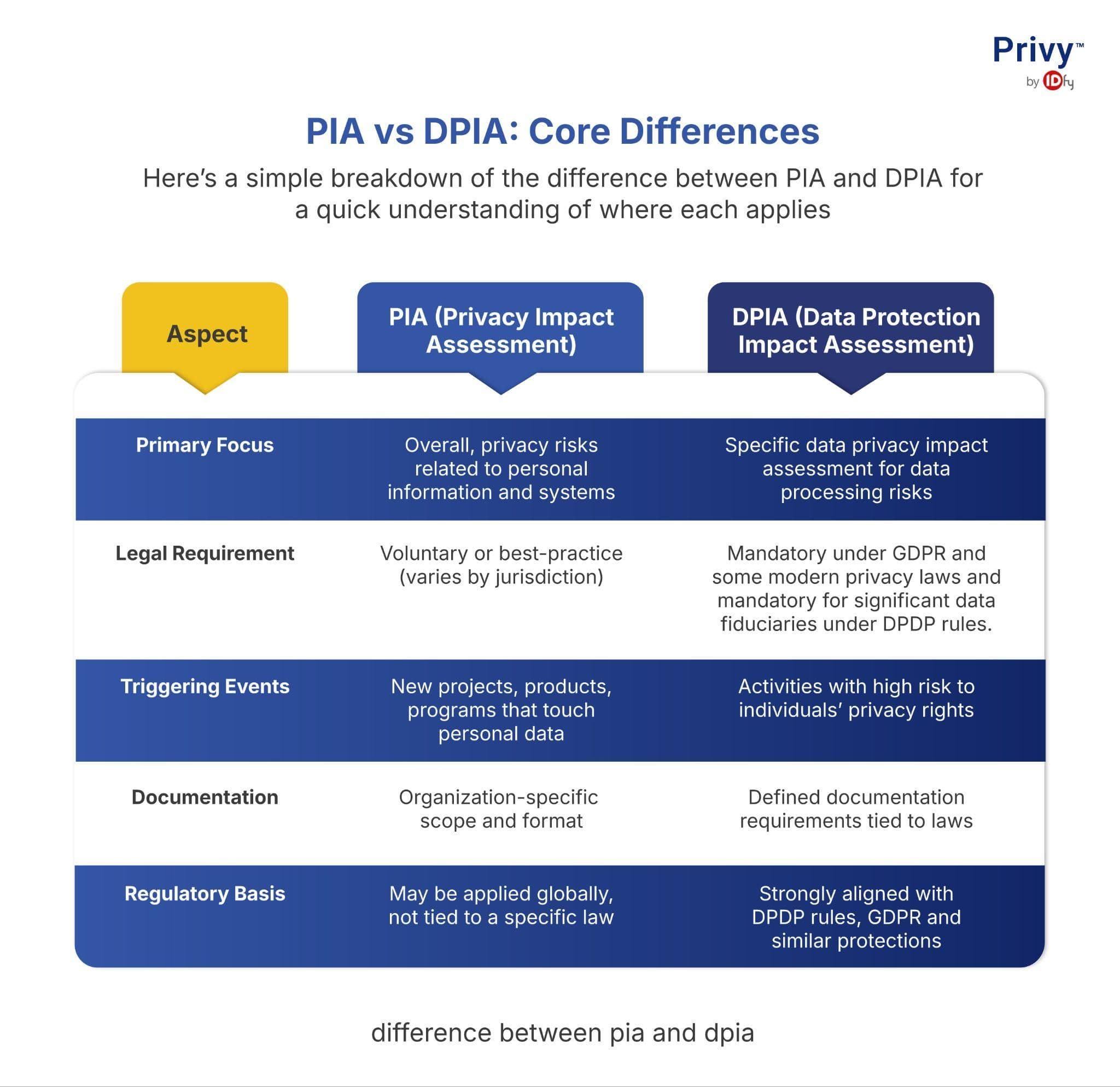
In short, all DPIAs are kinds of PIAs, but not all PIAs are DPIAs. A DPIA is essentially a legally required, more rigorous subset of a broader privacy impact assessment, especially where data privacy is at stake. Read about the top 7 DPIA tools in this blog to make a more informed decision while choosing the DPIA tool for your enterprise.
Importance of Privacy Impact Assessments
Both PIAs and DPIAs are essential tools in the modern privacy toolkit. They provide several key advantages:
1 . Proactive Risk Management
By evaluating privacy risks early in a project lifecycle, organizations can prevent costly compliance failures, breaches, and reputational damage.
2 . Compliance and Accountability
DPIAs, in particular, help organizations demonstrate compliance with data protection laws such as DPDP. PIAs support broader accountability and governance in privacy practices.
3 . Trust and Transparency
Conducting these assessments signals to customers, regulators, and partners that your organization values data privacy and is committed to protecting individual rights.
4 . Better Decision-Making
When privacy considerations are embedded early, teams can make more informed decisions about design, technology choices, and vendor relationships.
How Privy by IDfy Helps Organizations Navigate PIA and DPIA
At Privy by IDfy, we understand that conducting privacy and data privacy impact assessments isn’t just about ticking a compliance box; it’s about building trust, safeguarding rights, and enabling innovation responsibly. Privy’s suite of consent governance platforms, Privy Cookies Manager, and Privy Inspect AI, helps organizations seamlessly integrate privacy assessments into their workflows. Here’s how Privy supports your privacy and compliance journey:
- Automated Assessment Workflows
Privy streamlines PIA and DPIA execution with guided templates, clear checkpoints, and actionable insights, helping teams quickly identify and categorize risk across systems.
- Centralized Data Mapping & Documentation
With Privy’s intuitive dashboards, organizations can map personal data flows, store assessment artefacts, and maintain consistent documentation, a critical requirement for DPIA compliance under GDPR-like frameworks.
- Continuous Monitoring & Updates
Data processing activities evolve, and so should privacy assessments. Privy enables continuous tracking and alerts for changes that might trigger reassessment or more stringent DPIA requirements.
- Integration with Privacy Controls & Consent Management
Privy’s consent solutions tie directly into assessment outputs, ensuring that user consent practices align with risk findings and compliance protocols.
In short, Privy not only helps organizations understand the difference between PIA and DPIA, but it also empowers them to operationalize privacy impact assessments confidently, efficiently, and in alignment with global privacy standards.
Conclusion
Understanding the difference between PIA and DPIA is essential for modern businesses that handle personal data. While both aim to assess and mitigate privacy risks, PIAs provide a broader privacy evaluation, and DPIAs offer a legally mandated, structured way to measure high-risk data processing under frameworks like DPDP rules. Both assessments reinforce responsible data use, build trust, and support compliance in an increasingly regulated privacy landscape.
If you’re ready to strengthen your privacy posture and integrate impact assessments into your compliance strategy, reach out to us at shivani@idfy.com. We’d love to help.

Dive into the complex world of code privacy violations including sensitive data sharing and excessive collection. Learn why knowing data storage isn't enough.

Learn what a Privacy Impact Assessment is, its purpose, the differences between PIA and DPIA, and why privacy laws rely on them.

How to choose the right privacy impact assessment tool. Explore the best data privacy management software & understand how to conduct an assessment
Discover the best incident management software and incident management tools for privacy incidents. Learn how to choose the right incident management system and how Privy helps organizations stay compliant and audit-ready.