

How to Choose the Best Privacy Incident Management Software in 2026
Date Published
Privacy incidents are no longer rare disruptions; they have now become operational realities. From accidental disclosures and unauthorized access to regulatory breaches under the Digital Personal Data Protection Act, 2025, organizations today must treat privacy incidents with the same urgency as cybersecurity threats.
However, spreadsheets, emails, and fragmented workflows are not enough. Modern enterprises need structured, auditable, and intelligent incident management software to respond quickly, contain risks, and demonstrate compliance.
In this blog, we shall explore what makes the best incident management tools, what features truly matter, and how organizations can build a future-ready incident management system designed for privacy governance.
Importance of Privacy Incident Management Software
A privacy incident is not just a technical glitch. It can mean regulatory scrutiny, reputational damage, financial penalties, and erosion of customer trust.
Under India’s Digital Personal Data Protection Act, 2025, a personal data breach includes unauthorized processing, accidental disclosure, alteration, destruction, or loss of access to personal data. The Act requires Data Fiduciaries to implement reasonable security safeguards and notify authorities and affected individuals in case of a breach. This means incident response must be fast, documented, auditable, repeatable, and compliant.
An effective incident management system ensures that when something goes wrong, your organization does not scramble; it executes. We have also done an in-depth analysis of what privacy incident management is and how to mitigate it in another blog. Do give a read for more insights.
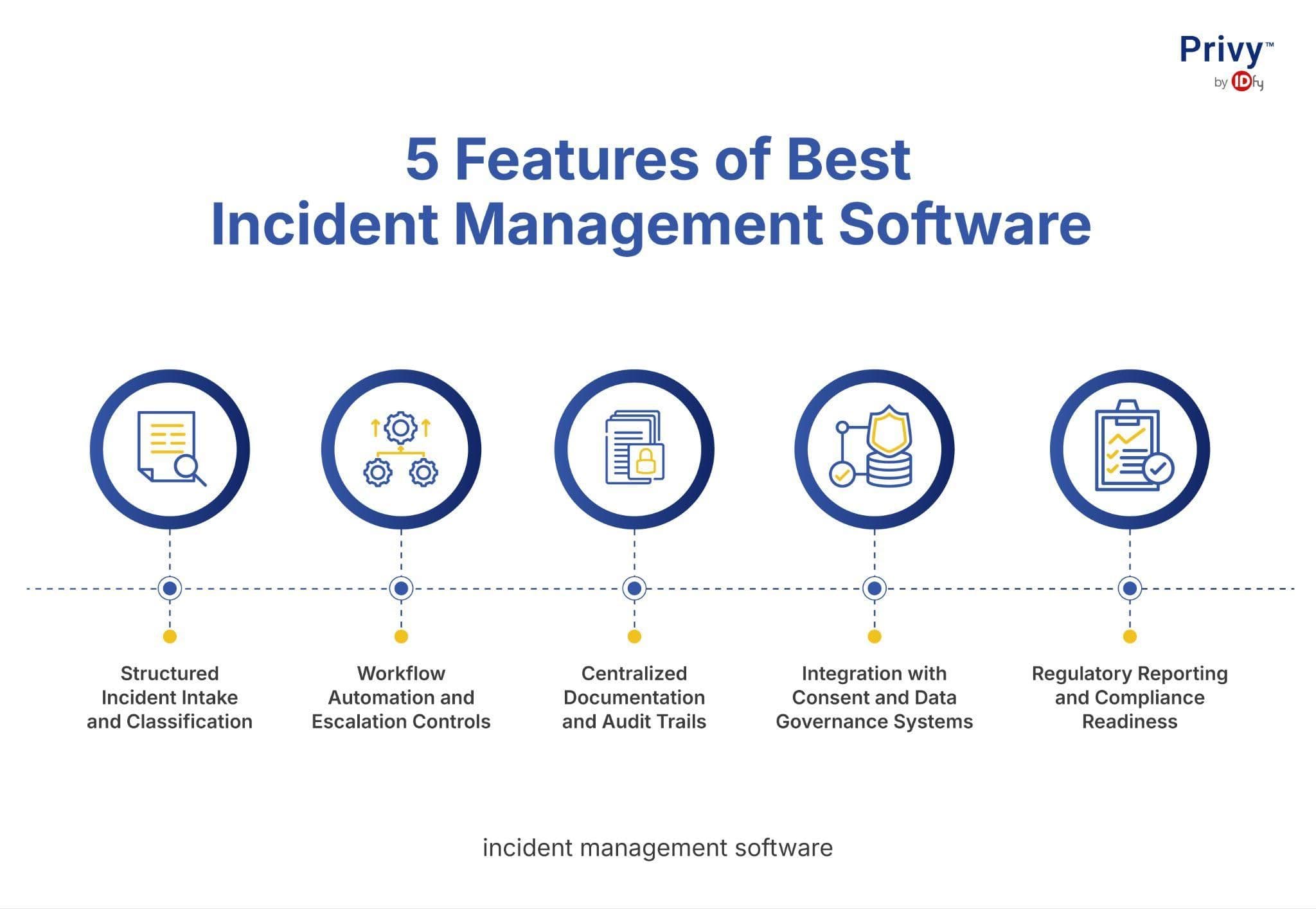
5 Features of Best Incident Management Software
Every incident management tool is not built for privacy. Traditional IT service management tools focus on uptime and system outages. Privacy incidents, however, require a different lens: legal defensibility, consent mapping, regulatory reporting, and cross-functional collaboration. Here are the core capabilities to look for:
1 . Structured Incident Intake and Classification
The best incident management software allows teams to log incidents in a standardized way. Whether reported by IT, customer support, compliance, or a third-party processor, every incident should be captured through a consistent workflow. Key capabilities include:
- Customizable intake forms
- Categorization (data breach, unauthorized access, consent violation, misconfiguration, etc.)
- Risk scoring models
- Auto-assignment to relevant teams
Without structured intake, organizations lose valuable response time and audit clarity. You can also read about the top causes of privacy incidents in this detailed blog of ours.
2 . Workflow Automation and Escalation Controls
An effective incident management tool automates what can be automated. This includes:
- SLA tracking
- Escalation to legal or DPO teams
- Regulatory notification reminders
- Documentation checkpoints
Automation reduces human error and ensures that high-risk privacy incidents receive immediate attention.
3 . Centralized Documentation and Audit Trails
Privacy regulators care about evidence. What happened? When it happened? Who responded to it? And what remediation steps were taken? Your incident management system should maintain:
- Immutable audit logs
- Version-controlled documentation
- Decision records
- Communication history
A well-maintained audit trail transforms an incident from a liability into a defensible event.
4 . Integration with Consent and Data Governance Systems
Privacy incidents are rarely isolated. They often relate to:
- Incorrect consent configuration
- Misaligned processing purposes
- Data shared with unauthorized processors
- Outdated privacy notices
The best incident management software integrates with consent governance platforms, RoPA repositories, and data processor inventories. This creates contextual intelligence rather than siloed reporting.
5 . Regulatory Reporting and Compliance Readiness
Under the DPDP Act, organizations must notify the Board and affected Data Principals in case of a personal data breach within the first 72 hours of the data breach. An advanced incident management system should support:
- Pre-configured regulatory templates
- Notification timelines tracking
- Evidence bundles for regulators
- Exportable compliance reports
This is where privacy-focused incident management tools outperform generic IT systems.
Categories of Incident Management Tools in the Market
Organizations typically evaluate three broad categories:
1 . IT-Centric Incident Management Software: Strong in operational workflows but limited in the privacy governance context.
2 . GRC-Based Incident Management Systems: Good for compliance alignment, but often complex and heavy to deploy.
3 . Privacy-Native Incident Management Tools: Designed specifically for regulatory compliance, consent management integration, and audit defensibility.
The right choice depends on your regulatory exposure, data volume, and governance maturity.
How Privy by IDfy Strengthens Privacy Incident Management
At Privy, we recognize that privacy incidents do not happen in isolation. They are often symptoms of governance gaps in consent management, processor oversight, notice configuration, or data journey design. Our ecosystem helps organizations proactively reduce incidents and respond effectively when they occur.
1 . Privy Consent Governance Platform (CGP)
Privy CGP enables structured consent lifecycle management aligned with the DPDP Act. It supports:
- Configurable consent notices based on business processes
- Mapping of consent purposes to processing purposes
- Data processor management
- Automated Records of Processing Activities (RoPA)
- Version control of consent artifacts
- Comprehensive audit trails
Each consent artifact is stored in a tamper-proof, immutable format with hashing and versioning mechanisms. This ensures evidentiary integrity during incident investigations.
When a privacy incident relates to consent, such as unauthorized processing or improper purpose mapping, CGP provides traceability.
2 . Privy Inspect AI: Proactive Risk Detection
Manual compliance reviews are time-consuming and reactive. Privy Inspect AI acts as a compliance copilot for Data Protection Officers. Through its intelligent Chrome plugin and in-house AI models trained for DPDP compliance, Inspect AI:
- Identifies personal data fields across digital journeys
- Categorizes sensitive and non-sensitive data
- Automates RoPA identification
- Generates DPDP-compliant consent notices
- Detects non-compliance in privacy policies and terms
By identifying compliance gaps before go-live, Inspect AI reduces the probability of privacy incidents occurring in the first place.
3 . Privy Cookie Manager
Many privacy incidents originate from improper tracking practices. The Privy Cookie Manager enables:
- Cookie discovery and categorization
- Banner activation and customization
- Preference management
- Real-time compliance visibility
This reduces risks related to unauthorized tracking and misconfigured consent banners.
Building a Privacy-First Incident Management System
Choosing incident management software is not just about features. It is about maturity. Ask yourself:
- Do we have a single source of truth for consent artifacts?
- Can we trace which processor accessed which data and for what purpose?
- Are our audit logs tamper-proof and version-controlled?
- Can we demonstrate compliance within hours, not weeks?
An ideal incident management system should sit at the intersection of consent governance, data processor oversight, regulatory compliance, real-time monitoring, and immutable auditability. This is where Privy’s incident management tool comes in handy.
Conclusion
The next evolution of incident management tools will not be reactive ticketing systems. They will be governance engines.
They will predict incidents using AI, continuously validate compliance gaps, align consent with processing, automate reporting, and preserve evidentiary integrity.
Organizations that invest in privacy-native incident management software today will not just manage incidents better, but they will also prevent them. While privacy incidents are inevitable, regulatory penalties and reputational damage are not.
The right incident management software provides structure, speed, and defensibility, and integrates governance into every workflow. They also turn compliance from a burden into a strategic advantage.
If you are evaluating how to strengthen your privacy incident response framework or want to understand how Privy can support your governance journey, we would be happy to connect.
Reach out to us at shivani@idfy.com to explore how Privy can help you build a resilient, audit-ready privacy ecosystem.

Dive into the complex world of code privacy violations including sensitive data sharing and excessive collection. Learn why knowing data storage isn't enough.

Learn what a Privacy Impact Assessment is, its purpose, the differences between PIA and DPIA, and why privacy laws rely on them.

How to choose the right privacy impact assessment tool. Explore the best data privacy management software & understand how to conduct an assessment

Understand the difference between PIA and DPIA, when to conduct a privacy impact assessment or data privacy impact assessment, and how organizations can strengthen data privacy compliance with Privy.