

Navigating the DPDP Era with Consent Governance
Date Published
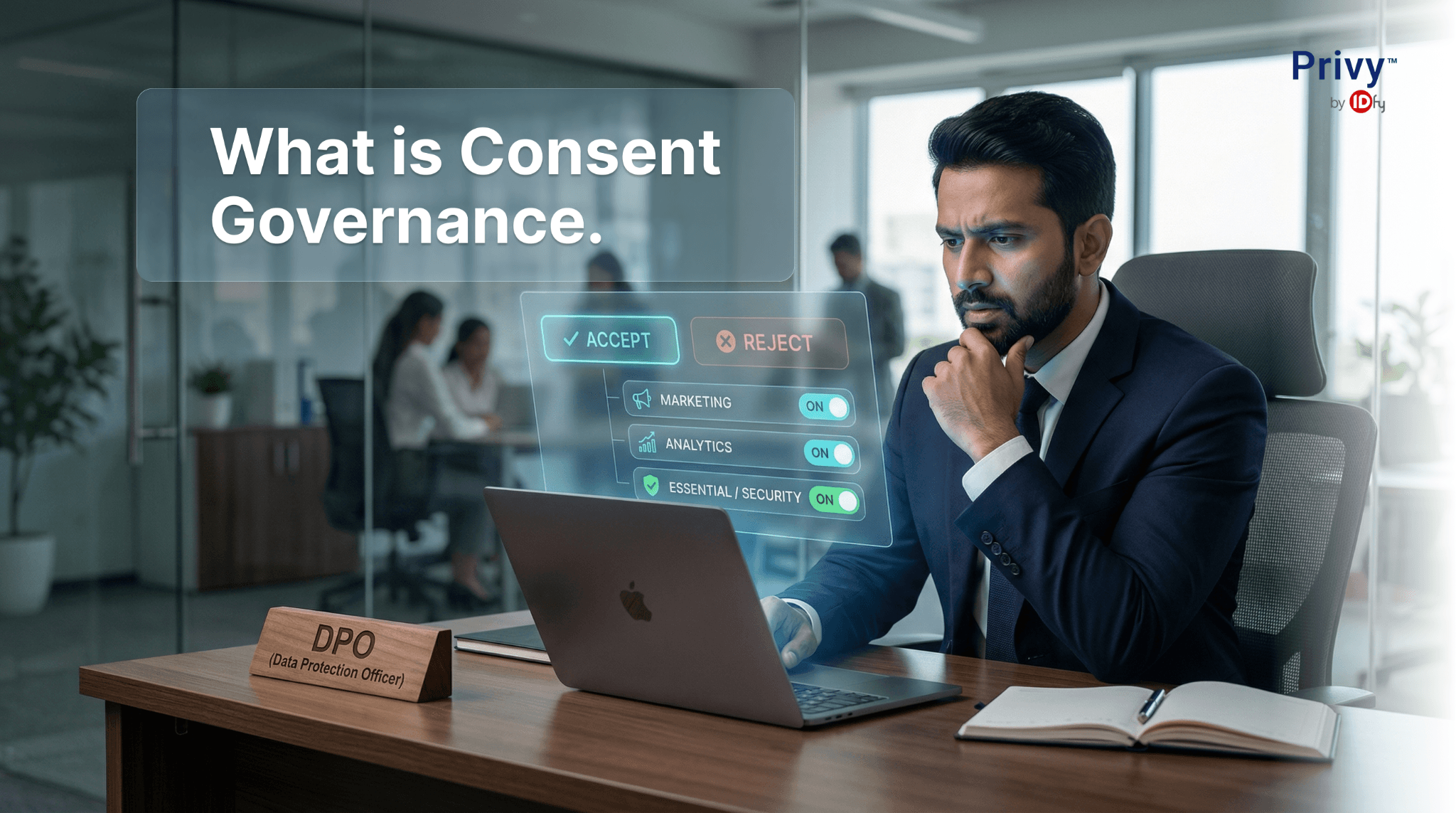
For any large-scale Indian institution, be it a Tier-1 bank managing millions of savings accounts, or a healthcare conglomerate handling sensitive patient records, the regulatory landscape has just shifted from recommended to perilous.
The Digital Personal Data Protection (DPDP) Act is no longer a distant cloud on the horizon; it is the ground on which we stand. Organizations that continue to treat data as a grab-and-store commodity are standing on a fault line. Under the new regime, a single lapse in handling a user’s "Yes" or "No" through your online consent management system can result in penalties of up to ₹250 crore.
But the risk isn't just financial. In an era where digital trust is the primary differentiator, failing to provide a clear consent notice or mismanaging the backend lifecycle is a reputational scarlet letter. To survive, the transition from simple consent management to robust consent governance is mandatory.
What is Consent Governance?

If you manage a hospital, you don’t just tuck patient records away in a secure folder; you govern them through strict access protocols, retention limits, and disposal schedules.
Consent management is the "signature" that allows you to create the record, but governance is the framework that ensures a surgeon can see the medical history while the billing clerk only sees the insurance details. It dictates how long that record lives, who can move it, and exactly when it must be purged to protect patient privacy. Without this layer, a "protected" record is just a liability waiting to be mishandled.
Consent Governance is the strategic framework that oversees the entire lifecycle of a user's permission. It isn't just about the "Accept" button on your app or a basic online consent management banner. It is the systemic infrastructure that ensures:
- Creating an Artifact: Every consent event generates a tamper-proof digital receipt (an artifact) stored securely by your consent management system.
- Enforcement: Your backend systems (like a Core Banking Solution or a Student Information System) literally cannot access a data field unless a valid, unrevoked consent artifact is present.
- Doing an Audit: You can prove, at any microsecond, who agreed to what, when, and in which consent notice version. However, an audit trail is only as good as the actions it enables. Under the DPDP Act, this auditability must power Data Principal Rights Management (DPRM), the true heart of modern privacy. Beyond just logging a preference, your management tool must operationalize these rights.
- Seamless Revocation: The audit must show an instant kill switch effect. If a parent withdraws consent, the tool must prove that downstream marketing systems stopped using that data immediately.
- Correction & Erasure: You need a verifiable trail showing that when a user exercised their right to be forgotten or corrected, the change cascaded across all silos, not just the front-end form.
- Grievance Redressal: If challenged by the Data Protection Board, your audit logs serve as your primary defense, documenting that you responded to user requests within legal timelines.
Accountability isn't just about keeping records; it’s about demonstrating that the Data Principal remains in the driver’s seat of their own information lifecycle.
What is Consent Management?
While governance is the strategy, consent management is the tactic. It refers to the specific tools and processes used to collect and store user preferences.
In a school setting, consent management is the digital form parents sign to allow the school to use their child's photo in a newsletter. It handles the interface, the consent notice, and the database that records the response. However, online consent management often operates in a silo. Without governance, the marketing team might still use that photo even after the parent withdraws consent because the management tool didn't talk to the content tool. This is why a sophisticated consent manager is required to bridge the gap between collection and actual data usage.
Parental Consent & The Identity Challenge
While collecting consent from an adult is a one-to-one interaction, parental consent under the DPDP Act is a three-way architectural challenge. The law defines anyone under 18 as a child, and platforms are now legally required to obtain verifiable parental consent (VPC).
The keyword here is verifiable. A simple "I am over 18" checkbox or a parent’s self-declared name is no longer sufficient. As industry experts note, the Indian internet has long operated on a "convenient lie" where age was self-declared. The DPDP Act ends this era, moving the burden of proof onto the organization.
A major talking point in Indian tech circles today, highlighted by recent analysis in CXO Digital Pulse, is the identity-relationship gap. While we can verify an individual’s identity via Aadhaar or DigiLocker, there is currently no seamless, national digital registry that links a parent to a child for instant online verification. This creates a structural mismatch:
- The Cost of Compliance: For gaming and ed-tech companies, the cost of verifying a minor can be significant (estimates suggest up to ₹1.5 crore per million checks).
- The Global Discrepancy: Most global platforms (like Instagram or TikTok) set their age threshold at 13. India’s higher bar of 18 creates a massive compliance blind spot for those "mid-teen" years (13-18) where users are digitally active but legally require parental intervention.
Consent vs. Governance in Practice
Returning to our school example: a sophisticated consent management system must do more than just store a signature. If a 16-year-old signs up for an educational app, the system must:
- Detect Age: Use age-gating (like Aadhaar-based "Proof of Age" tokens) to trigger the minor-specific flow.
- Verify the Guardian: Use government-authorized mechanisms (like DigiLocker or virtual tokens) to confirm the parent's identity.
- Bridge the Gap: Ensure the marketing AI doesn't include that 16-year-old in a "targeted ads" bucket, as the DPDP Act strictly prohibits behavioral monitoring or targeted advertising directed at children.
Implicit vs. Explicit Consent
Under the DPDP Act, the lines have been redrawn. The days of "by using this site, you agree to our terms" are over. Your online consent management strategy must now account for these two distinct paths.
Explicit Consent
This is the gold standard. For most processing activities, especially marketing, profiling, or sharing data with third parties, consent must be free, specific, informed, unconditional, and an unambiguous affirmative action.
- Example: A bank must ask explicitly via a clear consent notice if it can use your KYC data to pitch you a credit card. You cannot bundle such consent into the account opening terms.
Implicit Consent
The DPDP Act replaces deemed consent with certain legitimate uses. The scope is narrower than before. It applies when a user voluntarily provides data for a specific, obvious purpose.
Example: If a patient walks into a clinic and shares their symptoms for a diagnosis, the clinic has implicit consent to process that data for that specific treatment. They do not have consent to sell that data to a pharma company without a fresh consent notice.
Consent Management and First-Party Data
With the death of third-party cookies and the tightening of the DPDP Act, first-party data (data you collect directly) is the only reliable asset left for Indian businesses. However, first-party data is only an asset if it is backed by a rigorous consent management system.
- Trust as a Service: When a BFSI institution provides a transparent online consent management preference center where users can toggle their data permissions, it builds immense brand equity.
- Data Cleanliness: Governed consent management ensures that your marketing funnels are only populated by high-intent users who want to hear from you, drastically increasing conversion rates and reducing "spam" complaints. Here’s a detailed blog on personalisation vs privacy for a better understanding of what the new rules of DPDP add to data cleanliness.
Features to Expect from a Modern Consent Management Platform (CMP)
When evaluating an online consent management solution, look for these governance-ready features:
- Multi-Channel Collection: Does the consent management system work on web, mobile, SMS, and physical kiosks?
- Dynamic Notice Orchestration: Can it automatically serve a consent notice in all 22 scheduled Indian languages?
- Immutable Logs: Are consent receipts hashed and stored by the consent management system in a way that is legally defensible in court?
- Granular Preference Centers: Can users opt out of marketing but stay opted in for security alerts through the consent management interface?
- Automated Revocation: Does it trigger a delete command across your entire tech stack the moment a user withdraws? We have also done a detailed blog on Incident management under DPDP for more insights.
How Privy by IDfy is Solving the Consent Governance Crisis
For most Indian institutions, the sheer volume of legacy data and incoming data makes DPDP compliance feel like trying to change the tires on a moving truck. Privy was built as the specialised operating system for this transition, acting as a robust consent manager for the modern enterprise.
1. AI-Powered Gap Analysis
Privy doesn't just wait for you to tell it what's wrong. Its AI Compliance Co-pilot module scans your existing digital journeys and databases to identify dark patterns or unconsented data collection points. It evaluates your current online consent management flows and provides a comprehensive gap assessment in minutes, not months.
2. Speedy, No-Code Integration
Whether you are a startup or a legacy bank, engineering bandwidth is always a bottleneck. Privy provides a library of ready-to-use SDKs and APIs that allow for consent management integration in days. Its notice orchestrator lets your legal team update a consent notice once and have it reflect across all platforms instantly, without a single line of code from your developers.
3. Built for Indian Scale
Privy is a consent management system designed for the unique complexity of India. From handling 22-language translations for every consent notice to managing the massive transaction volumes of a national-scale retail chain, it ensures that your online consent management grows at the speed of your business.
Conclusion
In the DPDP era, ignorance of the law is a ₹250 crore mistake. If your institution handles personal data, be it student records, bank statements, or customer emails, you are now a data fiduciary. The responsibility to employ an effective consent manager and govern that data is no longer optional.
Consent Governance is the bridge between being a "target" for regulators and being a leader in the digital economy. Transition to holistic consent management today. Don't let a compliance gap become a crisis. Secure your data lifecycle and build a foundation of trust with your customers.
To see Privy in action or for a strategic audit of your online consent management flows, contact us at shivani@idfy.com.

Consent Governance under the DPDP Act: a transformative approach ensuring compliance, fostering trust, and redefining customer engagement

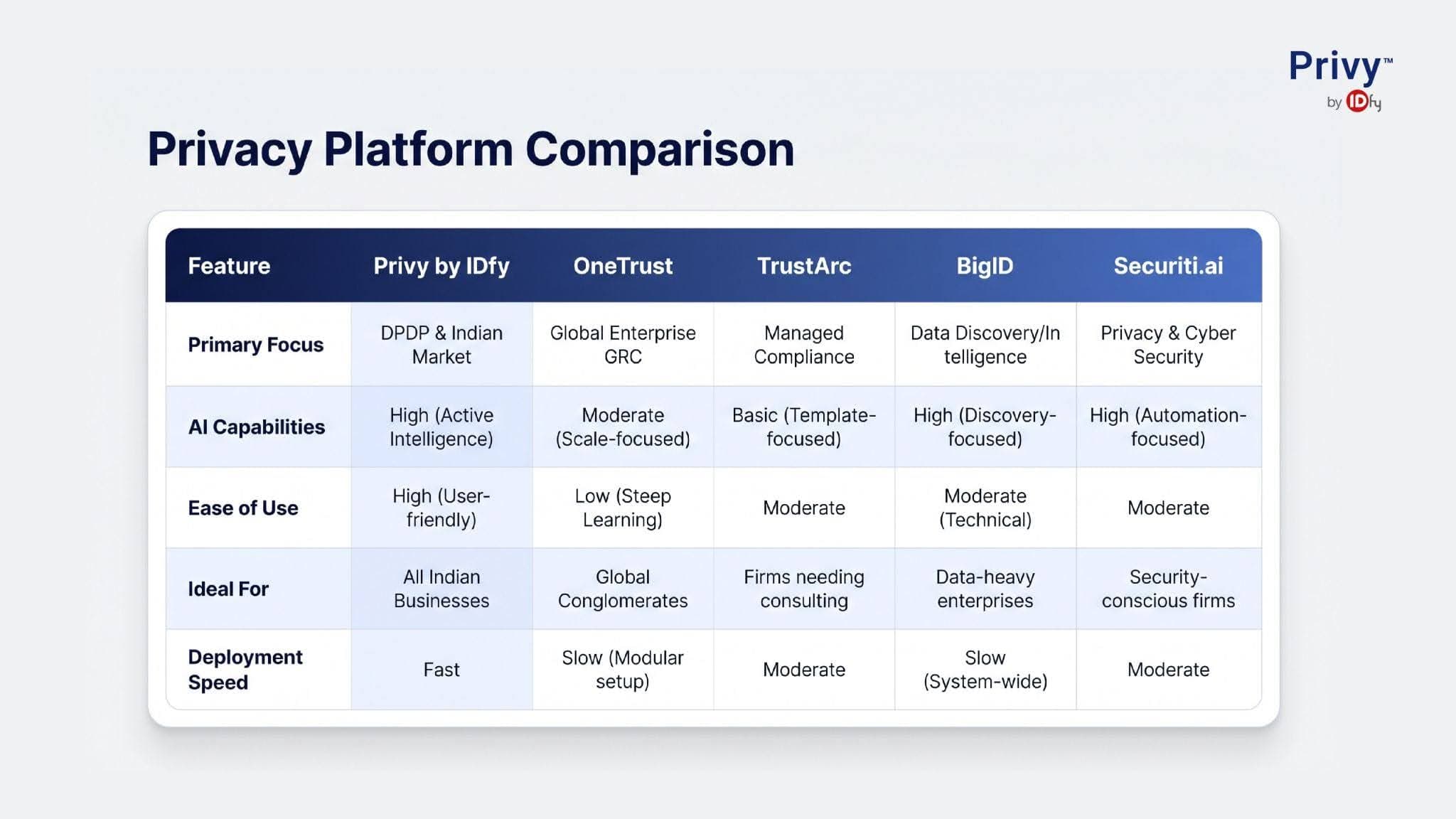
Detailed guide on top consent tools vs privacy platforms. Learn why AI-driven governance is the fastest route to DPDP compliance in India.