

DPDP Implementation: A Step-by-Step Guide for Indian Enterprises (2026 tO 2027)
Date Published

Plenty of articles tell you when the DPDP deadlines fall. Very few tell you how to actually get an enterprise ready before them. This is the second kind. The DPDP Rules 2025 were notified on 13 November 2025, and the core obligations become enforceable around 13 May 2027, which leaves most organisations a runway measured in quarters, not years, once you account for how long mapping, consent redesign, and vendor renegotiation really take.
This guide lays out DPDP implementation as a sequenced programme: what to do first, what depends on what, and where teams most often stall. It is written for the DPO, CISO, or compliance lead who has read the law and now has to build the thing. Each phase names the concrete deliverable, so this reads as a plan rather than a summary of the Act.
Why the Timeline Is Tighter Than It Looks
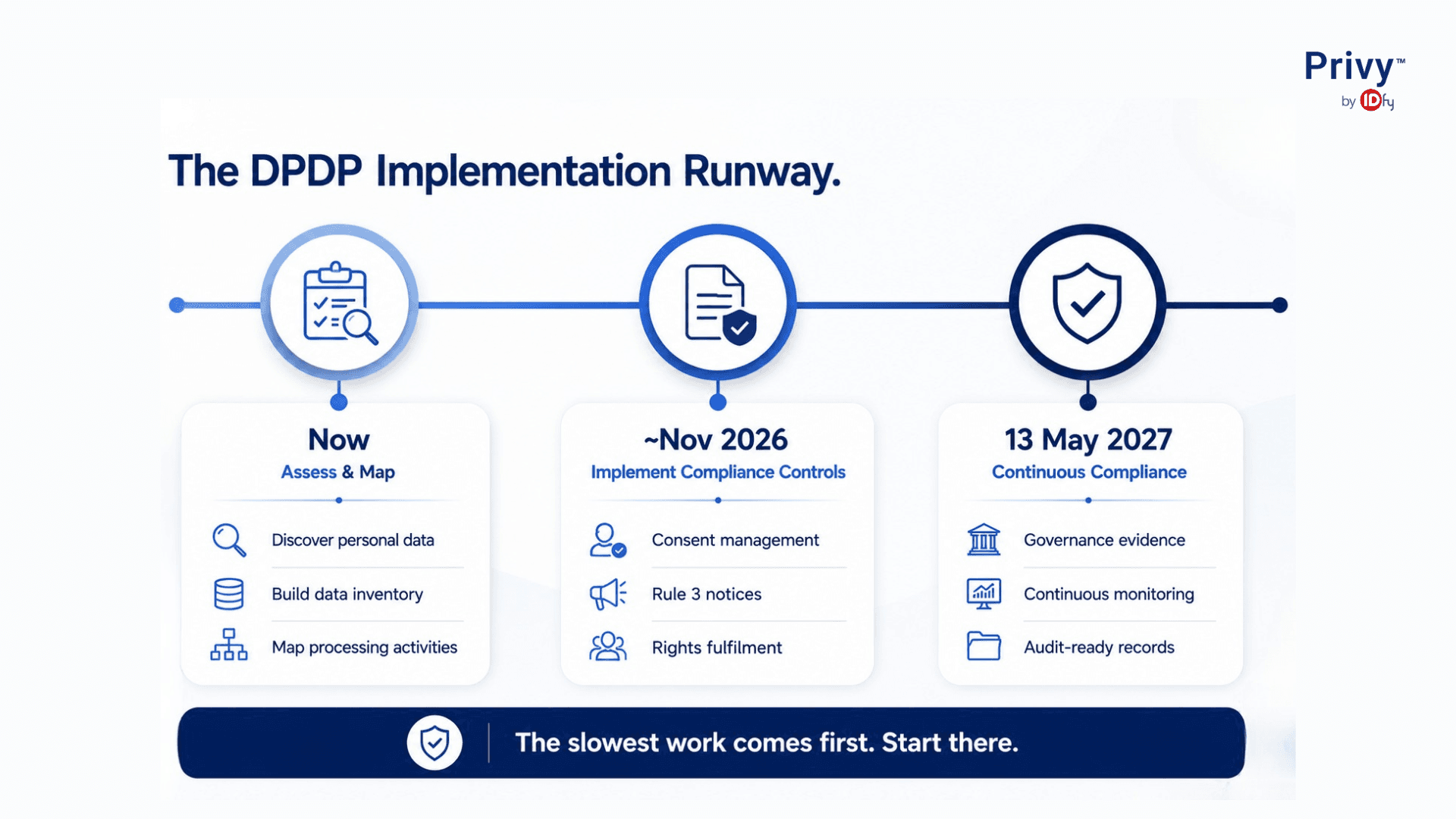
The enforcement dates are staged. The consent manager framework opens around November 2026 at the 12-month mark. The transitional period, during which the Data Protection Board leans toward guidance over penalties, is expected to close around the same time. Full substantive compliance, including security safeguards, valid consent, data principal rights, breach reporting, and retention limits, lands at the 18-month mark on 13 May 2027. Significant Data Fiduciaries face their first audit and DPIA cycle in early 2027, ahead of that.
Here is the catch. The work that has to be done first, discovering and mapping personal data across an entire enterprise, is also the slowest. A large organisation cannot map its data estate, rebuild consent journeys, renegotiate vendor contracts, and stand up rights workflows in a single quarter. These are multi-quarter programmes with dependencies, and starting late compresses them into exactly the window when regulatory scrutiny begins. The DPDP Rules 2025 set the clock; the implementation plan decides whether you beat it.
Phase 1: Gap Assessment and Data Discovery
Every DPDP implementation starts in the same place, whether the team admits it or not: finding out what personal data the organisation actually holds and where. A gap assessment measures the distance between current practice and the Act's requirements. Data discovery finds the personal data itself, across databases, cloud storage, SaaS tools, on-premise file shares, and the unstructured repositories where forgotten sensitive data hides.
The deliverable here is an honest inventory plus a prioritised gap list. Skip it, and every later phase runs on assumptions. You cannot write an accurate notice, service an erasure request, or scope a breach for data you have not located. This is why data discovery, mapping, and governance are the foundation of DPDP compliance, and why data visibility comes before almost everything else. Most enterprises underestimate how much personal data lives outside the systems they think of first.
Phase 2: Data Mapping and the ROPA
Once the data is found, it has to be mapped: where it comes from, where it flows, which systems and vendors touch it, and on what basis. That map feeds the single most requested artefact in any audit, the Record of Processing Activities. A ROPA documents what personal data you process, for what purpose, under what lawful basis, and who it is shared with. It is the first thing an auditor or the Data Protection Board asks to see.
The deliverable is a live data map and a current ROPA generated from it. Built by hand in a spreadsheet, a ROPA is stale the day after it is finished, which is why maintaining a record of processing activities should be automated from the map rather than assembled manually. The distinction between static and dynamic data mapping decides whether this artefact stays useful or becomes a point-in-time snapshot that misleads.
Phase 3: Rebuild Consent and Notices
With the map in place, consent can be rebuilt on solid ground. Under the Act, consent has to be free, specific, informed, and as easy to withdraw as it was to give. Bundled, blanket consent no longer holds. Each purpose needs its own consent, notices have to meet Rule 3 (standalone, plain language, itemised, available in English and the Eighth Schedule languages), and a withdrawal has to propagate through every connected system.
The deliverable is a consent architecture that records exactly what each data principal agreed to, versions every notice change, and enforces withdrawal everywhere. This is where consent management becomes infrastructure rather than a banner, and where what Rule 3 demands of a consent notice sets the bar the notice module has to clear. Legacy data collected before the Act needs its own remediation: a compliant notice reissued to those data principals, with historical consent that fails today's standard treated as a risk to fix.
Phase 4: Operationalise Data Principal Rights
The Act gives individuals enforceable rights: access to a summary of their data, correction, erasure, grievance redressal, and nomination. Implementation means turning each into a repeatable workflow that meets the Rules' timelines, with grievance redressal completed within 90 days.
The deliverable is a rights-fulfilment process that can take a request, find every copy of that person's data across all systems, and action it completely and on time. This is where Phase 1 and 2 pay off, because fulfilling a data subject request is impossible without a current data map behind it. A rights request that returns an incomplete answer is the kind of gap an audit surfaces immediately.
Phase 5: Assign Ownership, PIAs, and Breach Response
Implementation is not only systems. Someone has to own it. A Significant Data Fiduciary must appoint a Data Protection Officer, and even organisations below that threshold need a clear owner, because a programme without a named owner drifts. The DPO's mandate becomes real work at this phase, distinct from the security remit a DPO and a CISO each carry.
Two further deliverables belong here. Privacy impact assessments, mandatory for SDFs and advisable for any high-risk processing, run as a structured workflow tied to the real data map, covered in how PIAs work under the DPDP Act. And a tested breach response, because the Rules require a two-stage notification: notify the Data Protection Board, then affected data principals within 72 hours. Rehearse that workflow before an incident, or a mishandled breach stacks a second violation on the first, which is why incident management under DPDP belongs in the plan, not the appendix.
Do Not Forget the Vendors
Personal data leaves the enterprise constantly, to cloud hosts, payment processors, analytics tools, and marketing platforms. Under the Act, the fiduciary stays accountable for what those processors do, so vendor governance is part of implementation, not a separate track. Contracts need the required processor clauses, and vendors need ongoing monitoring rather than a one-time check at onboarding. Vendor gaps cause a large share of real breaches, which is why third-party risk management has to run alongside the internal phases rather than after them.
Where Implementation Stalls, and How to Avoid It
Three failure patterns show up repeatedly. The first is starting with a policy rewrite instead of data discovery, which produces polished documents describing a data estate nobody has actually mapped. The second is treating each phase as a separate tool, so discovery, consent, rights, and breach response end up in disconnected systems that cannot share evidence, leaving the compliance team to stitch a story together under audit pressure. The third is leaving vendors until last, then discovering that half the data map runs through processors whose contracts say nothing about DPDP.
Avoiding all three comes down to sequence and connection. Do the slow discovery work first. Keep the phases feeding one shared record, so a classification finding informs the consent obligation, the rights workflow, and the breach scope at once. A view of how this runs end to end is set out in the 90-day implementation guide for Indian enterprises, which is a useful accelerant for the first, heaviest phase.
How Privy by IDfy Supports DPDP Implementation
Privy by IDfy was built to run this sequence as one connected programme rather than six disconnected tools. Data Compass handles Phase 1 and 2: discovery, India-specific classification, mapping, and an automatically maintained ROPA across structured and unstructured systems. The consent governance layer covers Phase 3, with Rule 3 notices, multilingual consent, and versioned records, and connects to data principal rights for Phase 4. Privacy impact assessments, third-party risk management, and incident response cover Phase 5, and InspectAI, the AI layer described on the Privy platform overview, keeps the map current and connects every module to one audit trail.
The connection is the point. When discovery, consent, rights, and breach response draw on a single current record, DPDP implementation stops being a scramble to reconstruct evidence and becomes a programme that can demonstrate compliance on demand.
Conclusion
DPDP implementation is a sequencing problem before it is a legal one. The organisations that will be ready by May 2027 are running the phases in order: discover and map the data first, build consent and rights on top of it, assign ownership, and keep vendors inside the programme rather than bolted on at the end. Knowing the timeline is the easy part. Meeting it takes a plan that starts with the slowest work and keeps every phase feeding one shared record of where personal data lives.
To see how Privy by IDfy supports each phase of DPDP implementation across your systems, and how the phases connect into one audit trail, write to shivani@idfy.com.
FAQ’s
What is the first step in DPDP implementation?
A gap assessment and data discovery. Before rewriting policies or consent notices, an organisation has to know what personal data it holds and where, because every later phase depends on that inventory.
How long does DPDP implementation take?
For a large enterprise, it is a multi-quarter programme, not a single project. Data discovery and mapping alone can take months, and consent redesign, rights workflows, and vendor renegotiation add more. With full compliance due 13 May 2027, most organisations need to be well into the work through 2026.
What are the key phases of a DPDP implementation plan?
Gap assessment and discovery, data mapping and ROPA, consent and notice redesign, data principal rights workflows, and ownership plus PIAs and breach response, with vendor risk management running alongside.
Who owns DPDP implementation inside an organisation?
A Significant Data Fiduciary must appoint a Data Protection Officer. Other organisations should still name a clear owner. Implementation touches legal, security, IT, and business teams, so it needs a single accountable lead.
When does DPDP become fully enforceable?
The DPDP Rules 2025 were notified on 13 November 2025. Most substantive obligations take effect around 13 May 2027. The consent manager framework opens around November 2026, and SDF audits begin in early 2027.
.jpg&w=3840&q=75)
Learn why DPDP readiness for banks is important and how Privy can help in DPDP compliance for the banking sector.

DPDP readiness is no longer a legal exercise it’s board's responsibility. Governance, maturity, roadmap, full-stack privacy execution. Privy by IDfy