

DPDP Compliance Breach in India: The Hidden Costs Indian Companies Can’t Afford
Date Published
.jpg&w=3840&q=75)
With the Digital Personal Data Protection (DPDP) rules out, privacy is no longer just a bill or compliance checklist; it has moved beyond that. The rules impose a hefty penalty on organizations that do not comply in any form.
Failure to comply with these rules can lead to serious reputational, operational, and financial consequences. The regulatory bodies established by the Indian government have also increased their scrutiny, and as a result, Indian enterprises must act quickly to avoid risks and implement strict data protection measures.
The DPDP rules reflect the shift in the perception of India towards data privacy. The global pressure, along with the sudden surge in consumer awareness for strict data protection, has forced Indian businesses to reevaluate their strategies around data governance. Enterprises are left with only one choice: either to invest in compliance now or face the increasing financial or reputational consequences later. In this blog, we will understand what the DPDP non-compliance costs are and how Indian enterprises can avoid them.
The Penalty Structure for DPDP Compliance Breach
The first and the biggest consequence of non-compliance with the DPDP Act is the hefty fine of up to ₹250 crore. The financial risks associated with non-compliance with the DPDP rules are severe for businesses that fail to secure personal data or neglect breach notification requirements. The massive fine structure helps in reinforcing accountability, encouraging enterprises to prioritize data privacy.
The act also adds financial loss to the organizations along with the other costs that can lead to disruption of business operations.
The structure of these penalties is based on how severe the violations are. The idea behind having higher fines is to ensure that the organizations are not non-compliant or negligent.
Here’s a detailed breakdown of the data breach costs for Indian organizations:
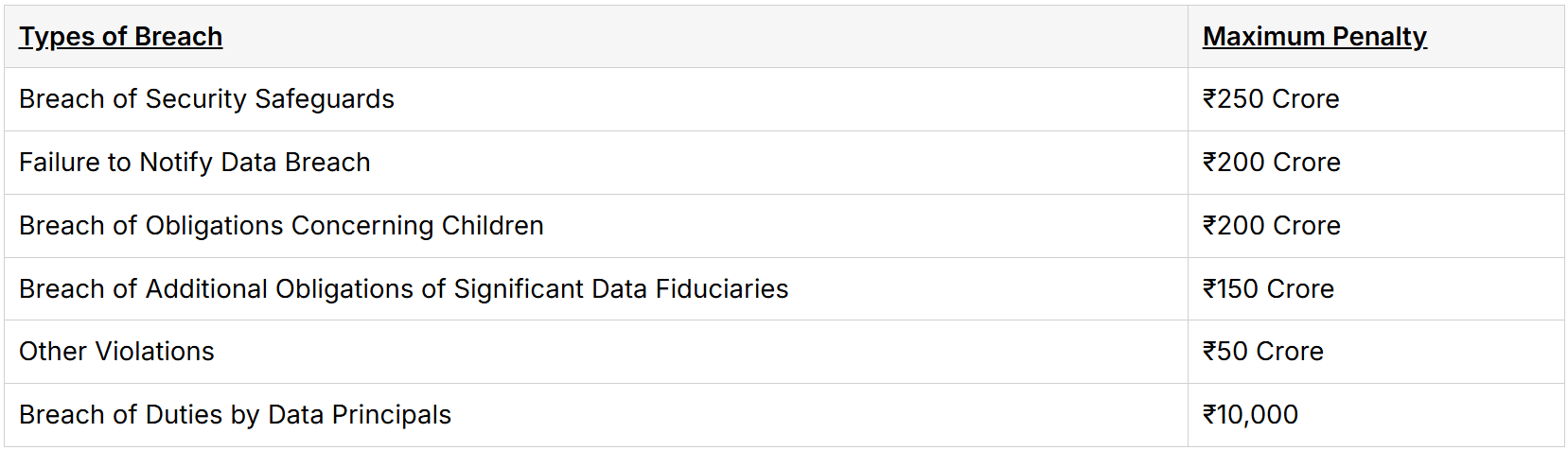
The penalty for every breach has been put in place after considering the intent of the breach, its nature, and where the breach happened as a result of a purposeful disregard for the laws or as a mistake, along with the extent of damage caused by the breach. Data Protection Board of India (DPB) has also been set up to scrutinize the offenders and enforce the Act, holding powers similar to the Civil Court of India. The actions that DPB can take are as follows:
- Monitor the different activities by data Fiduciaries to ensure compliance.
- Conducting strict examinations of complaints.
- Imposing various penalties based on the details of each case.
The DPDP Act enforces composite penalties that allow cumulative fines for multiple breaches without any financial ceiling. This implies that the payback of the fines for the organizations will never end. This stringent enforcement of the rules overseen by DPBI itself reminds enterprises about the importance of data protection, with the fines ranging from a minor amount to a severe financial consequence.
DPDP Compliance Enabled Via Continuous Strategic Monitoring
It’s time for Indian enterprises to move from occasional, checkbox-style compliance to continuous, real-time oversight if they want to meet the enforcement expectations of the DPDP Act. The rising DPDP non-compliance cost and the growing hidden privacy costs make one thing clear: businesses can no longer afford reactive, once-a-year audits or manual consent tracking.
This is where Privy by IDfy becomes invaluable. Privy provides a full-stack privacy governance and consent management layer that helps organizations stay ahead of regulatory scrutiny, not just respond to it. Instead of relying on fragmented tools, enterprises get an integrated platform that continuously monitors consent flows, flags compliance gaps, and ensures that personal data is processed only within the legal boundaries defined by the Act.
Privy’s Consent Governance Platform (CGP) supports real-time consent validation, multilingual consent notices, automated purpose mapping, and tamper-proof consent artefact storage, making it far easier for teams to demonstrate compliance when regulators come calling. This level of continuous oversight directly reduces the cost of ignoring DPDP and helps organizations avoid the steep DPDP penalties and risks associated with poor data governance.
Beyond consent, Privy Inspect AI plays a critical role by scanning internal systems, APIs, and data pipelines to identify policy violations or sensitive data exposures that may go unnoticed in large enterprises. These blind spots are often the source of unexpected regulatory action, inflating the data breach cost in India for organizations that lack visibility into how personal data moves across teams and vendors.
By adopting Privy as part of their privacy infrastructure, companies can:
- Avoid costly, last-minute compliance firefighting
- Detect possible breaches or misuse before they escalate
- Strengthen their audit posture with verifiable, interoperable consent records
- Demonstrate proactive compliance with the Data Protection Board
- Reduce legal exposure stemming from third-party and processor relationships
In a world where the cost of ignoring DPDP continues to rise, Privy helps enterprises protect themselves from hefty fines by creating a living compliance ecosystem, one that doesn’t just meet the DPDP Act’s expectations but continuously adapts alongside the organization. With regulatory enforcement tightening, Indian businesses have a narrow window to shift from reactive compliance to proactive privacy governance. Deploying Privy’s monitoring and consent infrastructure ensures that this transition is not just possible but smooth, helping organizations stay compliant, reduce operational risk, and avoid the mounting financial consequences of DPDP non-compliance.
Conclusion
DPDP compliance is not as complex as it looks. It can be easily navigated with the right DPDP privacy management tool and made sustainable and scalable across enterprises. This is exactly what Privy by IDfy is trying to solve for India at large.
Get in touch with us at shivani@idfy.com to take control of your data with India’s most trusted DPDP compliance platform. We will keep you updated on the latest developments regarding the DPDP rules and how they will impact your business. Stay glued to this space for more information on data, privacy, compliance, and all things DPDP.
FAQ's
What is a risk-based privacy impact assessment and how is it different from a standard PIA?
A standard privacy impact assessment evaluates all processing activities with roughly equal attention. A risk-based approach applies scrutiny proportionate to harm — low-risk activities like collecting a newsletter email get lighter treatment, while high-risk processing like handling Aadhaar details, medical records, or large-scale automated decision-making receives deeper analysis and more rigorous documentation. The triage logic matters: an organisation that treats a food preference field with the same gravity as a patient health record is either wasting resources or producing a PIA that satisfies no one. Under the DPDP Act, the concept of Significant Data Fiduciary designation is itself risk-based — the obligations scale with the sensitivity and volume of data processed, which makes a risk-weighted assessment the natural approach.
What is shadow data and why is it the hardest problem in a DPIA?
Shadow data is personal data being collected by your systems that your legal or compliance team has not documented — and often does not know about. It appears in several ways: a developer adds a new data field to an onboarding form without a privacy review, a third-party SDK embedded in a mobile app starts collecting device identifiers, or an analytics integration quietly captures more fields than the integration agreement specifies. The problem is structural: manual PIA processes depend on business teams self-reporting what data they collect. Shadow data is precisely the data no one thought to report. An automated AI inspection layer that reads live digital journeys and extracts every data field being collected — rather than relying on documentation — is the only reliable way to surface it before a regulator does.
How does risk scoring work in a data privacy impact assessment?
Risk scoring assigns a weighted severity to each processing activity based on a combination of factors. Data sensitivity is the primary variable — financial identifiers, Aadhaar, health records, and children's data carry higher base scores than name and email. Volume is the multiplier — processing a hundred records and a million records at the same sensitivity level carry different aggregate risk profiles. The nature of the processing adds further weight: automated decision-making that affects individuals, profiling for credit or employment, and cross-border transfers each add to the score. The purpose of scoring is not to produce a number for its own sake. It is to tell a DPO and a CXO where to concentrate remediation effort and which processing activities cannot proceed without stronger safeguards or without explicit board-level sign-off.
Why does a PIA need to connect to the RoPA, and what breaks when they are separate?
A RoPA — Record of Processing Activities — is the master inventory of what an organisation processes, why, and with whom. A PIA is the risk evaluation of specific processing activities within that inventory. When they are maintained separately, two failure modes compound each other. First, the PIA may assess a processing activity that the RoPA does not reflect, producing an orphaned risk record with no audit trail back to the declared processing. Second, the RoPA may include processing activities that have never been through a PIA, creating undocumented risk. Under the DPDP Act, both the accountability obligation and the SDF impact assessment requirement assume that risk evaluation and processing inventory are coherent. A bi-directional sync — where a new PIA automatically updates the RoPA, and a RoPA change triggers a reassessment — is the architecture that makes them coherent in practice rather than in theory.
What does a CXO actually need to present to the board after a risk-based DPIA?
The board-level conversation is not about methodology. It is about three things: current risk posture, the delta from last review, and what it would cost to leave identified risks unmitigated. A well-structured DPO dashboard presenting total risk score across processing activities, a categorised list of high-risk findings with assigned owners and remediation timelines, and a documented trail of assessments conducted gives a CXO everything needed for that conversation. The tamper-proof, digitally signed assessment artefact matters here too — not just for regulators, but for D&O liability. If a penalty lands and board members need to demonstrate they were informed and acted on available information, the audit trail of conducted assessments is the evidence that makes that case.
How does Privy's approach differ from a manual risk-based privacy impact assessment process?
A manual DPIA depends on a questionnaire filled in by a business team, reviewed by legal or privacy counsel, and filed in a document management system. Three structural problems follow: the questionnaire captures only declared data, the review is as good as the reviewer's knowledge of the actual technical environment, and the document is accurate only at the moment it was completed. Privy's approach starts from the digital journey itself — the AI Compliance Co-pilot reads live product flows, extracts actual data fields, and maps them against the privacy policy automatically. Risk scoring runs on real processing parameters, not on self-reported ones. When a new processor is added or a data field changes, the system triggers reassessment rather than waiting for the next audit cycle. The output is a compliance artefact that reflects what actually happened, not what was planned.
Under the DPDP Act, can we face a penalty for inadequate PIAs even if no breach occurred?
Yes. The DPDP Act's penalty provisions do not require a data breach as a precondition. Penalties can be imposed for failing to implement reasonable security safeguards, which includes failing to conduct the impact assessments that would have identified and mitigated risks. For Significant Data Fiduciaries, the obligation to conduct periodic impact assessments is explicit — and failure to comply with SDF obligations carries penalties up to ₹150 crore. Beyond the specific SDF provision, the Data Protection Board has broad authority to examine compliance posture and impose penalties where it finds inadequate technical and organisational measures. An enterprise that cannot demonstrate a structured, documented risk assessment programme is exposed on that question regardless of whether a breach has occurred.
How frequently should a risk-based privacy impact assessment be reviewed?
The frequency depends on the risk profile of the processing activity and the rate of change in the product or data environment. A static, low-risk processing activity that has not changed in two years does not require the same review cadence as an AI-driven lending model that updates its feature set quarterly. As a baseline, a full reassessment annually and a triggered reassessment on any material change — new processor, new data category, new technology, new jurisdiction — is a defensible standard. For Significant Data Fiduciaries, periodic assessments are explicitly required under the Act, and the Board is expected to prescribe further guidance on minimum frequency. The advantage of an automated platform is that the trigger for reassessment comes from the system detecting a change, not from someone remembering to schedule a review.
Learn what incident management under DPDP means and how Indian enterprises can handle incident response under DPDP.

Learn what privacy incident management is, how it differs from breach response, and why having an incident management policy is critical for modern organizations.

Learn the top causes of privacy incidents in 2026 and how a strong incident management process, incident management life cycle, and privacy governance framework help organizations reduce risk, improve compliance, and respond effectively.