

AI Data Classification for DPDP Compliance: Why Indian Enterprises Need to Know Where Personal Data Lives
Date Published
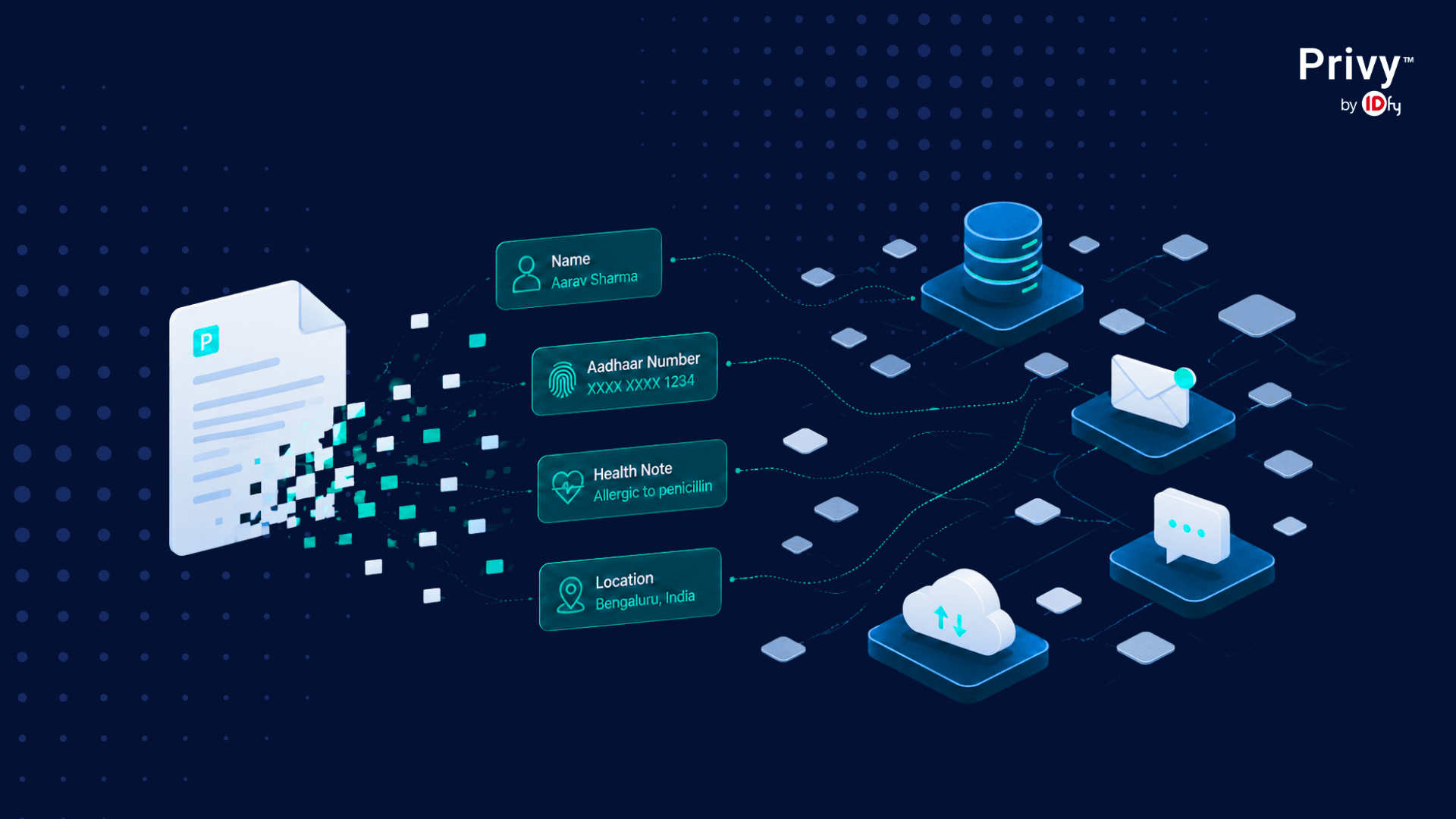
Most Indian enterprises started their DPDP programme with a policy. They wrote a notice, drafted a consent form, and named a compliance owner. Then they hit the part the policy cannot solve on its own: knowing what personal data they actually hold, and where it lives. The Digital Personal Data Protection Rules, 2025 were notified on 13 November 2025. Substantive obligations switch on roughly 18 months later, in May 2027. Every one of those obligations assumes the enterprise already knows what personal data it has, where it sits, and who can touch it. Most do not.
That gap is what AI data classification closes. Before consent notices, before rights workflows, before breach drills, a Data Fiduciary needs a current, defensible map of its personal data. This guide explains what that means, why older methods cannot produce it, and how it connects to the rest of a DPDP programme.
What Is AI Data Classification?
AI data classification uses machine learning and visual language models to automatically find, label, and categorise personal and sensitive data across an organisation's systems, structured and unstructured alike.
Older tools matched fixed patterns. A PAN looks like five letters, four digits, one letter, so a rule could flag it. That works for neatly formatted fields and breaks down everywhere else. AI-based classification reads context instead. It can tell when a document contains a customer's health condition, or that a spreadsheet column labelled "ref" actually holds Aadhaar-linked identifiers. It classifies by meaning, not just shape. For a Data Fiduciary, the output is a categorised inventory: this is personal data, this is sensitive, this is a financial identifier, this is duplicated, this looks stale. That categorisation is what makes every downstream DPDP control possible.
Why Traditional Classification Falls Short
Most enterprises already attempt some form of classification, using methods that were not built for a law expecting a continuously accurate picture of personal data.
- Manual tagging and spreadsheets. A register that is accurate on the day it is signed and stale within a quarter.
- Static rule sets. Regex catches well-formatted identifiers and misses anything ambiguous, while over-flagging harmless text.
- Unstructured and duplicated data. Most enterprise personal data lives in documents, emails, and transcripts, then gets copied across drives. Manual methods barely see it.
- Shadow systems and vendor-held data. A team exports a customer list to a third-party tool, and the data leaves the systems the privacy team knows about.
The picture stays partial, manual, and out of date, while the obligation is total, operational, and live.
Why This Matters For DPDP Compliance
DPDP does not name classification as a requirement. It asks for outcomes that are impossible without it.
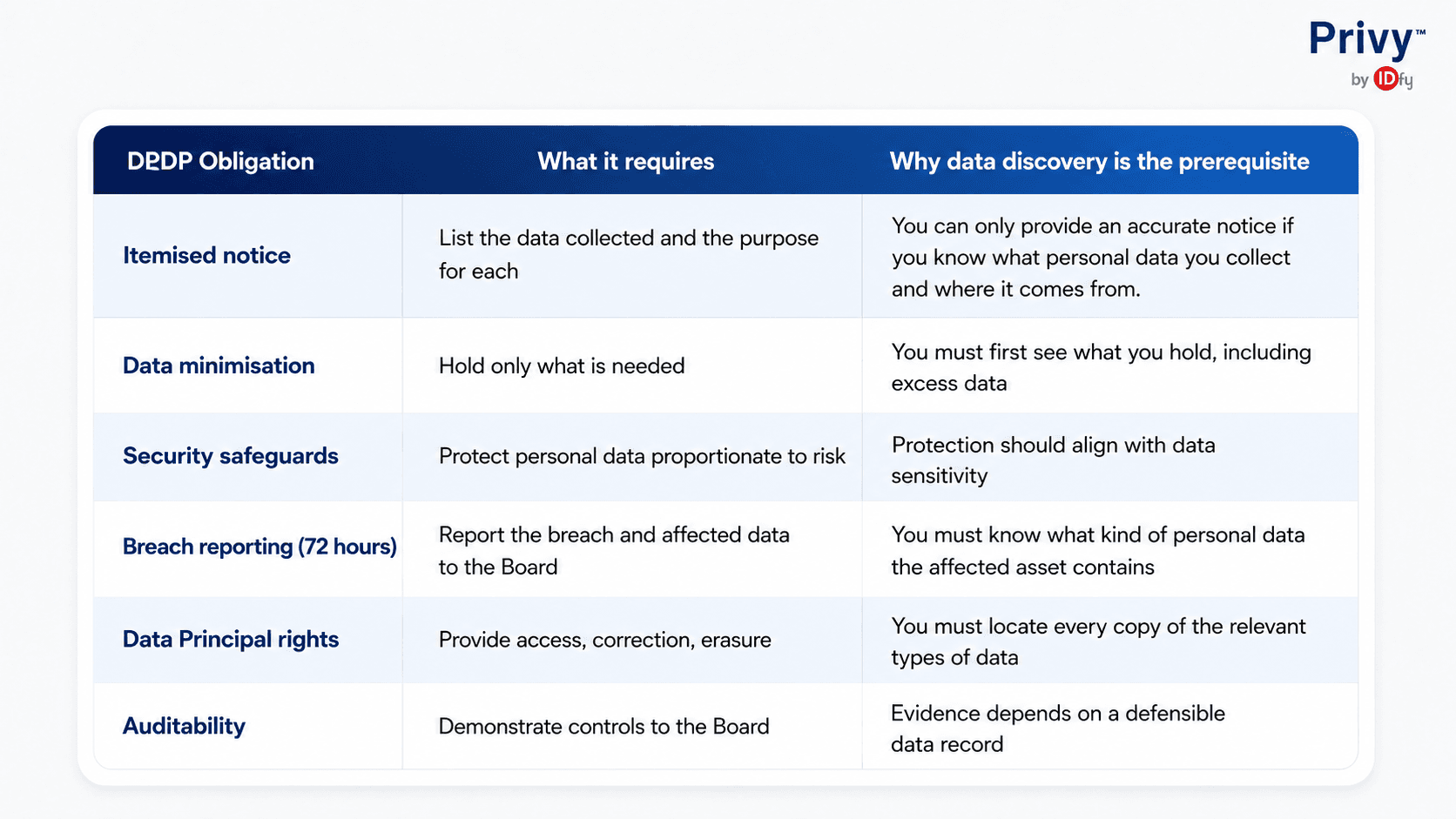
Almost every obligation, from a notice to a 72-hour breach report, rests on the same foundation: knowing what kind of data is lost or if any asset was affected.
You Cannot Govern What You Cannot See
Personal data exists across structured databases, unstructured file repositories, cloud storage, object buckets, data lakes, network shares, backup systems, and archival environments. New assets are created continuously, data is duplicated across environments, and copies often extend to third-party processors. A point-in-time inventory quickly becomes outdated, making automated discovery and classification essential for maintaining a current view of enterprise data. By the time a manual inventory is finished, it describes a version of the enterprise that no longer exists. Only automated, context-aware scanning can cover that surface area at the pace DPDP demands.
Discovery, classification, mapping, lineage: the difference
These terms get used interchangeably, and they should not be. Each answers a different question.
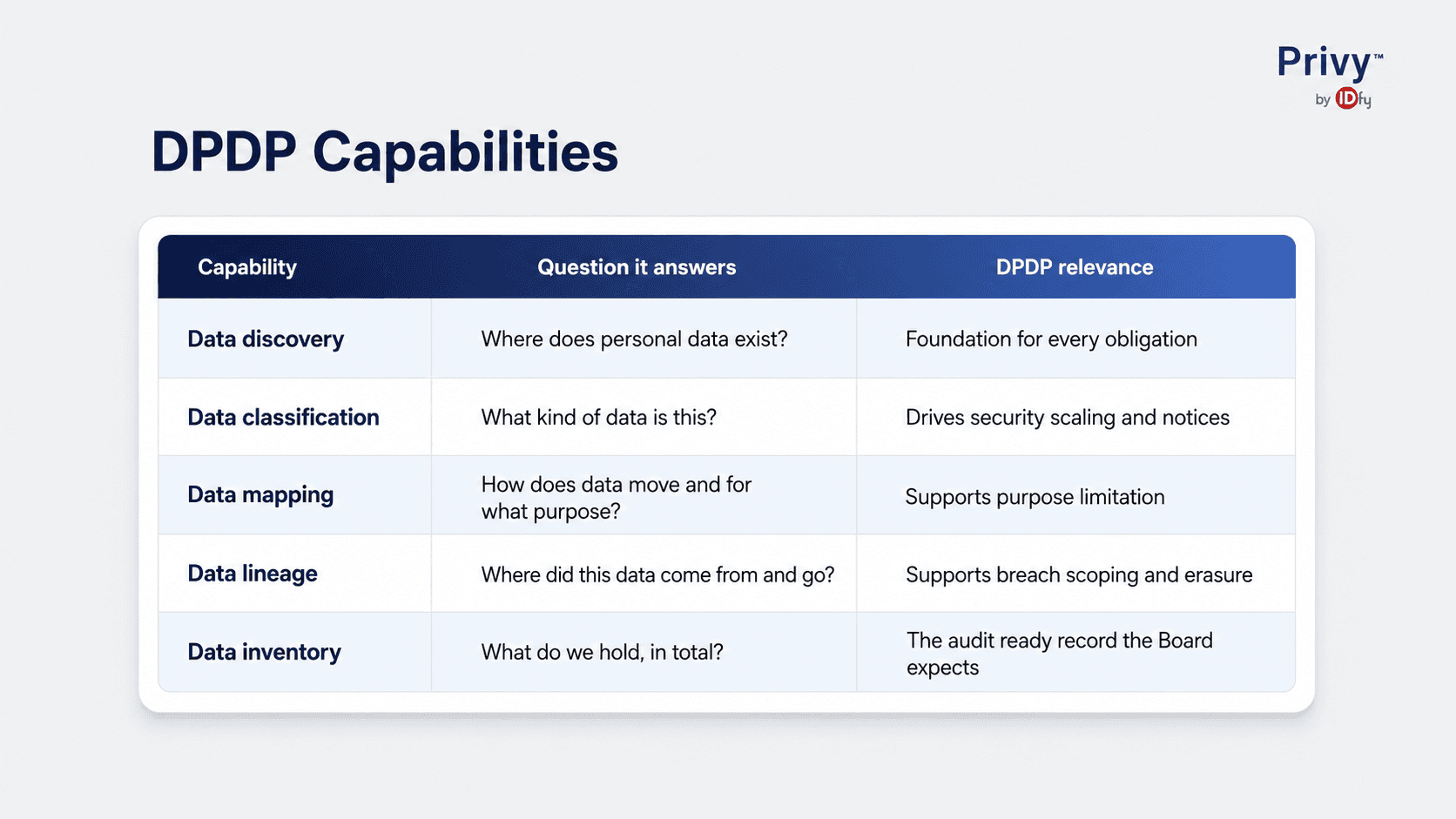
Discovery finds personal data. Classification labels it. Mapping shows its purpose. Lineage traces its copies. Inventory maintains the total record. DPDP readiness needs all five working together.
Where It Matters Most Across Indian Sectors
BFSI and NBFCs hold dense concentrations of KYC documents and credit data spread across loan origination and collections systems. Insurance carries health declarations and claims documents mixed with third-party data inside scanned forms. Fintech moves personal data to many processors quickly through APIs, where lineage shows where it actually went. E-commerce accumulates behavioural and payment data across order systems and analytics tools, where threshold-based retention rules make a current inventory essential.
While these industries typically manage the highest volumes and most complex flows of personal data, the need for data discovery is industry-agnostic. Any organisation that collects, stores, or processes personal data needs visibility into where that data resides, how it moves, and who has access to it. Customer support is the layer most programmes ignore: tickets, call transcripts, and CRM notes are full of personal data in free text, and this is exactly where most breaches get exposed.
How Classification Supports The Rest Of DPDP
A consent record on its own only says a person agreed to a purpose. It becomes useful once it connects to the actual data that consent governs. When a Data Principal withdraws consent for marketing, the enterprise has to know which datasets are processed for marketing, in which systems, and stop exactly those uses. That mapping is only possible once the data has been classified.
The same logic applies to rights requests. A single customer's data may exist in a database, a CRM, and a vendor's system. An erasure that misses the duplicates can resurface in a later breach. Classification and lineage turn "we think that is everywhere it lives" into "here is every location, confirmed."
It applies to breach response too. When a system is compromised, the questions are immediate: what data did it hold, whose data was it, how severe is the exposure? An enterprise that has classified in advance can answer in hours instead of spending its 72-hour window on incident response discovery work.
It applies to AI governance as well. Employees paste customer data into public chatbots. Teams connect copilots to document stores without checking what they contain. An enterprise cannot govern AI's use of personal data if it does not know which data is personal in the first place.
What To Look For In A Classification Platform
Not every tool labelled "classification" does what DPDP readiness needs.
- Discovery across all environments, covering structured and unstructured data
- Sensitive data classification that reads context, not just patterns
- Purpose mapping linked to the consent ledger and rights workflows
- Breach and vendor risk linkage for fast impact scoping
- Data lineage, privacy risk scoring, and audit trails for the Board
- India DPDP readiness built around Data Fiduciary obligations, not borrowed from elsewhere
A tool that does discovery and classification alone produces a map with no way to act on it. The value sits in the connections.
How Privy by IDfy helps
Privy by IDfy is a full-stack DPDP compliance platform built for Indian enterprises. Its data discovery module, Data Compass, identifies where personal data lives across structured and unstructured systems and classifies sensitive data. The value is the connection, not the scan. Privy links classification to consent and rights management, PIAs, incident response, vendor risk management, and audit trails. No platform removes a Data Fiduciary's legal accountability, and compliance still depends on how an organisation runs its programme. Privy is the infrastructure that makes running it well achievable.
Conclusion
DPDP readiness is the ability to know your personal data, govern it, and prove your controls when the Board or a Data Principal asks. That rests on a foundation most enterprises have not built: a current, defensible map of where personal data lives. The enterprises that treat classification as the first step will spend the runway to May 2027 building a programme that holds up. See how Data Compass maps your personal data before your next audit. Contact us for a demo: shivani@idfy.com.
FAQ's
What is AI data classification?
It uses machine learning and visual language models to automatically find, label, and categorise personal and sensitive data across an organisation's systems, including unstructured data in documents and chat logs.
What is the difference between data discovery and data classification?
Discovery finds where personal data exists. Classification identifies what kind of data it is. DPDP readiness needs both, plus mapping, lineage, and inventory.
When does DPDP compliance become mandatory in India?
The DPDP Rules, 2025 were notified on 13 November 2025. Most substantive obligations take effect around May 2027.
Why can't traditional classification tools handle DPDP requirements?
Manual registers go stale, regex rules cannot read context, and sampling does not satisfy obligations tied to actual records.
Does Privy by IDfy guarantee DPDP compliance?
No platform can guarantee compliance, since legal accountability stays with the Data Fiduciary. Privy helps organisations operationalise DPDP obligations and connect discovery and classification to consent, rights, breach, and audit workflows.

Learn how AI detects hidden privacy risks & strengthens AI data privacy. Discover what AI governance means & how Privy enables proactive AI inspection
Discover how data mapping simplifies privacy audits, improves data governance, enhances data classification, and builds a structured data catalog.