

A Guide to Major Incident Management for CXOs
Date Published
In the current regulatory climate, a privacy incident is no longer a "what if" scenario for the C-suite; it is a "when" event. As of 2026, the stakes for Indian enterprises have shifted from theoretical risk to measurable financial and legal liabilities.
According to recent findings from the IBM Cost of a Data Breach Report 2025, the average cost of a data breach in India has hit an all-time high of ₹220 million, a 13% increase from the previous year. For highly regulated sectors like healthcare and BFSI, these costs often exceed ₹300 million per incident. These figures are not just technical overhead; they represent the "triple penalty" of extreme regulatory fines under the Digital Personal Data Protection (DPDP) Act, massive operational downtime, and a swift erosion of brand equity, where nearly 81% of consumers report they would stop engaging with a brand following a privacy breach.
For a CXO, the real danger is not just the breach itself, but the lack of a "forensic-ready" response. While most organizations focus on perimeter security, the DPDP Act mandates a shift toward accountability and rapid notification. The Act authorizes penalties up to ₹250 crore for failure to take reasonable security safeguards to prevent a breach.
This guide moves beyond the technical jargon of the SOC (Security Operations Center) to provide a strategic framework for Major Incident Management. It is designed for leaders who recognize that in a "privacy-first" era, the difference between a managed crisis and a corporate catastrophe lies in how quickly and how transparently you can move from detection to containment.
What is Privacy Incident Management vs. Incident Response Management?
To understand your survival odds, we must distinguish between the sailors patching the hull and the Captain navigating the storm.
Incident response management is the tactical, "all hands on deck" effort in the engine room. When a leak is detected, the incident response team moves in to cauterize the wound, isolating compromised servers, blocking malicious IPs, and stopping the immediate inflow of water. It is technical, fast-paced, and focused on immediate containment. In the Titanic scenario, these are the engineers desperately trying to keep the pumps running.
Privacy incident management, however, is the Command Bridge. It is the high-level orchestration of the entire vessel’s safety. It doesn’t just ask if the pumps are working; it asks: How many compartments are flooded? Have we notified the maritime authorities (the Data Protection Board)? How do we manage the panic among the passengers (your customers)? While incident response asks "How do we stop the leak?", privacy incident management asks "How do we keep the ship from breaking in half?" For a CXO, your role is to ensure that the orchestration between legal, PR, IT, and compliance is as synchronized as a Swiss watch, because in a major incident, a lack of coordination is the weight that pulls you under. We have also done a detailed blog on what causes privacy incidents for you to understand this space even better.
Why Speed is Your Only Currency
For a CXO, the most critical moment of a crisis is the Triage Phase, where you must distinguish between a "Security Incident" and a "Data Breach." Treating them as the same leads to either regulatory over-notification (which damages your reputation unnecessarily) or under-notification (which invites catastrophic fines).
1. Incident vs. Breach: The Legal Threshold
- The Incident: Any event that compromises the availability, integrity, or confidentiality of your systems (e.g., a DDoS attack that slows your site or a server that goes down due to a hardware fault). It is a technical problem.
- The Breach: Under the DPDP Act, an incident becomes a "Personal Data Breach" the moment it leads to the unauthorized access, disclosure, destruction, or alteration of personal data.
The Litmus Test: If a server is encrypted by ransomware but contains no personal data, it is a major incident. If that same server contains customer Aadhaar numbers, it is a Personal Data Breach, and the 72-hour regulatory clock starts the moment you identify it.
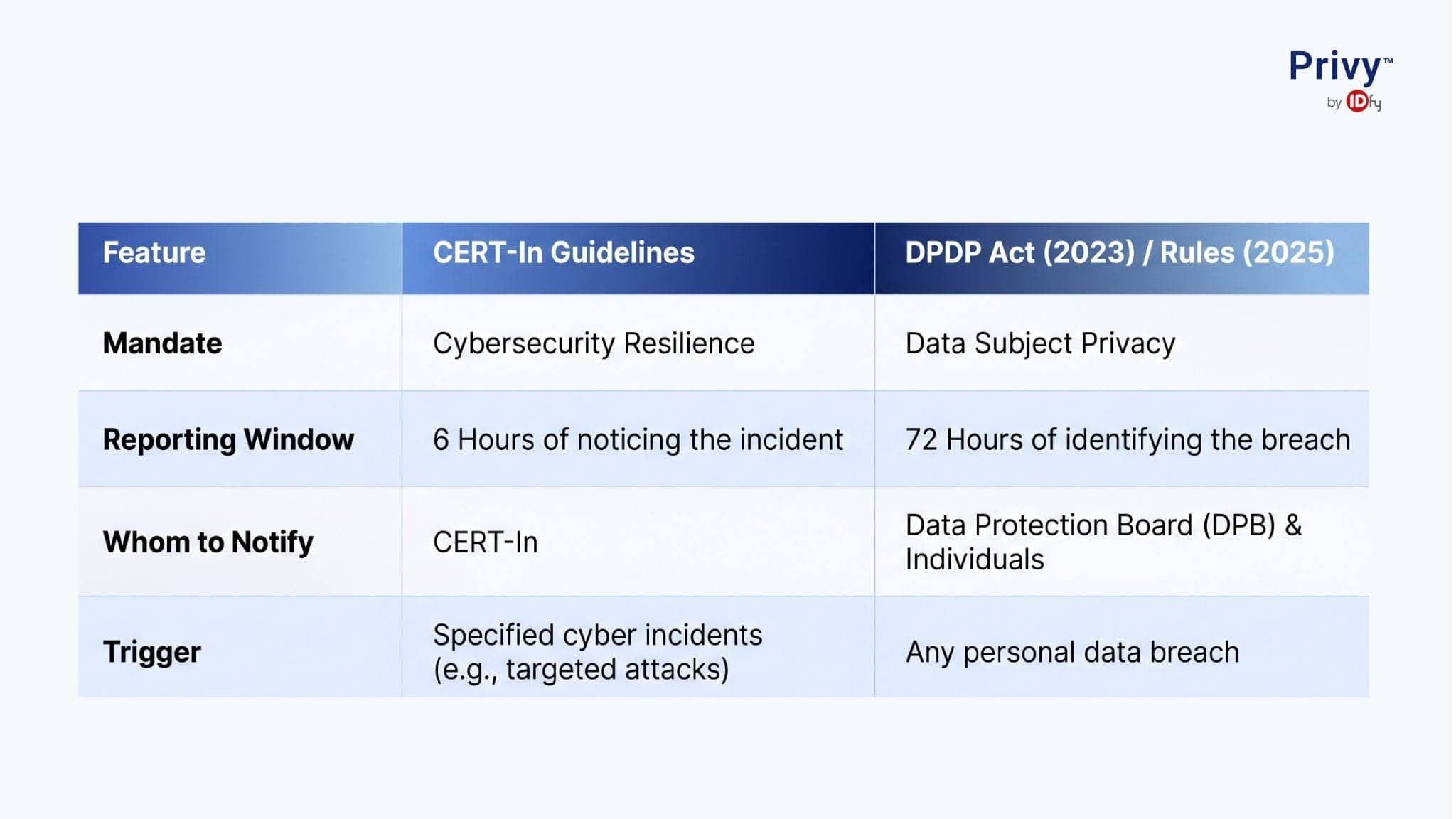
2. The Overlapping Regulatory Crisis: CERT-In vs. DPDP
In India, CXOs face a unique "Dual Notification" challenge. You aren't just reporting to one authority; you are often reporting to two, with conflicting timelines:
3. The Vendor Liability Trap
A common misconception is that if your cloud provider or CRM vendor is breached, the liability sits with them. Under the DPDP Act, this is false. The law places the ultimate onus of accountability on the Data Fiduciary (the organization that collected the data). While the vendor (the Data Processor) may be technically responsible for the leak, you are legally responsible to the Data Protection Board and your customers.
- Downstream Management: You must have "Oversight Telemetry" with your vendors. If their system fails, your incident management plan must trigger.
- Contractual Shields: Ensure your Data Processing Agreements (DPAs) mandate that vendors notify you within 1–4 hours of a breach, giving you enough time to meet your own 72-hour regulatory deadline.
The Irrecoverable Cost of Silence
Waiting to "be sure" before managing an incident is a losing strategy. A 2025 research paper on the long-term impact of breaches highlights that 51% of breach costs are incurred more than a year after the incident.
According to the MIT research, the "Shadow Cost" of a poorly managed breach includes:
- Systemic Valuation Drop: Companies with "reactive" incident response see a 7–10% permanent dip in market valuation compared to peers with automated management.
- The Identification Gap: Organizations that took over 200 days to identify a breach saw costs jump by ₹8.5 crore (approx. $1 million) compared to those who contained it within 30 days.
Research Spotlight: For an in-depth look at how privacy incidents erode long-term shareholder value and the specific metrics that define resilient organizations,
The Privacy Program Maturity Model: From Reactive to Optimized
Privacy readiness is a spectrum of operational capability. Moving from "having a policy" to "having a posture" requires a transition through four key stages:
- Reactive: You have a DPO and a generic policy. You react only when a breach is reported by a third party.
- Defined: You have a manual Incident Response Plan and have mapped your major data flows.
- Managed: You perform regular Privacy Impact Assessments (PIAs) and have automated discovery tools scanning your hold.
- Optimized: This is the "Self-Healing" stage. Your systems sense unauthorized data movement and trigger Synthesized Response, automatically notifying legal and technical teams while isolating the affected data compartments.
An optimized program doesn’t just wait for a person to pull a lever. It uses Automated Discovery and Granular Consent Governance to know exactly where every byte of data lives, who has access to it, and what the "SOS" protocol is for that specific data class.
AI-Powered Navigation Through the Storm

In the frantic minutes following a breach, human instinct is often the first thing to fail. People panic, they downplay the damage, or they provide conflicting reports. This is why Privy by IDfy is built on a foundation of AI-driven efficiency.
Privy isn't just a ledger of your data; it’s your ship’s advanced AI Navigation System. Built specifically for the unique complexities of the Indian regulatory landscape, Privy acts as your Privacy Co-pilot to ensure you never lose your bearings.
- Speed as the Ultimate Survival Tool: While most companies are still trying to figure out which "deck" was breached, Privy’s AI-powered engines have already mapped the affected PII (Personally Identifiable Information) and categorized the risk. It identifies the "leak" before the water reaches the upper decks. Looking for the best tools for incident management? Here’s a detailed blog.
- Integration Across the Fleet: Whether you are a nimble fintech speedboat or a massive legacy banking tanker, Privy integrates across your entire stack. It turns fragmented data silos into a unified, audit-ready ecosystem, a single, unbreakable hull.
- AI-Enhanced Accuracy for Every Scale: Privy uses AI to scan your digital journeys and identify gaps in consent. During a major incident, this means you can instantly verify your legal standing for every data point affected. It provides the black box evidence needed to prove compliance with regulators.
For the CXO, Privy offers a DPO Dashboard, the ultimate Command Bridge view. No more contradictory reports from the engine room and the legal department. Just clear, actionable insights that allow you to make high-stakes decisions with the cold, hard logic of data.
Why Your Current Incident Response Management is Probably Failing
Most organizations treat incident response like a routine maintenance check.
Is the leak patched? Check. Is the engine back on? Check. However, the DPDPA has changed the maritime laws of the digital ocean. You now have to manage Data Principal Rights. If a major incident occurs, you will likely see a surge in passengers demanding their belongings. These are DPARs (Data Principal Access Requests). People will want to know what happened to their data.
If your incident response management doesn't account for this second wave of requests, your operational costs will sink you even if the breach doesn't. Privy automates these workflows, ensuring that your crew isn't buried in manual paperwork while they should be steering the ship to safety.
Conclusion
We are entering an era where privacy is no longer a "regulatory tax"; it is your brand's seaworthiness. Customers are increasingly savvy; they won't board a ship they don't trust.
Major incident management isn't just about damage control; it’s about demonstrating to your customers, your board, and the regulator that you are a responsible fiduciary of their information. It’s about being "Privacy Ready" in a way that is scalable, intelligent, and uncompromisingly fast. Don't wait for the sound of grinding ice to find out where your lifeboats are.
Ready to transform your privacy posture from a sinking ship into an impenetrable fortress? Whether you are looking to automate your consent lifecycle or need a robust framework for major incident management, we are here to guide you through the fog. Reach out to us for a deep dive into how Privy by IDfy can secure your organization’s future across India, no matter your scale. Contact us at shivani@idfy.com. We would be happy to help.
Learn the top causes of privacy incidents in 2026 and how a strong incident management process, incident management life cycle, and privacy governance framework help organizations reduce risk, improve compliance, and respond effectively.
.jpg&w=3840&q=75)
Learn what the DPDP non-compliance cost for Indian enterprises is, and what this data breach cost in India can lead to.