

How Privy's AI Copilot Makes DPDPA Compliance Autonomous
Date Published
Most DPDP compliance work in Indian enterprises still runs on people checking things. A DPO reviews a new product launch for consent gaps. A compliance analyst audits vendor contracts once a quarter. Someone remembers to update the privacy notice when a new data field gets added, usually after the fact. That model was built for a world where personal data moved slowly enough for a person to keep up. It is not built for the world enterprises operate in now, where new tools, new vendors, and new data flows appear every week. Compliance automation, the kind that scores ₹60 CPC in India's keyword data because buyers are actively evaluating it, exists because manual review cannot scale to match that pace. This is where an AI compliance copilot changes what is possible.
But the copilot is only as good as what it understands. A tool that scans for gaps without understanding the business context around each gap produces alerts. A tool that already knows which personal data sits in which business process, under which lawful basis, shared with which vendor, and consumed by which AI system produces decisions. That difference is the whole story, and it is what this piece is about.
Why AI Changes the Deadline, Not Just the Toolset
Before getting to how InspectAI works, it is worth naming why the timing matters now rather than two years ago. Two things are happening to Indian enterprises at once. Personal data is moving faster than ever, and AI systems are now consuming that data in ways no one fully maps. Every copilot, model, and agent an enterprise adopts becomes a new place personal data can flow, often without a privacy review ever happening. The gap between what a company thinks it processes and what it actually processes widens every week.
Privacy and AI governance used to be treated as separate programmes, run by separate teams on separate timelines. That separation no longer holds, something India's shifting AI regulation is making harder to ignore. The moment an AI system ingests personal data, an AI question becomes a privacy question: is there consent for this, does it match the stated purpose, is sensitive data reaching a model that does not need it. Answering that in time requires detection that runs at the speed data moves, not at the speed of a quarterly review. Speed here is no longer an efficiency gain. It is the difference between catching a purpose violation before a model trains on the data and discovering it in an audit afterward.
What "Autonomous Compliance" Actually Means
Autonomous does not mean unsupervised. It means the system finds problems before a person has to go looking for them, and keeps finding them continuously rather than at the next scheduled review. A traditional compliance programme runs in cycles: audit, fix, wait, audit again. An autonomous one runs continuously. It scans live systems, flags gaps as they appear, and routes them to the right workflow automatically. The person still makes the judgment call. The system makes sure the judgment call gets made in time.
For DPDP specifically, that distinction matters because the obligations themselves are continuous. Consent has to stay aligned with actual processing every day, not just on the day the notice was published. A breach has to be reported within 72 hours of discovery, which only works if discovery itself is fast and the response is structured. A static, periodic compliance process structurally cannot meet a continuous obligation.
Where Manual Compliance Breaks Down First
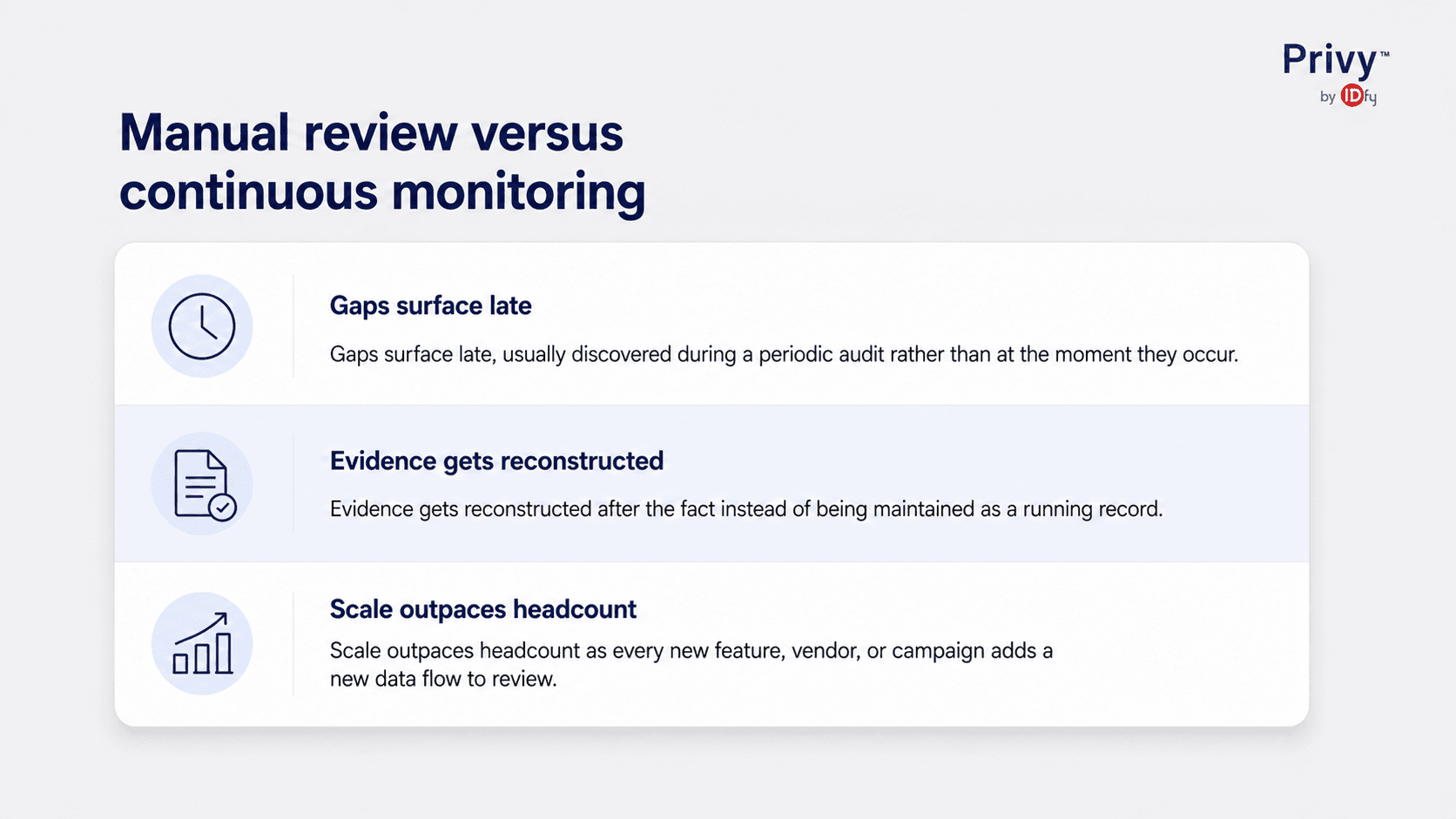
Three patterns repeat across Indian enterprises building DPDP programmes by hand.
Gaps surface late. A consent mismatch or an undisclosed data flow usually gets found during an audit, months after it started, not when it happened.
Evidence is reconstructed, not maintained. When a regulator or auditor asks for proof, teams scramble to assemble logs and approvals after the fact instead of pulling them from a running system.
Scale outpaces headcount. Every new product feature, vendor integration, or marketing campaign adds a new place personal data can flow. Compliance teams cannot manually review every one of them in time.
None of this happens because compliance teams are careless. It happens because the work itself does not scale linearly. A 10-person privacy team can review 10 product changes a quarter with reasonable thoroughness. It cannot review 200 changes a quarter with the same thoroughness, because the review process was designed for occasional checks, not constant ones. Adding headcount helps at the margins, but it does not change the structural mismatch between a continuous obligation and a periodic process.
How Privy's InspectAI Works As A Compliance Co-pilot
InspectAI is the intelligence layer that runs across Privy's three pillars and seven modules. Its role is to scan digital journeys, websites, apps, and user flows for the gaps a manual review would catch too late, and then connect what it finds to the module that can fix it. This is the shift from AI as a reporting tool to AI as a governance layer. Its intelligence does not come from scanning alone. It comes from context, a continuously maintained understanding of every personal data asset that InspectAI builds by learning from every module on the platform at once.
That context is drawn from across all three pillars of the Privy platform: Data Compass, consent governance, and continuous compliance. Every module feeds the same context model, so InspectAI understands a piece of personal data the way the enterprise does, not as an isolated value but as data with a purpose, a permission, an owner, a destination, and a set of obligations attached to it.
From RoPA and the purpose taxonomy, it learns which personal data belongs to which business process and why it is being processed, so a data element is never just "PII," it is PII processed for a declared purpose. From consent, it learns whether valid consent exists for that processing and whether it has been withdrawn or modified, so a purpose can be checked against permission automatically. From Third Party Risk Management, it learns which vendor is attached to which business process and what data-sharing obligations apply, so an expanded sharing footprint is visible the moment it appears. From data lineage, it learns where each data element originated and where it flows downstream, so the blast radius of any change is already mapped.
And it does all of this without ever seeing the data itself. Privy is PII-blind by design. The context graph is built entirely from metadata, including document type, PII categories, sensitivity, business process, consent state, vendor relationships, and lineage, never the underlying customer records. Customer data stays inside the enterprise's own environment. InspectAI can tell that a phone number belongs to a customer, was collected for order fulfilment, and is covered by withdrawn consent, without ever reading the number. It governs on context, not on content, which means the intelligence gets sharper while exposure goes down.
Because InspectAI holds all of this in one connected model, a single finding arrives pre-enriched. In practice, that shows up as a few connected capabilities working together rather than one isolated feature.
Continuous journey scanning. InspectAI scans live digital touchpoints to surface personal data collection, consent misalignments, and dark patterns that trick users into broader consent than they realise they are giving. This replaces a manual audit checklist with something closer to always-on monitoring.
Autofilled assessments. This is context paying off directly. When a new initiative triggers a DPIA, InspectAI pre-populates it from what the graph already knows: the systems involved, the data categories, the third parties receiving data, the cross-border transfers, and the high-risk processing. A DPIA that took a privacy team days of manual data-gathering starts mostly filled, because the enterprise never needed to re-answer questions the graph already had answers to. It is the difference between the old spreadsheet approach and a modern PIA workflow.
Automatic workflow triggering. When InspectAI flags a risk, it does not just generate a report. It can launch a PIA or trigger a vendor review through Third Party Risk Management automatically, so the gap moves into a resolution workflow instead of sitting in an inbox.
Connection to incident response. When a flagged risk is severe enough to qualify as an incident, InspectAI links to incident management to turn the alert into a tracked, time-bound response rather than a delayed internal escalation.
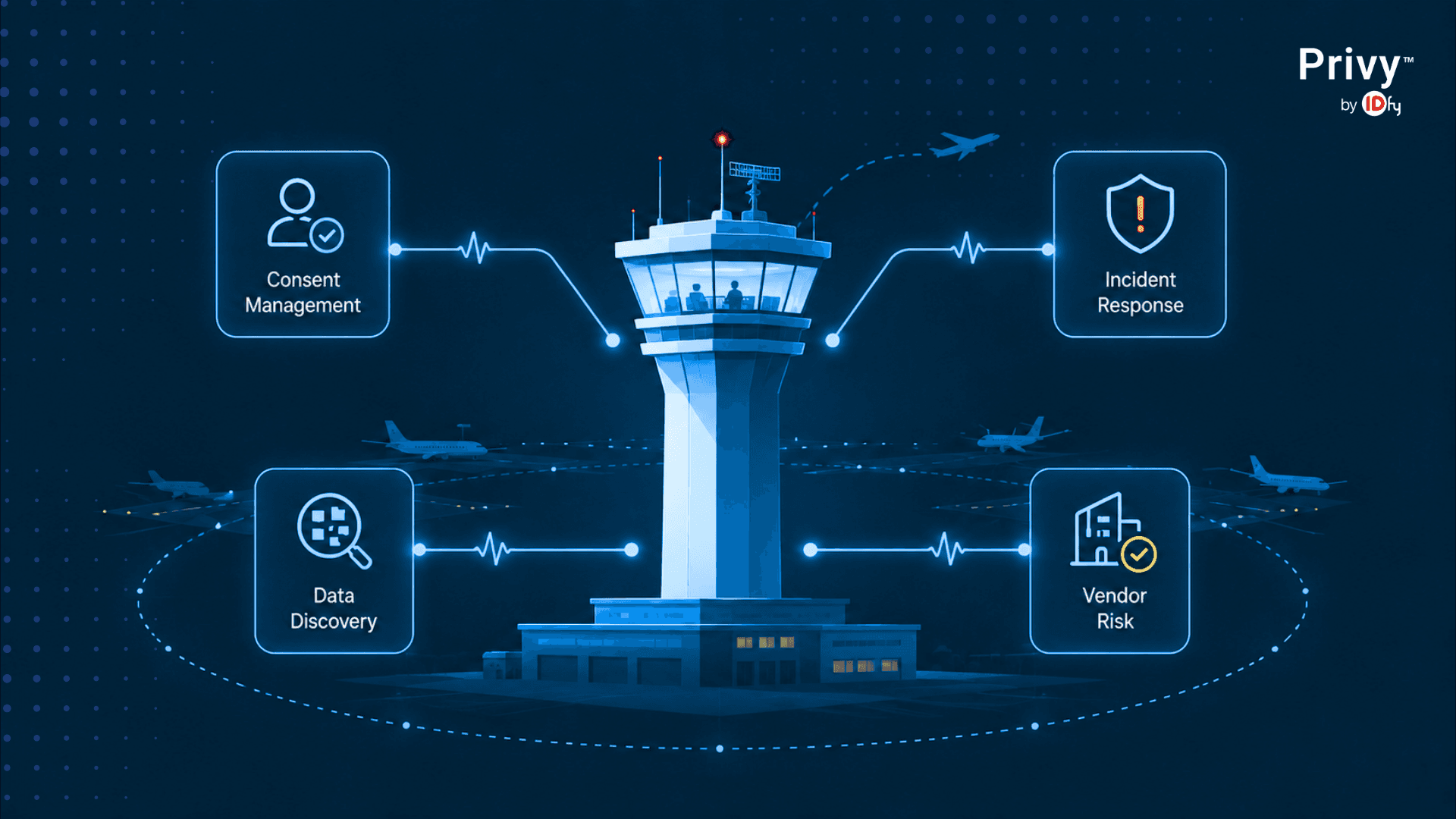
A closed loop across modules. Because InspectAI connects to Data Compass for data discovery, consent governance for purpose alignment, PIA workflows for risk assessment, and incident management for response, the output of one module becomes the trigger for the next. That loop is what makes the compliance programme autonomous rather than just automated, and it is the core of using AI to automate privacy compliance. Automation runs a fixed task faster. A closed loop notices, decides, and acts without waiting for a person to connect the dots between modules manually.
Why This Matters More Once May 2027 Arrives
The Digital Personal Data Protection Rules, 2025 were notified on 13 November 2025, with most substantive obligations taking effect around 18 months later. Once that deadline passes, a regulator's question stops being "do you have a policy" and becomes "show me your controls were running." A policy document proves intent. A continuously logged, autonomously monitored system proves operation.
This is also where Significant Data Fiduciaries face a sharper version of the same problem. SDFs carry annual DPIA obligations and algorithmic due diligence requirements that assume the enterprise can already show, with evidence, how its systems behave over time, not just what they were designed to do. An AI co-pilot that has been watching continuously has that evidence on hand. A team relying on quarterly manual reviews has to go build it from scratch under deadline pressure.
What To Expect From An AI Co-pilot, And What It Does Not Replace
An AI co-pilot finds gaps faster, routes them automatically, and keeps a continuous evidence trail. It does not remove the need for human judgment on what to do about what it finds, and it does not replace the legal accountability that sits with the Data Fiduciary regardless of which tools are running. The honest framing is that InspectAI changes the speed and completeness of detection and response. It does not change who is accountable when something goes wrong.
That distinction matters because it sets realistic expectations. An enterprise evaluating compliance automation should look for a system that surfaces risk early, connects findings to action, and produces evidence a Board or regulator can actually use, not a system that claims to make compliance someone else's problem.
Most tools can find a phone number. Few can tell you that this phone number belongs to a customer, was collected for order fulfilment, is covered by consent that was withdrawn last week, is being shared with a notification vendor whose contract does not cover marketing use, and is now flowing into an AI model. Finding the number is pattern matching. Knowing all of that is context. InspectAI runs on the second.
How Privy by IDfy Brings This Together
Privy by IDfy is built around the idea that compliance has to run as a connected system, not a set of separate tools. InspectAI sits at the centre of that system, scanning continuously and triggering the right module, whether that is Data Compass for discovery, the consent governance platform for purpose alignment, PIA workflows for risk assessment, Third Party Risk Management for vendor exposure, or incident management for breach response. It is one connected privacy platform rather than a stack of point tools.
The result is a compliance programme that moves at the pace personal data actually moves, instead of the pace of a quarterly review cycle. Privy does not remove the work of running a DPDP programme well. It makes that work visible, continuous, and provable, which is what autonomous compliance is meant to deliver.
For a DPO evaluating where to start, the practical entry point is usually discovery. Once Data Compass has mapped where personal data lives, InspectAI has a baseline to monitor against, and every subsequent gap it finds is measured against something real rather than guessed at. The same logic underpins data retention and lifecycle governance: you cannot enforce a rule on data you have not located. That sequencing, discovery first, monitoring second, automation third, is what separates an AI co-pilot that produces useful findings from one that produces noise.
Conclusion
Manual compliance was never going to keep pace with how fast personal data moves through a modern enterprise, and AI has only widened the gap. An AI co-pilot like InspectAI closes it by understanding personal data in full context, without ever seeing the data itself, watching continuously, connecting what it finds to the right workflow, and building the evidence trail a regulator or Board will eventually ask for. The work of running a DPDP programme still belongs to the people doing it. InspectAI just makes sure nothing slips through while they do it. If you want to see how InspectAI would scan your own systems, or have questions about getting started with Privy by IDfy, write to shivani@idfy.com for a demo or any compliance-related queries you'd like to walk through.
FAQ's
What does an AI compliance copilot do?
It continuously scans an enterprise's digital systems for compliance gaps, such as consent misalignments or undisclosed data flows, and routes those gaps to the relevant workflow automatically instead of waiting for a scheduled audit to find them.
Is autonomous compliance the same as automated compliance?
Not quite. Automation speeds up a fixed task. Autonomous compliance, as InspectAI is built, connects detection across multiple modules, including consent, data discovery, risk assessment, and incident response, so one finding can trigger the next step without manual handoff.
Does an AI co-pilot remove the need for a DPO or compliance team?
No. It changes what the team spends time on, shifting effort from finding gaps to deciding how to resolve them, but legal accountability for DPDP compliance stays with the Data Fiduciary regardless of the tools used.
How does InspectAI connect to other compliance modules?
It scans journeys for risk and triggers workflows in Data Compass, consent governance, PIA, Third Party Risk Management, and incident management directly, creating a closed loop rather than a standalone alert system.
Why does continuous monitoring matter more as the May 2027 deadline approaches?
Once core DPDP obligations take effect, demonstrating compliance requires evidence that controls were running over time, not just a policy document. Continuous monitoring builds that evidence as a byproduct of normal operation.
Understand how AI inspection and AI governance tools are transforming AI and compliance. Learn how AI data privacy automation strengthens regulatory readiness.
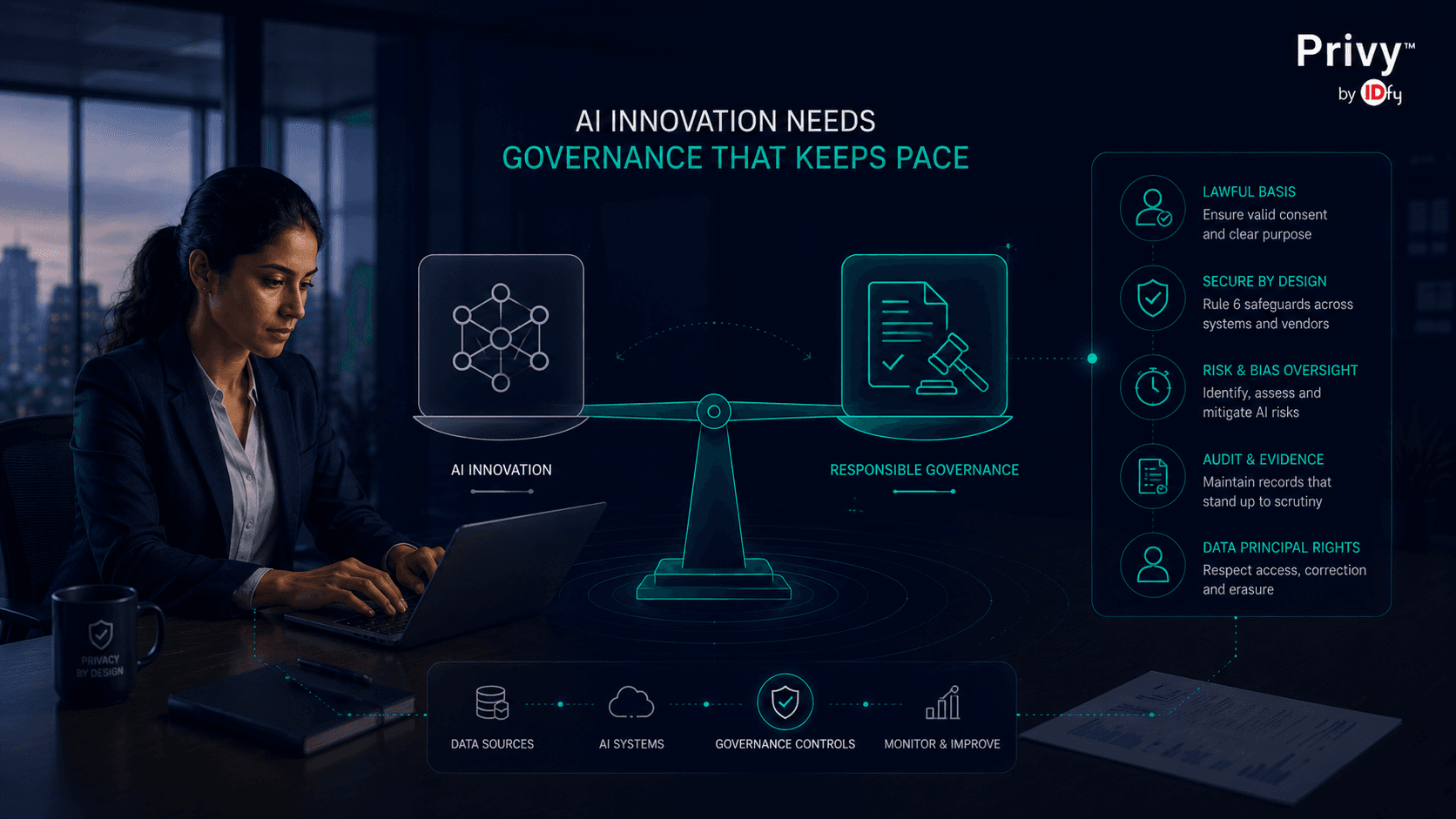
What AI governance means under India's DPDP Act, where Significant Data Fiduciaries face new duties, and how enterprises can build readiness in 2026.