

Data Minimization in DPDP: Why Collecting Less Data is the Smartest Strategy in 2026
Date Published

A recent landmark study on DPDP compliance revealed a staggering statistic: 96% of Indian websites are still collecting user data without explicit consent. As we move through 2026, the regulatory honeymoon period has ended. For any leadership team, this isn’t just a compliance checkbox; it is a ticking financial and reputational time bomb.
The stakes have never been higher. A FICCI-EY Risk Survey from early 2026 identified cybersecurity breaches as the top risk to Indian organizational performance, with 51% of executives ranking it above geopolitical instability. While many organizations are still focused on building larger data lakes to fuel AI, they are inadvertently building massive liability reservoirs. In the age of India’s Digital Personal Data Protection (DPDP) Act, every byte of unnecessary data is a target for state-actor cyberattacks. Recent reports show that the healthcare and pharma sectors recorded over 3.79 million threat detections in the past year alone, data that, once leaked, cannot be reset like a password.
The stakes are no longer theoretical. With the Ministry of Home Affairs (MHA) and security agencies increasingly scrutinizing how open-source intelligence and personal data are harvested from public sources, the line between useful insight and unlawful surveillance is razor-thin. Furthermore, as India moves to lock children out of social media through mandatory KYC and age-verification, the volume of sensitive personal data being collected is exploding. The "collect everything, analyze later" mindset is no longer a competitive advantage; it is a high-risk gamble. The smartest leaders in 2026 have realized that the leanest data stack is the safest and most profitable one.
Organizations preparing for long-term DPDP compliance are now shifting from reactive privacy programs toward operational privacy governance models that continuously monitor what personal data is collected, why it is collected, and whether it is still necessary to retain. This shift is fundamentally changing how enterprises think about user privacy, data retention, and transparent data practices.
Organizations exploring scalable privacy governance models are increasingly operationalizing broader DPDP implementation strategies across business, legal, and technology teams through structured governance frameworks like Privy’s DPDP operational readiness resources.
DPDP Implementation for Indian Enterprises
Understanding Data Minimization under the DPDP Act
At its core, data minimization is the principle that an organization should only collect personal data that is strictly necessary to fulfill a specific, stated purpose. If you are a digital lender, you need a credit score; you do not need access to a user’s entire contact list.
Under the DPDP Act, every byte of personal data stored is no longer just an asset; it is a potential legal and financial liability. The Act mandates that data collection must be strictly relevant and limited to the specified purpose of processing. In a landscape where the Data Protection Board (DPB) can impose penalties up to ₹250 crore per instance, holding excessive or "dark data" creates an unjustifiable risk profile for the modern enterprise.
One of the biggest operational risks enterprises face today is the existence of “invisible data.” This includes forgotten backups, duplicate customer records, abandoned SaaS environments, legacy databases, and unstructured files sitting across departments. Without strong data discovery and data mapping capabilities, organizations often underestimate how much sensitive personal data they actually hold.
Organizations are increasingly using automated discovery and mapping systems to strengthen visibility into sensitive personal data across fragmented ecosystems.
Why Data Visibility Is the First Step to Compliance
To quantify the impact of these regulations on enterprise health, we collaborated with MIT to produce a comprehensive research paper on the enterprise privacy and DPDP rules. Our findings suggest that Indian enterprises are currently carrying a significant "Privacy Debt" that requires immediate architectural shifts.
Key takeaways from the Privy & MIT research include:
- The Proportionality Gap: Many organizations collect 35–50% more data points than are actually utilized for their core business logic, significantly increasing their attack surface for regulatory scrutiny.
- The Cost of Inaction: The research reveals that the cost of retrofitting privacy into legacy systems is 10x higher than adopting a "Privacy by Design" approach from the outset.
- Consumer Trust Dividends: Our data indicates a direct correlation between transparent data minimization and customer retention; users are 40% more likely to engage with platforms that explain exactly why a specific data point is being requested.
- Operational Efficiency: Enterprises that successfully implemented automated data purging (as mandated by Section 12) saw a 15–20% reduction in cloud storage overheads by eliminating Redundant, Obsolete, and Trivial (ROT) data.
By aligning your digital architecture with the principles outlined in our MIT collaboration, your organization moves from a state of reactive compliance to one of strategic data leadership.
Privacy-conscious enterprises are increasingly integrating consent governance directly into their digital infrastructure so that data minimization, user privacy, and processing accountability become enforceable operational controls rather than static policy statements.
Privacy by Design and Privacy by Default: The New Blueprint
To implement minimization effectively, organizations must shift from reactive compliance to proactive engineering through two critical frameworks:
- Privacy by Design: This means embedding data protection into the very fabric of your technology. It isn't an add-on; it's the foundation. From the moment a product is conceived, the question must be: What is the minimum amount of sensitive personal data we need to make this work?
- Privacy by Default: This ensures that the strictest privacy settings are applied automatically. The user shouldn't have to hunt through settings to protect their information. By making user privacy the "out-of-the-box" experience, you build trust and significantly reduce the volume of data you are responsible for.
This becomes even more important as enterprises begin integrating AI systems into onboarding journeys, customer analytics, fraud detection, employee monitoring, and personalization engines. AI systems trained on excessive or unnecessary personal data dramatically increase governance complexity and regulatory exposure.
How AI Detects Hidden Privacy Risks
Data Minimization Architecture
Under the Digital Personal Data Protection (DPDP) Act, data collection is no longer about what you can collect, but what you must collect. This shift moves organizations away from "data hoarding" toward a lean, purpose-driven data strategy.
1. The Statutory Mandate: Section 6 of the DPDP Act
Section 6(1) of the DPDP Act explicitly ties the validity of consent to the necessity of the data being collected. It states that consent must be "limited to such personal data as is necessary for such specified purpose."
The Act provides a clear illustration: If a telemedicine app asks for your contact list to provide medical services, that consent is invalid because the contact list is not necessary for the core purpose of a medical consultation. Organizations must now justify every data field they request.
As DPDP enforcement matures, regulators are expected to increasingly scrutinize excessive field collection across onboarding forms, APIs, mobile applications, and third-party integrations. Enterprises that fail to align collection practices with business necessity may struggle to defend their processing activities during audits or investigations.
Organizations preparing for audits are increasingly adopting structured DPDP readiness and compliance assessment frameworks.
DPDP Compliance Checklist for Indian Enterprises
2. Core Principles of Data Minimization
- Adequacy: You must collect enough data to fulfill your stated purpose effectively.
- Relevance: The data must have a direct, rational link to the service being provided.
- Necessity: If you can achieve the goal without a specific piece of personal data, you should not collect it.
4. How to Implement Data Minimization (The Checklist)
To move from policy to practice, Indian CXOs should adopt these technical and operational shifts:
- Field-Level Audit: Review every API and form. If a field (like Gender or DOB) isn't critical for the transaction, remove it or make it optional.
- Data Discovery & Mapping: Use automated tools to find Shadow Data, personal info sitting in logs, temp files, or old databases that no longer serve a purpose.
- Just-in-Time Collection: Only collect data when it’s needed. Don’t ask for a delivery address at the sign-up stage if the user is just browsing.
- Automated Retention & Deletion: Implement Purge-by-Default logic. Under Section 12, once the purpose is served, the data must be erased. Automate this to avoid the legal risk of holding "zombie data."
- Privacy by Design (PbD): Ensure that new product features are built with data-blind defaults, where the system assumes the least amount of data is required.
Modern enterprises are increasingly adopting intelligent data discovery and classification systems that continuously monitor sensitive personal data across cloud repositories, endpoints, employee devices, vendor systems, and legacy infrastructure. This helps organizations identify unnecessary data accumulation before it evolves into regulatory exposure.
How Privy by IDfy Solves the Minimization Challenge
Navigating these requirements while maintaining operational speed is the primary challenge. Despite the law being in effect, 80% of Indian organizations admit they have not yet updated their privacy policies or governance frameworks. This is where Privy becomes a strategic asset.
Privy is designed to automate the complexities of the DPDP Act. Instead of relying on manual audits that are outdated the moment they are finished, Privy provides a real-time infrastructure for managing consent and data flows.
Transitioning from a hoarding culture to a minimization culture is technically and operationally difficult. This is where Privy acts as a strategic architectural layer. Privy is designed to ensure that data minimization isn't just a policy in a handbook, but a functional reality in your codebase.
- Automated Purpose Limitation: Privy helps organizations map every data point collected to a specific legal purpose. If a form field or an API call starts collecting data that hasn't been whitelisted as necessary, Privy provides the visibility to flag and stop it.
- Third-Party Risk Management: One of the greatest leaks in any organization is through its vendors. Even if you practice minimization, your marketing or payroll partners might not. Privy’s Third-Party Risk Management module allows you to monitor and control the data flow to external entities, ensuring they only receive the minimum subset of data required to perform their function.
- Consent Orchestration: Privy manages the entire lifecycle of consent. When a user withdraws consent for a specific purpose, Privy ensures that the associated data is restricted or deleted across your systems, preventing "data residue" from becoming a compliance liability.
As enterprises expand digital ecosystems and AI-powered vendor integrations, third-party governance is becoming one of the biggest privacy risk areas under DPDP. Organizations increasingly require centralized visibility into how vendors collect, process, store, and transfer sensitive personal data across the ecosystem.
Privacy Incident Management and Governance
By integrating Privy, organizations move away from manual, error-prone audits and toward a system where transparent data practices are baked into the infrastructure.
The Financial Implications of Data Retention and Deletion
One of the most overlooked aspects of the DPDP Act is data retention. The law is clear: once the purpose for collecting the data is served, the data must be deleted. Recent 2026 updates to the DPDP Rules have even introduced dual intimation requirements, mandating that firms notify users before erasing their data if they have been inactive for a specific period.
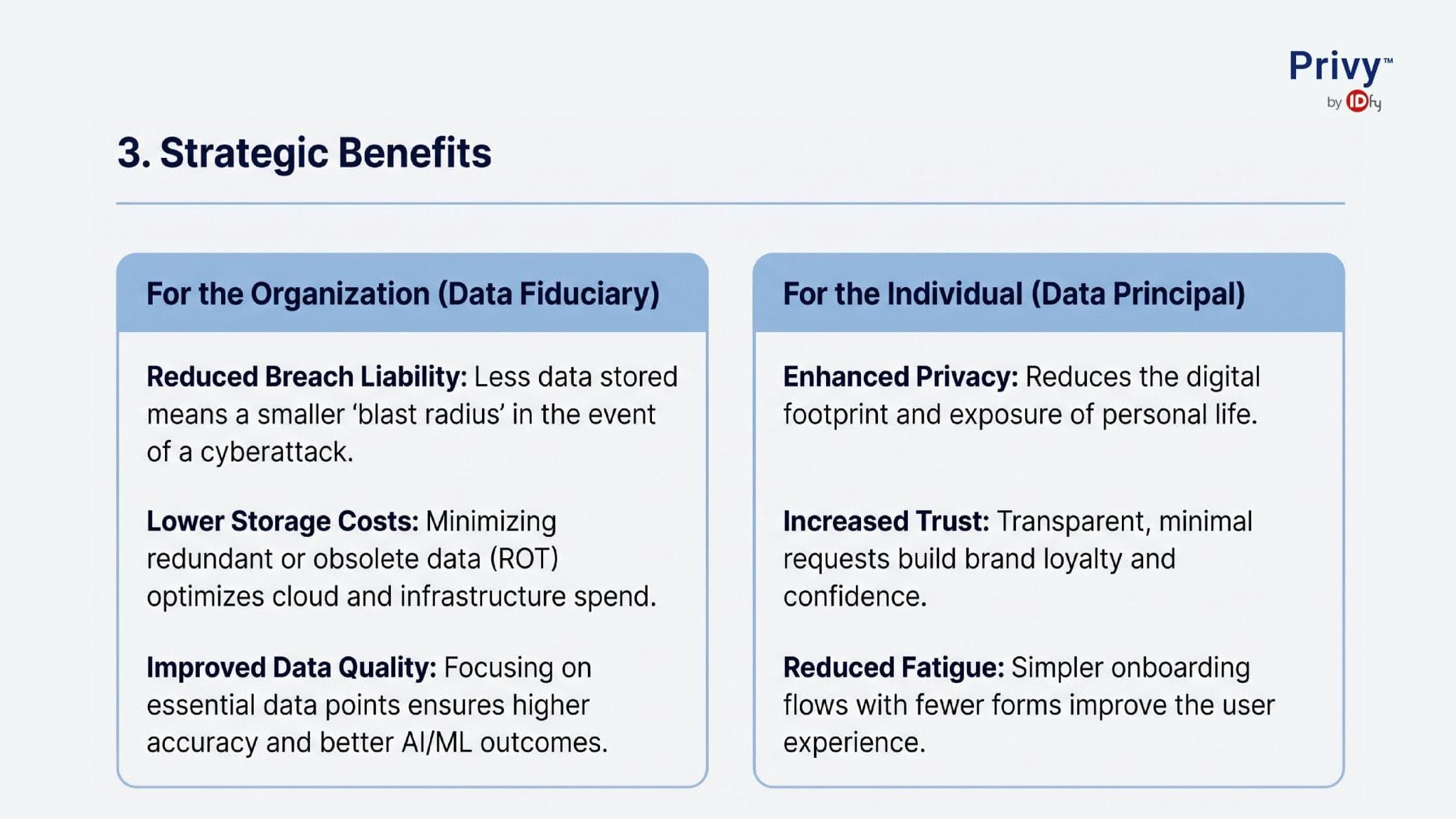
Data minimization isn't just a legal checkbox; it is a high-yield financial and security strategy. In an era where the DPDP Act mandates strict purpose limitation, the business case for less is more is backed by compelling data.
1. Direct Financial Returns
Implementing strict retention policies and eliminating Redundant, Obsolete, and Trivial (ROT) data delivers immediate balance-sheet impact:
- Storage & Backup Savings: Organizations can reduce total storage and backup expenditures by 30–50% by purging unneeded data.
- Database Efficiency: Moving non-active data to long-term archiving reduces active database capacity consumption by an average of 50% due to improved compression and indexing.
- Industry-Specific Gains: Optimization potential varies by sector, with Telecom seeing up to 65% waste reduction, followed by Finance and Retail at 25–45%.
2. Hardening Security
In 2026, the average global cost of a data breach has climbed to $4.88 million. Data minimization acts as a natural insurance policy:
- Reduced Attack Surface: You cannot lose data you do not have. Eliminating non-essential PII reduces the volume of high-value targets for threat actors.
- Financial Impact Mitigation: Reducing the volume of retained records directly correlates to lower forensic, notification, and remediation costs following an incident.
- Accelerated Recovery: Disaster recovery and business continuity operations are 25% faster when there is less data noise to restore and validate.
3. Strategic Compliance & Legal Advantage
Beyond avoiding the ₹250 crore fines under DPDP, a structured retention policy streamlines legal operations:
- eDiscovery Optimization: Strict retention can reduce the cost of finding data for legal inquiries by 50–70%.
- Rapid Audit Response: Compliance teams can respond to regulatory inquiries 40% faster by operating within a lean, indexed data environment.
- Litigation Shielding: Proactively removing data past its legal retention period prevents zombie data from being used against the organization in future proceedings.
As you plan your next fiscal cycle, treating data minimization as a CAPEX/OPEX optimization tool is essential. For more on how to align your spend with these new mandates, read our CXO Guide to DPDP-Informed Budget Planning.
Implementing Transparent Data Practices for Long-term Trust
Transparency is the antidote to the non-compliance crisis. In industries like healthcare, where you handle diagnostic reports and medical histories, transparency creates a privacy dividend. When users see that you only ask for what is necessary and explain exactly why, their trust in your platform increases.
With the consent management platform becoming fully operational in late 2026, users will have a dashboard view of who has their data. Organizations that have already practiced minimization will stand out as reliable partners, while those hoarding data will face a wave of consent withdrawals and potential litigation.
Transparent consent experiences are rapidly becoming one of the strongest differentiators in digital trust. Users increasingly evaluate organizations not just by products or pricing, but by how responsibly they handle personal data, consent withdrawal, and preference management across digital channels.
Do Cookie Banners Affect User Trust?
Conclusion
The DPDP Act has fundamentally changed the rules. Collecting less data is no longer just a legal obligation; it is the smartest privacy strategy available. By embracing data minimization, investing in privacy by design, and utilizing tools like Privy to manage third-party risks, your organization can move faster and more securely than the competition.
The era of data hoarding is over. The era of data stewardship has begun.
Organizations that operationalize privacy governance early will be significantly better positioned to manage AI risk, third-party exposure, retention obligations, consent governance, and future regulatory investigations at scale. In the coming years, privacy maturity will increasingly become a competitive business differentiator rather than just a compliance benchmark.
Organizations looking to strengthen long-term privacy governance and technical safeguards can also explore Privy’s guide to Privacy-Enhancing Technologies (PETs) under DPDP.
Guide to Privacy-Enhancing Technologies (PETs) under DPDP
Are you ready to streamline your data footprint and ensure DPDP compliance? For an in-depth consultation on automating your privacy workflows and managing third-party risks, reach out to shivani@idfy.com.
Discover how data mapping simplifies privacy audits, improves data governance, enhances data classification, and builds a structured data catalog.