

Cookie Consent Strategy To Improve Opt-In Rates Compliantly
Date Published
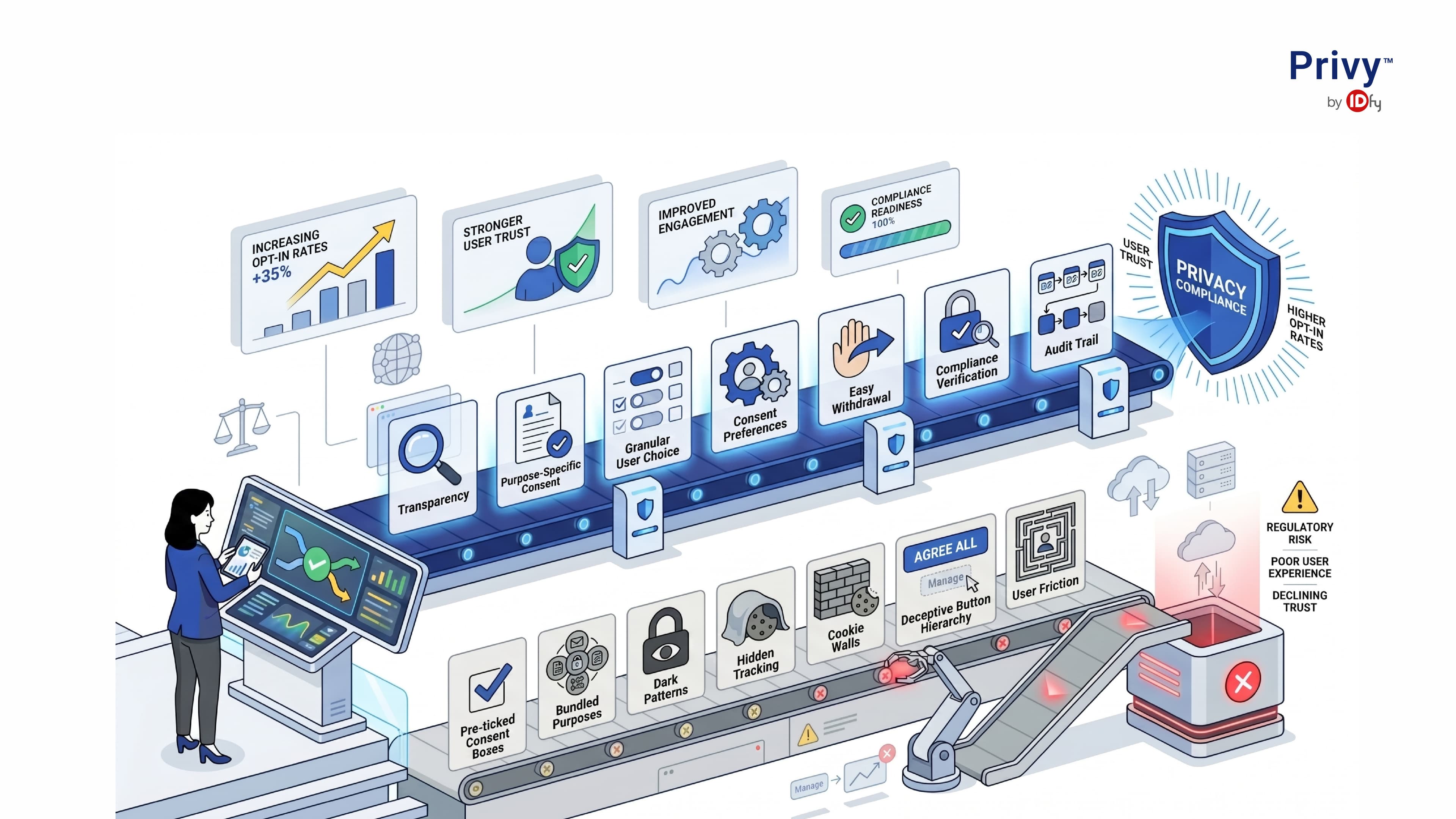
Most companies treat cookie consent as a UI/UX problem. Pick a banner template, add an "Accept All" button, and ship it. The result: either a banner that pushes users toward consent through pressure and confusion, or one that's so cautious it barely converts. Neither approach holds up under scrutiny.
A 2026 study analysed 14,000 websites and found that 24% of sites globally continue to set cookies even after a user explicitly rejects them. On 44% of EU sites, cookies were already set before any user interaction had occurred. And 57% of EU sites required significantly more steps to withdraw consent than to give it. These are not obscure edge cases. They're standard practice, and they represent real compliance exposure.
For enterprises building consent infrastructure in India, understanding what cookie consent means under the Digital Personal Data Protection Act is the starting point. With enforcement approaching, cookie consent is no longer just a UX conversation. It's a governance one.
Why Cookie Consent Opt-In Rates Are Declining
Users have become familiar with cookie banners. They've also become suspicious of them. Consent banners have historically relied on friction asymmetry: one click to accept, several clicks to reject. Users who saw through this started rejecting outright or closing banners without interacting. Regulators began taking note.
The research identifies this specifically as "RevocationHard" (DP15), a pattern where withdrawing consent is technically possible but designed to require significantly more effort than giving it. This violates the GDPR requirement that withdrawal must be as easy as granting consent. Under India's DPDP Act, the same principle applies. When users don't trust the banner, they reject or ignore it. Opt-in rates drop. And if the banner is also non-compliant, the enterprise gets the worst of both outcomes. If you're building the internal case for investing in proper consent infrastructure, this guide on DPDP consent management for enterprises covers the full operational scope.
Dark Pattern Problem: What's Actually Happening In Consent Banner
The 2026 research introduced a taxonomy of 19 dark patterns in cookie consent interfaces, including 9 newly identified ones that existing detection tools couldn't catch. A few are directly relevant to enterprise consent strategy:
Pre-consent cookies (DP16): Cookies set before the user has made any choice. Found on 44% of EU sites and 83% of US sites in the study. Under both GDPR and DPDP, processing personal data before valid consent is obtained is a direct compliance failure.
Fake opt-out (DP18): Cookies continue loading after the user clicks "Reject." Found on roughly 1 in 4 sites globally. This is typically a structural problem in how the consent banner connects to the tag management layer.
Pay to opt out (DP13): Users are asked to pay a subscription fee to avoid tracking. More common in the EU (8% of sites) than in the US (3%). Legally ambiguous but increasingly under scrutiny.
Missing purpose information (DP12): The consent screen doesn't explain what the data will be used for. This directly conflicts with DPDP's notice and purpose requirements.
The study also found a security dimension: sites using revocation barriers set 25% more cookies on average, and 80% of cookies across the dataset lacked the HttpOnly flag, leaving them vulnerable to cross-site scripting attacks. A poorly designed consent banner is not just a compliance risk. It's a security exposure.
Where Enterprises Typically Go Wrong
- Legal, product, and engineering teams operate in silos.
- Cookie policies and actual implementations are misaligned.
- Tag managers continue firing despite user preferences.
- Cookie inventories are not updated when vendors change.
- Consent records are not maintained in an auditable format.
Cookie Consent Under DPDP: What Enterprises Need To Prepare
India's DPDP Act requires that consent be free, specific, informed, and unambiguous. It must be sought for each distinct purpose. Withdrawal must be as easy as granting consent. And the data fiduciary must be able to demonstrate that valid consent was obtained.
For digital properties, this means cookie consent infrastructure needs to meet the same standard as any other consent workflow. A banner that pre-ticks analytics cookies, or buries the reject option, or continues loading third-party scripts after rejection, will not hold up.
Enterprises that have already invested in GDPR-compliant consent management have a head start. Those building from scratch under DPDP should not treat cookie consent as a minor configuration task. Assess your current DPDP readiness across consent, data mapping, and rights management before making infrastructure decisions. Check out: Top Consent Tools vs Privacy Platforms: Fastest DPDP Compliance Guide 2026
What Effective Cookie Consent Looks Like In Practice
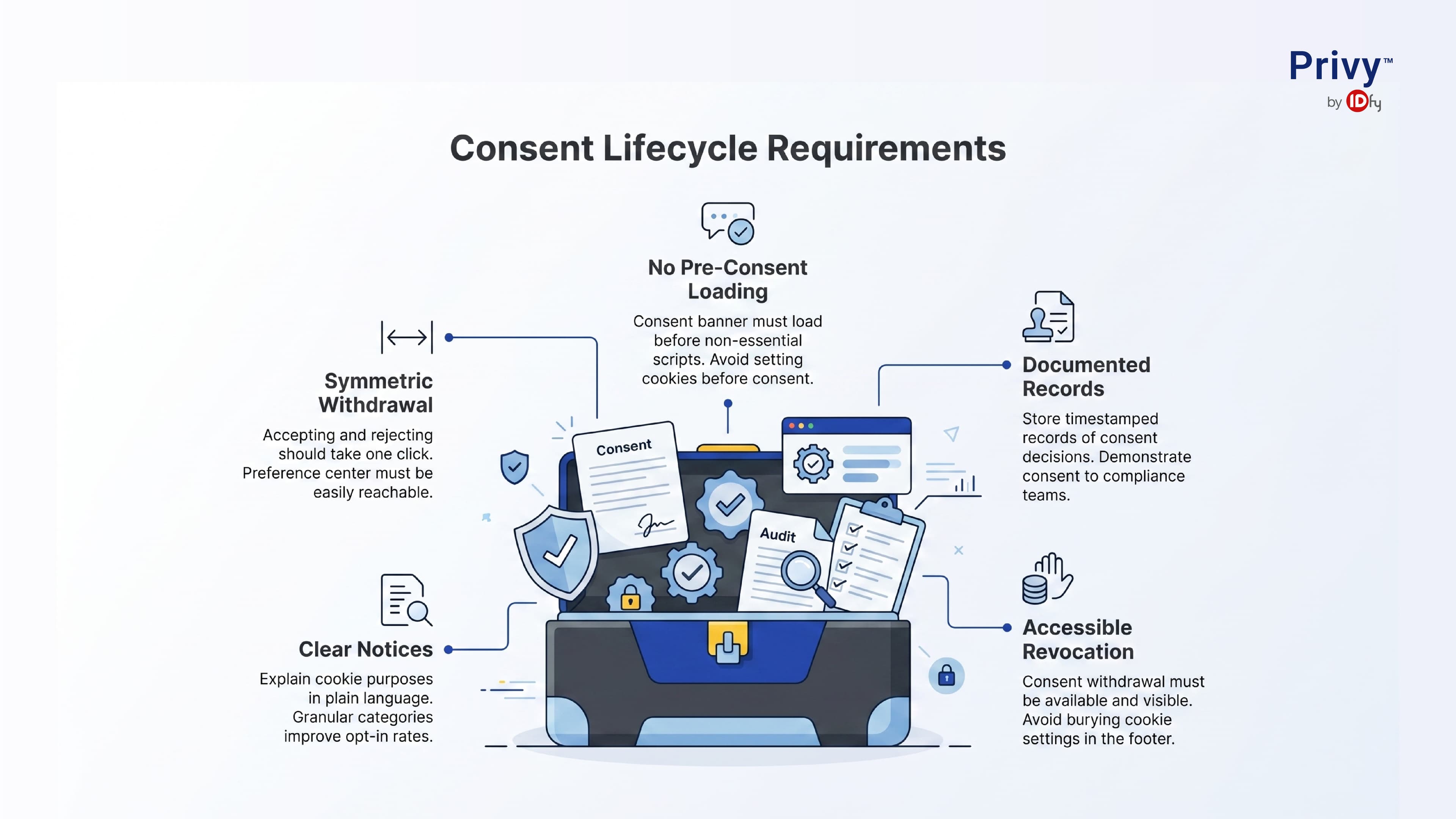
Building The Operational Layer For Cookie Consent
For enterprises preparing for DPDP readiness, cookie consent needs to connect to the broader consent governance layer, so that records, withdrawal history, and purpose mapping are available in one place when regulators or data principals ask for them.
Privy by IDfy's consent management solution gives enterprises the infrastructure to run cookie consent as a governed, auditable process: purpose-mapped consent banners, preference centre management, withdrawal workflows, and consent records with timestamps and audit trails. Privy by IDfy platform connects cookie consent to data discovery, rights management, vendor governance, and incident workflows, so consent evidence is never isolated from the broader compliance picture.
Conclusion
Cookie consent is often viewed as a banner design exercise, but under DPDP it is fundamentally a governance challenge. The real question is not whether users click "Accept," but whether organisations can demonstrate that consent was sought transparently, granted voluntarily, and can be withdrawn just as easily.
As regulatory expectations evolve, enterprises will need to move beyond checkbox compliance and build consent frameworks that are auditable, operationally sound, and aligned with how data is actually collected and processed across digital properties. Cookie banners that rely on ambiguity, friction, or dark patterns may deliver short-term gains, but they create long-term compliance and trust risks. The organisations that will be best prepared for DPDP are those that treat consent as an ongoing operational capability rather than a one-time implementation project. When transparency, user choice, and governance are built into the consent lifecycle, compliance becomes easier to demonstrate, and trust becomes easier to earn.
To learn how Privy by IDfy helps enterprises operationalise consent management through purpose-based consent collection, auditable records, withdrawal workflows, and governance controls, reach out to us at shivani@idfy.com. We'd be happy to help.
FAQ
What is a cookie consent strategy?
A cookie consent strategy is the operational plan for how an enterprise collects, records, and manages user consent for cookies across its digital properties. It covers banner design, purpose disclosure, consent records, withdrawal mechanisms, and ongoing governance as the cookie inventory changes.
How can enterprises improve cookie opt-in rates without using dark patterns?
By giving users clear, category-specific information about what each cookie does, making the reject option as visible and easy as the accept option, and offering granular choices. Users who trust the banner are more willing to consent.
What does the DPDP Act require for cookie consent?
Under India's Digital Personal Data Protection Act, consent must be free, specific, informed, and unambiguous. It must be sought separately for each distinct purpose, withdrawal must be as easy as granting consent, and enterprises must be able to produce records demonstrating that valid consent was obtained.
What is a cookie manager?
A cookie manager is a system that governs cookie consent across an enterprise's digital properties. It typically includes a consent banner, a preference centre, a cookie inventory, integration with tag management, and a record-keeping layer that makes consent auditable.
What are dark patterns in cookie consent banners?
Dark patterns are interface designs that push users toward consent without their genuine agreement. Common examples include pre-checked boxes, hidden reject buttons, more steps to withdraw than to consent, and cookies that load before any user interaction. A 2026 study of 14,000 websites found that 24% continue to set cookies even after a user explicitly rejects them.
Why is cookie consent an enterprise governance issue?
Because it sits at the intersection of legal compliance, data security, and customer trust. A broken consent implementation can mean data collected without valid consent, security vulnerabilities from unvetted third-party scripts, and exposure when regulators audit.
How often should enterprises update their cookie consent setup?
Every time new vendors, pixels, or analytics tools are added to a digital property, the cookie inventory and consent banner should be reviewed. The notice shown to users must reflect the processing actually happening.

Learn how cookie consent, cookie policy clarity, and the right cookie manager can turn compliance into credibility and trust.

Learn how global cookie laws shape cookie policies, why consent matters, and how using a cookie manager can simplify compliance and build user trust.