

Bank Data Breach Case Study: What It Shows About DPDP and Data Governance
Author
aishwarya
Date Published
October 2026, a bank data breach put customer records on the dark web. India's largest public sector bank received alerts from its threat intelligence provider, the Defence Cyber Agency, and CERT-In. It reviewed about 375,000 records and found 3,897 holding customers' personal data.
The leaked data included names, registered mobile numbers, dates of birth, gender, email addresses, and residential addresses. It also held branch and CIF identifiers, lead IDs, and metadata tied to loan and lead records. The bank disclosed the incident to BSE and NSE on 21 October, five days after the first alert, and engaged a cybersecurity agency empanelled by CERT-In. Its disclosure did not say how the data left its environment.
That sequence makes this bank data breach a useful case study. It is one of the data breach cases in India that raises the same questions every enterprise will face under the DPDP Act. Which data was exposed? Whose is it? Which systems and vendors held it? Who must be told, and when?
What the Bank Data Breach Shows About DPDP Obligations
Two sets of rules apply to a bank data breach in India. Indian Computer Emergency Response Team (CERT-In) requires reporting of listed incidents within 6 hours, and the RBI cybersecurity framework applies to banks. As the Internet Freedom Foundation notes, both duties run to regulators. The DPDP Act adds a duty for every data fiduciary to tell each affected data principal, from 13 May 2027. This table maps the facts of the case to the Act.
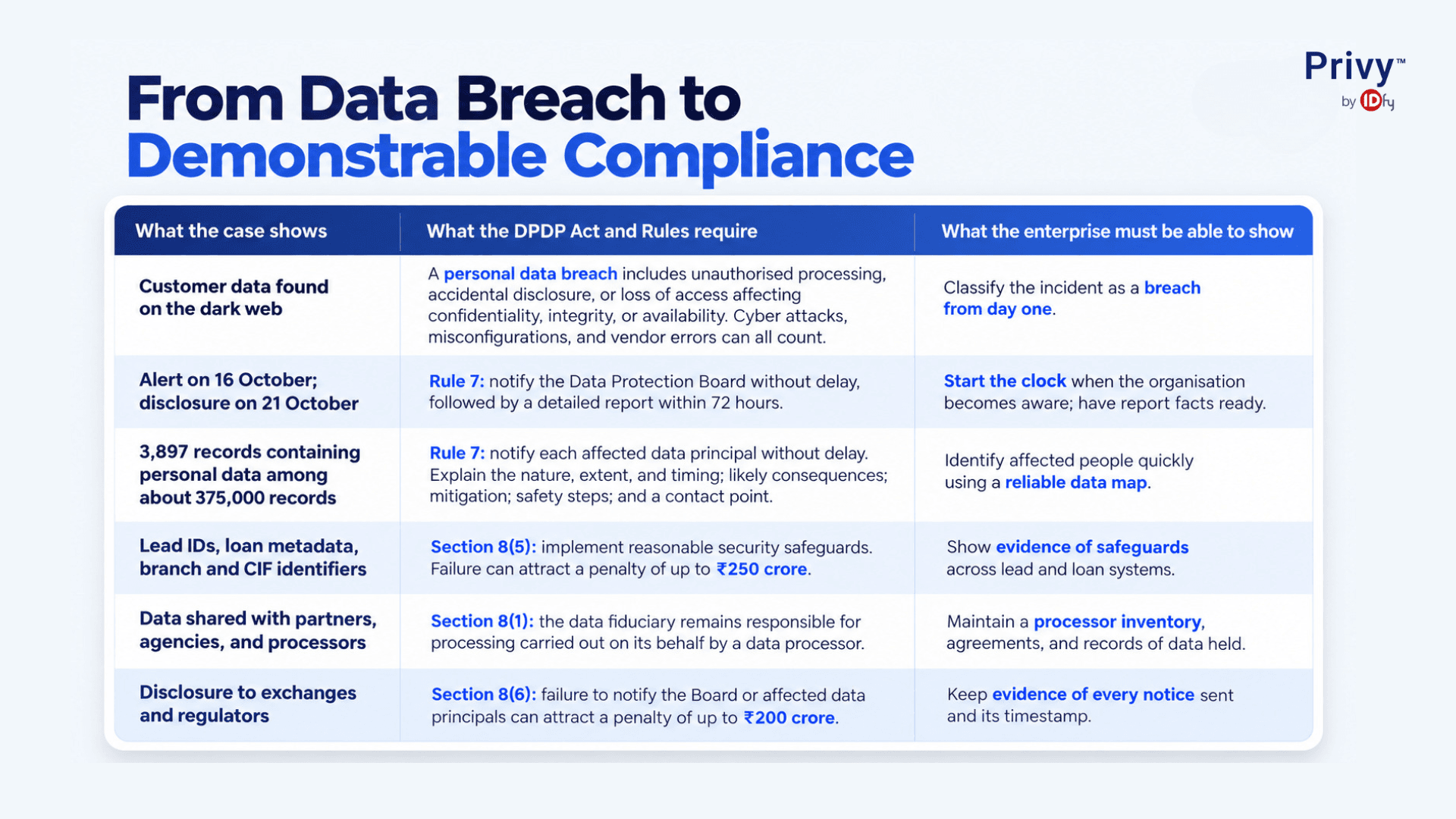
The likely consequences a notice must describe are concrete here. They include targeted phishing, fraudulent calls, and impersonation scams. Every row depends on one thing: knowing what personal data the enterprise holds, where, and who else touches it. That is data governance.
The Four Questions Every Breach Forces You to Answer
Four questions come first after a bank data breach.
- Which systems were affected?
- What personal data did they hold?
- Whose personal data may be affected, and which third parties are involved?
- Who must be notified, when, and what evidence supports your response?
The answers depend on work done before the breach. A data inventory that shows where each data element lives and who touches it turns questions 1 and 2 into a lookup. Dark web monitoring tells you that data has left. A data map tells you which data it was, whose it is, and where it came from. You need both.
Why Data Governance and Third Parties Decide the Outcome of a Bank Data Breach
Four gaps make any data leak harder to contain and slower to respond to.
Personal data lives in places nobody listed. Spreadsheets, test copies, lead lists, email exports, scanned documents, and legacy systems keep personal data long after the original purpose ends. Example: a lead list exported to a shared drive for one campaign and never deleted. Data discovery is how you find these copies.
Vendors and partners hold copies. Collection agencies, lead partners, cloud providers, and other processors handle customer data on your behalf. Under the DPDP Act, you stay accountable for what your third-party processors do with it.
Nobody maps how the data moves. APIs, integrations, and exports carry data between systems. Without a lineage map, an exposed file is hard to trace back to its source.
The response gets built on the day. Without a ready incident workflow, named owners, notice templates, and an evidence trail, teams spend days gathering facts.
What Readiness for a Bank Data Breach Takes
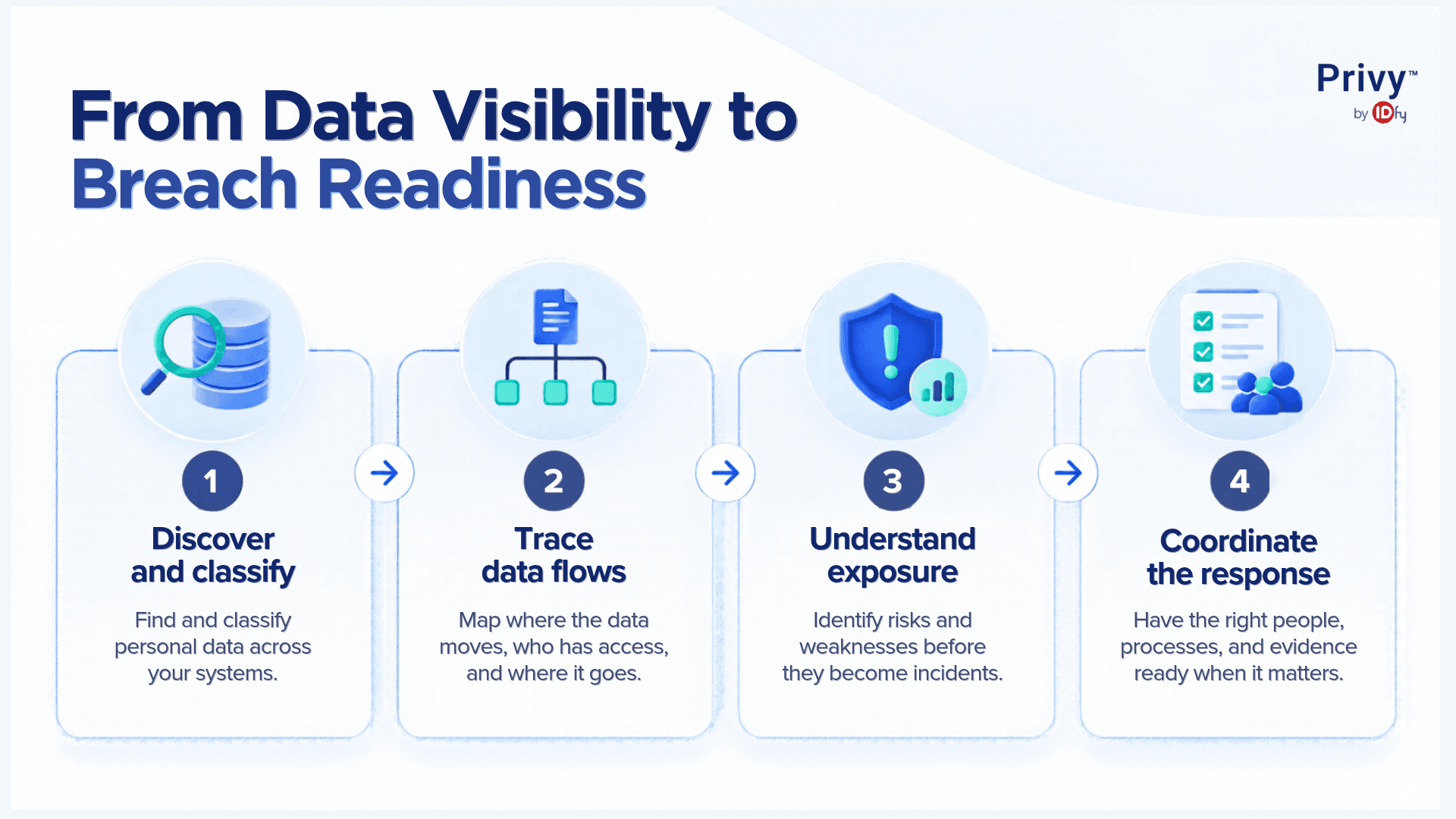
Readiness for a bank data breach is mostly data visibility. Four steps build it.
- Discover and classify. Find personal data across systems, files, scanned documents, and endpoints, and label what each element is.
- Trace data flows. Map how personal data moves across applications, APIs, and third parties.
- Understand exposure. Connect each data element to an owner, a processing purpose, and its recipients, so likely impact can be assessed.
- Coordinate the response. Run incident workflows, track reporting timelines, and keep the evidence that supports each decision.
For a full programme, read the DPDP compliance guide for 2026 and the guide to incident management under DPDP.
What is privacy incident management covers incidents, breaches, and response in practice.
What to Look for in Data Discovery Tools
Data discovery tools vary a great deal. Five checks help you compare them:
- It reads structured and unstructured data, including scanned documents and endpoints.
- It recognises Indian personal data types such as Aadhaar, PAN, voter ID, and passport numbers.
- It shows lineage, so you can see where data came from and where it went.
- It links each data element to an owner, a purpose, and recipients.
- It feeds incident workflows, so the first four questions are answered from a data map.
For vendor questions, read how to choose privacy incident management software in 2026 and IDfy's seven things an ideal DPDP solution should have.
How Privy Solves This Bank Data Breach Case
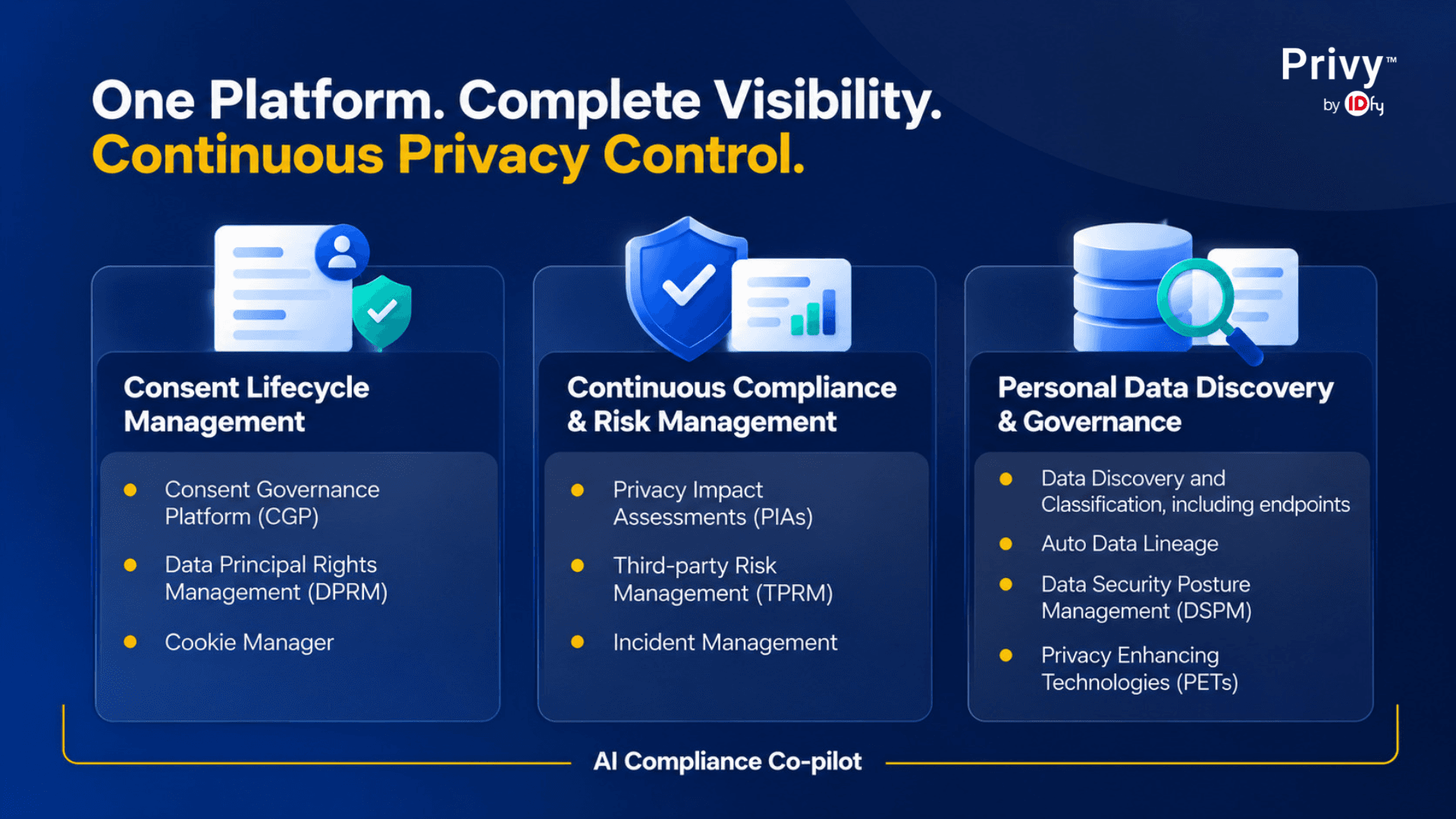
The fields in this case were names, contact details, dates of birth, branch and CIF identifiers, lead IDs, and loan metadata. Here is how an enterprise on Privy by IDfy goes from fields like these to answers, across 3 pillars and 10 modules.
Data Governance: Know the Data Before the Alert
Personal Data Discovery & Governance finds and classifies personal data across structured systems, unstructured stores, scanned records, and endpoints, including Indian identifiers such as Aadhaar, PAN, and voter ID. The data map shows which systems hold fields like these. Data Discovery & Classification builds it, and Automated Data Lineage traces how the data moved across applications, APIs, and third parties.
Third Parties: Know Who Holds Copies
Lead partners, collection agencies, and cloud vendors handle customer data on a bank's behalf. Third-Party Risk Management keeps each processor, its data processing agreement, and the data it handles in one place. It assesses, contracts, and continuously monitors every processor against agreement terms, so the list of who holds copies is ready when an alert arrives.
Incident Response: Run the Clock With Evidence
Incident Management runs an auditable, time-stamped workflow, with CERT-In, sector, and Data Protection Board notifications tracked together. It connects the data map to the notice: who is affected, what each person must be told, and the evidence behind every step. The AI Compliance Co-pilot gives one unified view across all modules and scans for gaps continuously.
Privy works alongside your security stack. It shortens the path from alert to answer, because the map already exists.
Largest Enterprises Trust Privy With DPDP
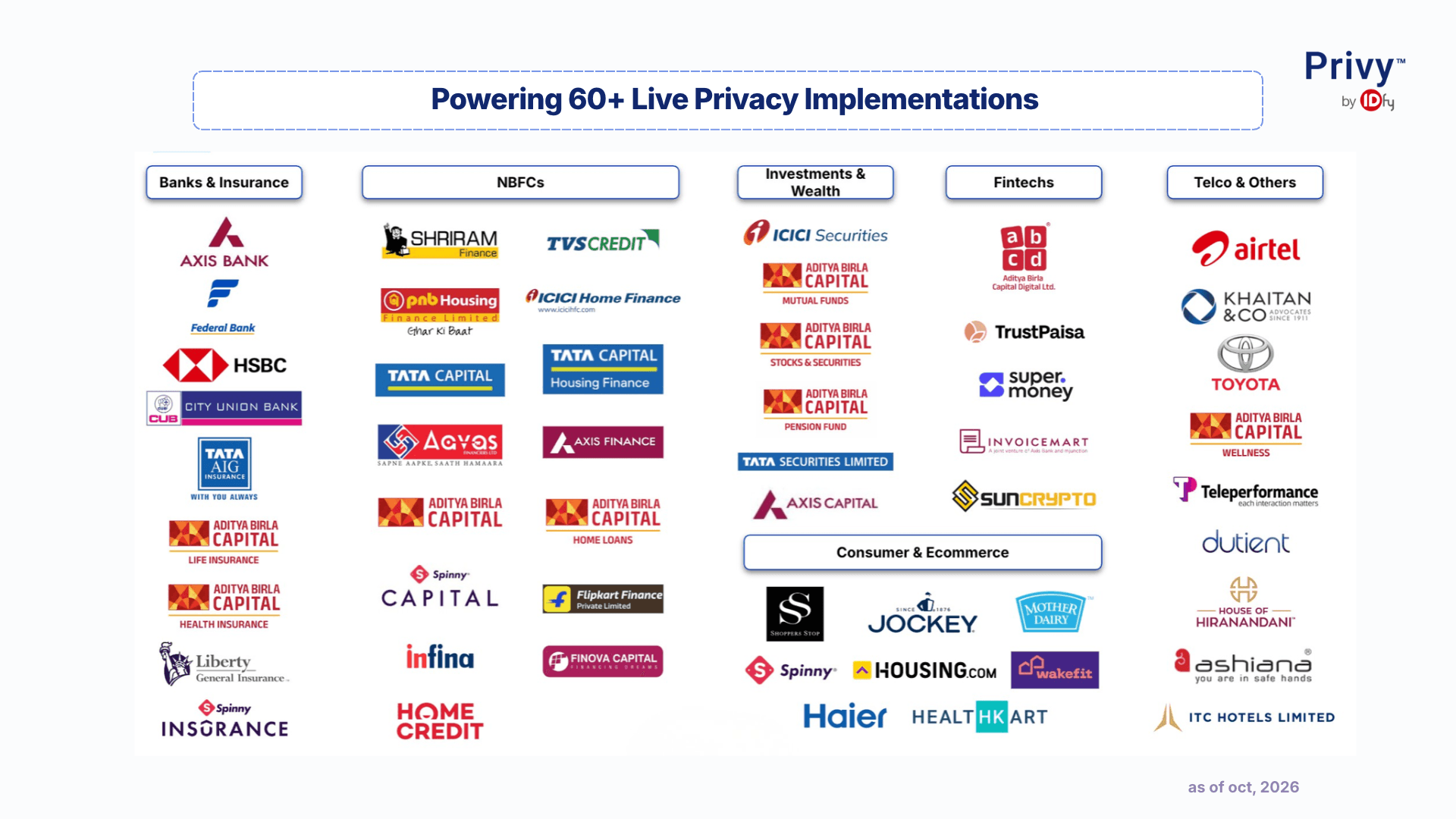
Privy by IDfy has 60+ enterprise implementations in progress across seven industries. Leading banks among them include Axis Bank, HSBC India, and Federal Bank. At full rollout, these implementations will discover and govern 10+ PB of personal data. They will protect the privacy rights of 500M+ people and govern 2B+ consent records in real time.
Privy is also ranked #1 in the MeitY-NeGD DPDP Innovation Challenge, a national test of working consent management systems. Click here to read more.
Figures represent projected scale upon full rollout of ongoing Privy implementations. M = million · B = billion · PB = petabytes.
Banks and NBFCs can start with our banks and NBFCs page. Any enterprise can start with the DPDP readiness assessment.
The solutions page shows the full set.
Conclusion
A bank data breach always raises the same four questions. The enterprises that answer them first are the ones that mapped their data, their vendors, and their response before the alert arrived.
To see how Privy by IDfy can help you map your data and prepare for DPDP breach notification, book a demo or write to shivani@idfy.com.
FAQ's
What happened in the bank data breach?
In October 2026, India's largest public sector bank received alerts that customer data was on the dark web. It reviewed about 375,000 records, found 3,897 with customer personal information, and disclosed the incident to BSE and NSE on 21 October. The disclosure did not say how the data left its environment.
Is a dark web data leak a personal data breach under the DPDP Act?
Yes, if it compromises the confidentiality, integrity, or availability of personal data. The Act defines a personal data breach as any unauthorised processing, or accidental disclosure, acquisition, sharing, use, alteration, destruction, or loss of access to personal data. The cause does not change the duty to notify.
When does DPDP breach notification apply?
Section 8(6) and Rule 7 apply from 13 May 2027. Until then, a bank data breach must be reported to CERT-In within 6 hours, and sector rules such as the RBI framework apply.
What is the penalty for a data breach under the DPDP Act?
A failure to take reasonable security safeguards can attract up to ₹250 crore. A failure to notify the Data Protection Board or affected data principals can attract up to ₹200 crore.
How do third parties affect liability after a data breach?
Under Section 8(1), the data fiduciary stays responsible for processing done on its behalf by a data processor. A leak that starts at a vendor still falls under the fiduciary's duty to notify. That is why an inventory of processors, signed agreements, and ongoing monitoring matter before an alert arrives.
What are data discovery tools, and why do they matter after a bank data breach?
Data discovery tools find and classify personal data across systems, files, and endpoints. After a bank data breach, they answer which systems held the data and whose it is, which are the first questions a regulator asks.
Is my bank account hacked after a data leak?
The fields reported so far (names, contact details, dates of birth, and loan metadata) do not by themselves give anyone access to an account. They do make phishing calls and messages more convincing, which is where most fraud starts. Never share an OTP or PIN, keep transaction alerts on, and report fraud through your bank's official channel and the national cybercrime helpline, 1930.
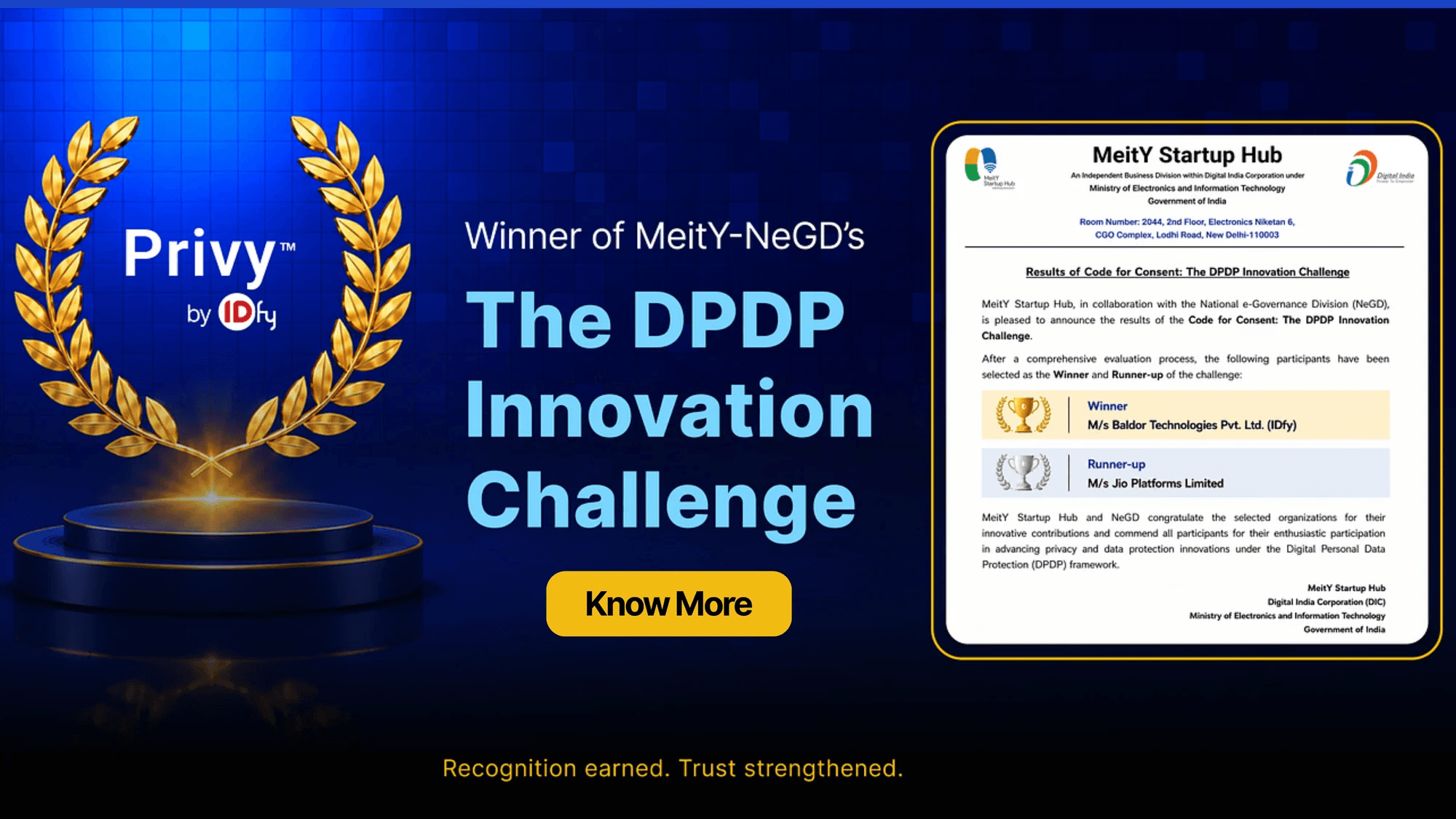
Privy by IDfy was ranked #1 in MeitY's DPDP Innovation Challenge. What that mean for India's most validated full-stack DPDPA compliance platform?

Learn why DPDP readiness for banks is important and how Privy can help in DPDP compliance for the banking sector.

RBI's June 2026 circular bans 11 dark patterns and redefines consent for NBFCs. Here's what changes before the January 2027 deadline.